

Key takeaways
- The tire and tube usually wear first. Confirm that replacements are available in the correct diameter, axle diameter, and hub width.
- Axle bushings need attention. Dirt and lack of lubrication can create wobble. Clean the axle periodically and lubricate it according to the manufacturer’s instructions.
- Steel rust begins at scratches. Rinse away fertilizer and damp soil, dry the tray, and touch up exposed metal with suitable outdoor paint.
- Overloading bends frames. Carry two controlled loads rather than one unstable load that strains the tray, legs, and handles.
- Do not leave a pneumatic tire under load for weeks. Long-term weight can deform the tire and reduce its service life.
- Clean after cement or fertilizer. These materials can harden or corrode components. Remove residue before it dries.
The best garden wheelbarrows for most yard work are a single-wheel, steel-frame barrow with a 5–6 cubic-foot tray; choose a two-wheel cart instead when stability, heavier loads, or easier storage matters more than tight turning.
Our top picks
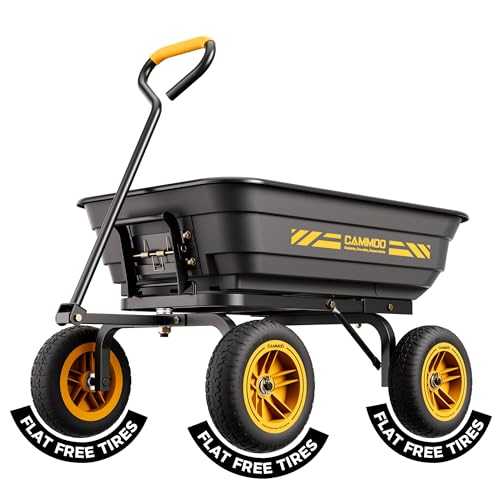


As an Amazon Associate we earn from qualifying purchases at no extra cost to you. Ratings are shown as listed on Amazon.
Best garden wheelbarrows by yard-work situation
| Yard situation | Best choice | Useful specifications | Why it fits |
|---|---|---|---|
| General planting, weeding, and cleanup | Single-wheel contractor barrow | 5–6 cu. ft.; 300–500 lb. rated load; pneumatic tire | Balances capacity, maneuverability, and price |
| Mulch, compost, or firewood on level ground | Two-wheel garden cart | 6–10 cu. ft.; 400–1,000 lb. rated load; pneumatic or flat-free tires | More stable and less tiring to unload |
| Small patio, narrow gate, or shed | Compact single-wheel barrow | 3–4 cu. ft.; 250–350 lb. rated load; width under 26 in. | Fits through restricted access and stores more easily |
| Rough lawn, gravel, or sloped paths | Single-wheel barrow with a large pneumatic tire | 6 cu. ft.; 16–20 in. tire; reinforced steel frame | A large air-filled tire rolls over obstacles better |
| Frequent heavy hauling | Heavy-duty steel barrow or powered cart | 6–10 cu. ft.; 500 lb. or higher rated load | Reduces frame flex and repeated lifting effort |
What to look for in the best garden wheelbarrows
Tray capacity and shape
A tray’s capacity determines how much material you can move per trip, but a larger tray is not automatically better. A 6-cubic-foot tray holds roughly 0.22 cubic yards, so moving 1 cubic yard of mulch requires about five full loads. A 4-cubic-foot barrow requires approximately seven loads for the same job. That difference matters when the pile is far from the garden.
Deep trays are useful for loose mulch, leaves, and compost. A wider, shallower tray is easier to load with a shovel and can be more stable when carrying rocks or pavers. Poly trays do not rust and are generally quieter against tools, while steel trays tolerate rougher abuse but may dent or corrode if the finish is damaged.
For ordinary beds and paths, 5–6 cubic feet is the most useful middle ground. Choose 3–4 cubic feet for smaller users, tight spaces, or light maintenance. Consider 8–10 cubic feet only if you have wide access routes and enough strength to control a loaded cart.
One wheel or two?
A single front wheel pivots naturally, making it the better design for weaving between shrubs, turning around raised beds, and tipping material into a precise spot. Its disadvantage is balance: the operator supports much of the load through the handles, especially on uneven ground or a slope.
Two-wheel models stand upright on their own and spread the load across the axle. They are easier to control with heavy soil, logs, or bags of fertilizer, and they are less likely to tip while parked. Their turning circle is larger, so they can be awkward in narrow planting areas. Some two-wheel carts also place the load farther forward, which reduces lifting strain but makes a full cart harder to pivot.
Tire type and wheel size
Pneumatic tires provide the most comfortable ride on grass, gravel, roots, and uneven soil. The air cushion also helps the barrow roll over small obstacles. The trade-off is maintenance: punctures, slow leaks, and pressure checks are part of ownership. A tire pressure around 25–35 psi is common, but use the pressure molded into the sidewall as the authority.
Flat-free tires eliminate punctures and are a sensible choice where thorny plants, scrap metal, or construction debris are common. They require less care but can transmit more vibration through the frame and may feel harder to push across rough ground. Solid wheels are acceptable for short trips on smooth paving, but they are usually less comfortable on lawns.
For general yard work, look for a pneumatic tire at least 16 inches in diameter. A 20-inch tire rolls more easily over ruts, while a smaller 12–14-inch tire can be adequate for a compact barrow used on level paths.
Frame material and maximum load
Powder-coated steel frames offer the best combination of rigidity and price for demanding work. Galvanized steel resists corrosion well, while aluminum frames are lighter but can flex more under high loads. A steel tray does not guarantee a strong barrow if the supporting legs, axle brackets, or handle joints are lightly built.
Pay attention to the stated maximum load, but treat it as a structural limit rather than a comfortable everyday target. Wet soil is considerably heavier than dry mulch. A practical working load of 250–350 pounds is enough for most homeowners, while a 500-pound rating is more appropriate for repeated heavy hauling. Never confuse volume with weight: a tray filled with damp clay can exceed a barrow’s safe load before it looks full.
Decision matrix: which barrow matches your priorities?
| Priority | Choose | Avoid |
|---|---|---|
| Lowest purchase cost | 3–5 cu. ft. single-wheel steel barrow | Powered or oversized carts |
| Limited storage space | Compact 3–4 cu. ft. model, removable tray, or folding handles | 10-cu.-ft. fixed-frame cart |
| Inexperienced operator | Two-wheel cart with a low center of gravity | Deep, top-heavy single-wheel tray |
| Weekly or more frequent use | Steel axle, replaceable tire, braced legs, 5–6 cu. ft. tray | Thin plastic supports or non-serviceable wheel assemblies |
| Narrow paths and close planting | Single wheel with handles no wider than the access route | Wide two-wheel axle and long turning radius |
Storage and maneuverability details that are easy to miss
Measure the narrowest gate, shed door, and path before buying. The barrow’s overall width includes the handles and wheel supports, not only the tray. Leave at least 2 inches of clearance on each side of a gate if the route includes a turn. Also measure storage height: an upright two-wheel cart may occupy less floor area but need more vertical clearance.
Handle length affects leverage. Long handles make a heavy load easier to lift but require more room to turn. Look for handles with rounded grips and enough spacing for gloved hands. A well-placed wheel should sit close enough to the tray that the load is carried over the axle rather than entirely by your arms.
For loading, keep dense material low and near the wheel. Do not heap wet soil high above the tray rim. A lower center of gravity makes a single-wheel barrow easier to steer and reduces the chance of a sideways tip.
Durability and maintenance realities
- The tire and tube usually wear first. Confirm that replacements are available in the correct diameter, axle diameter, and hub width.
- Axle bushings need attention. Dirt and lack of lubrication can create wobble. Clean the axle periodically and lubricate it according to the manufacturer’s instructions.
- Steel rust begins at scratches. Rinse away fertilizer and damp soil, dry the tray, and touch up exposed metal with suitable outdoor paint.
- Overloading bends frames. Carry two controlled loads rather than one unstable load that strains the tray, legs, and handles.
- Do not leave a pneumatic tire under load for weeks. Long-term weight can deform the tire and reduce its service life.
- Clean after cement or fertilizer. These materials can harden or corrode components. Remove residue before it dries.
How to choose the right capacity
Estimate the job before choosing the tray. If you need to move 2 cubic yards of mulch, a 6-cubic-foot barrow requires about 10 full loads because one cubic yard contains 27 cubic feet. A 4-cubic-foot model requires about 14 loads. If each round trip takes six minutes, the larger barrow saves roughly 24 minutes, provided you can safely control its heavier load.
That calculation explains why capacity should match both the material and the operator. The biggest tray is useful only when the access route is wide, the surface is manageable, and the maximum load will not be exceeded.
Bottom line for 2026
For the broadest range of garden jobs, select a 5–6-cubic-foot single-wheel barrow with a reinforced steel frame, replaceable 16–20-inch tire, and a rated load of at least 300 pounds. Choose a two-wheel cart for stability and heavier materials, a compact 3–4-cubic-foot model for restricted storage or narrow paths, and a flat-free tire where punctures would be more troublesome than extra vibration. The best garden wheelbarrow is the one whose capacity, width, wheel design, and weight you can control when it is full—not the one with the largest specifications.

Write Your Review
No reviews yet. Be the first to share your experience!