

Key takeaways
- Choose perimeter wire when your property has heavy tree cover, tall walls, or a reliable fixed border and you want predictable positioning without satellite equipment.
- Choose virtual boundaries when you want to avoid digging, expect to alter zones, or have several no-go areas that would make cable installation complicated.
- Use guide wires or mapped corridors for separated lawn zones. A mower may not reach a second area reliably if the connecting route is too narrow or includes gravel.
- Secure cables below the grass line over time. Loose wire is vulnerable to edging tools, aerators, animals, and frost heave.
The best robot lawn mowers depend less on peak cutting speed than on four fit questions: how much lawn they can cover, whether they can climb your slopes, how much boundary-wire work you will accept, and how well they cope with rain and debris.
Our top picks
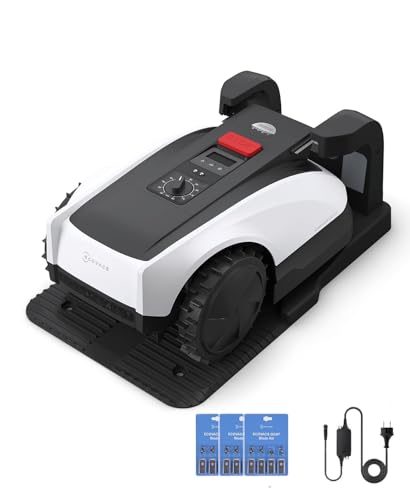


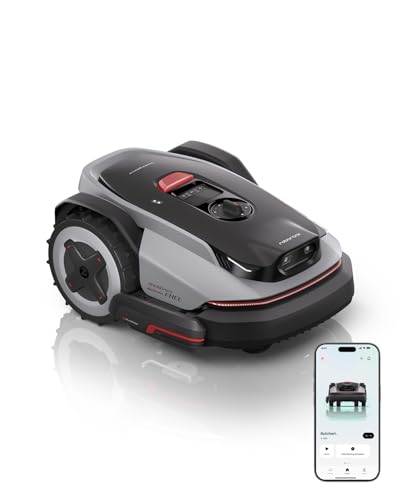
As an Amazon Associate we earn from qualifying purchases at no extra cost to you. Ratings are shown as listed on Amazon.
Quick picks for different yards
| Best for | Recommended type or model | Why it fits | Watch out for |
|---|---|---|---|
| Small, uncomplicated lawn | Worx Landroid M500 or comparable 500 m² mower | Compact, relatively accessible, and suitable for several connected lawn sections | Boundary-wire installation and limited capacity for complex terrain |
| Large lawn with simple borders | Husqvarna Automower 450X NERA | High area capacity, systematic mowing options, and a mature accessory ecosystem | High purchase price; installation quality matters |
| Steep or uneven ground | Mammotion LUBA 2 AWD | All-wheel drive and strong slope capability without a conventional boundary wire in many installations | More dependent on satellite positioning and careful map setup |
| Wire-free installation | Segway Navimow i-series or H-series | Virtual boundaries, app mapping, and satellite-assisted positioning | Tall buildings, trees, and narrow passages can affect positioning |
| Maximum traction in difficult terrain | Husqvarna Automower 435X AWD | Articulated all-wheel drive design and strong hill performance | Smaller rated cutting area than the largest conventional models |
Best robot lawn mowers compared
Husqvarna Automower 450X NERA: best for large, mostly open yards
The Automower 450X NERA is a strong choice when the main challenge is coverage rather than extreme slopes. Depending on configuration and regional specifications, it is rated for lawns of roughly 5,000 square metres and can use either a traditional boundary wire or a satellite-supported EPOS installation.
Its practical advantage is scheduling flexibility. A large property can be divided into work areas, while the mower returns to charge and resumes automatically. The three-blade cutting system uses small clippings as mulch, so the lawn needs frequent mowing rather than occasional long sessions.
Choose it when you have broad lawn areas, permanent borders, and a budget for professional-grade equipment. It is less attractive if your yard is small, fragmented, or full of temporary obstacles because you will not use its capacity efficiently.
Mammotion LUBA 2 AWD: best for steep, irregular lawns
LUBA 2 AWD is designed around all-wheel drive and virtual boundaries. Depending on the version, area ratings range from about 1,000 to 5,000 square metres. Mammotion specifies slope capability of up to approximately 75% or 37 degrees on suitable surfaces, though real performance depends on tire grip, wet grass, and the direction of travel.
This is one of the more convincing choices for yards with banks, rough transitions, and multiple no-go zones. It does not require the same continuous perimeter wire used by traditional robotic mowers. Instead, the owner creates digital boundaries in the app, normally with the help of a positioning station or supported satellite setup.
The trade-off is installation precision. The positioning station needs a clear enough view of the sky, and the map should be checked around trees, walls, narrow side passages, and garden structures. A mower that is theoretically powerful can still behave poorly if its virtual map is inaccurate.
Husqvarna Automower 435X AWD: best established option for hills
The 435X AWD uses an articulated body to keep its driven wheels in contact with uneven ground. Its rated capacity is around 3,500 square metres, and its published slope capability is approximately 35 degrees inside the cutting area, with lower limits often applying near the boundary.
That distinction matters. A mower may climb the middle of a slope but struggle when turning beside a retaining wall or approaching a wet edge. The 435X AWD is a sensible pick when you want strong traction from a long-established product family and prefer boundary-wire installation over satellite mapping.
Segway Navimow i-series: best for compact wire-free installations
The Navimow i-series, including models such as the i105N, targets smaller lawns with virtual boundaries and app-based mapping. Depending on the model, coverage is commonly in the several-hundred-square-metre range rather than several thousand. That makes it better suited to suburban yards than large estates.
Its main appeal is avoiding the labor of burying or pinning down a perimeter cable. The system uses satellite positioning supported by onboard sensors, so performance improves when the mower and reference equipment have a reasonably open view of the sky.
For a compact lawn with a clean perimeter, the i-series can be easier to live with than a wire-based mower. For a courtyard surrounded by tall walls, dense tree cover, or a covered passage, choose only after checking the positioning requirements for your exact site.
Worx Landroid: best value for small and medium lawns
Worx Landroid models are available in different capacity classes, commonly around 500, 700, 1,000, and 1,500 square metres. The range uses a perimeter wire, and some versions offer options such as an off-limits boundary, multi-zone management, and rain detection.
The key benefit is a broad selection of mower sizes and a comparatively approachable ownership model. A 500 m² mower may be suitable for a 300 m² lawn, but selecting a model close to its maximum rating leaves less recovery time during fast spring growth or wet weather.
These mowers are most suitable when the lawn is reasonably level and you are comfortable spending time on cable placement. They are less suitable for severe slopes, deep ruts, or lawns whose boundaries change frequently.
Capacity, slope, boundary, and weather comparison
| Model or family | Typical rated area | Published slope capability | Boundary method | Weather and cutting details |
|---|---|---|---|---|
| Husqvarna Automower 450X NERA | Up to about 5,000 m² | Up to about 50% in suitable conditions | Boundary wire or EPOS virtual boundary, depending on setup | Weather-resistant outdoor housing; small floating blades; automatic charging |
| Husqvarna Automower 435X AWD | Up to about 3,500 m² | Up to about 70% or 35° in the cutting area | Boundary wire | Weather-resistant housing; articulated all-wheel drive; automatic charging |
| Mammotion LUBA 2 AWD | About 1,000–5,000 m², depending on version | Up to about 75% or 37° under suitable conditions | Virtual boundaries using satellite positioning | All-wheel drive; weather-resistant design; separate charging and positioning hardware |
| Segway Navimow i105N | About 500 m² | Roughly 30% or 17° in typical published specifications | Virtual boundary | Weather-resistant outdoor use; small blades; app scheduling |
| Worx Landroid M500 | About 500 m² | Roughly 35% or 20° | Perimeter wire | Rain detection on many versions; interchangeable battery platform |
Manufacturer ratings are useful for comparison, not guarantees. A dry, well-maintained slope is easier than wet grass at the same angle. Measure a difficult bank with a phone inclinometer or a level and tape measure, and allow extra margin rather than buying at the published limit.
How much capacity do you need?
Do not match the mower exactly to the lawn’s measured area. A useful calculation is:
Required rated capacity = lawn area ÷ desired operating fraction.
For example, a 600 m² lawn divided by 0.75 gives 800 m². A mower rated for approximately 800–1,000 m² should have more reserve than a 600 m² model. That reserve helps when growth accelerates, the mower loses time in narrow passages, or rain prevents a scheduled session.
Also measure the narrowest passage. A mower may fit between two edges while its boundary sensors do not leave enough turning room. Check the mower’s width, charging-station clearance, and the manufacturer’s recommended distance from walls.
Boundary setup: wire versus virtual mapping
- Choose perimeter wire when your property has heavy tree cover, tall walls, or a reliable fixed border and you want predictable positioning without satellite equipment.
- Choose virtual boundaries when you want to avoid digging, expect to alter zones, or have several no-go areas that would make cable installation complicated.
- Use guide wires or mapped corridors for separated lawn zones. A mower may not reach a second area reliably if the connecting route is too narrow or includes gravel.
- Secure cables below the grass line over time. Loose wire is vulnerable to edging tools, aerators, animals, and frost heave.
Before buying a wire-free model, identify where its reference antenna or positioning station can be installed. A location with a clear sky view and a stable power supply is often more important than a few extra published square metres.
Weather resistance and ownership realities
Robot mowers are built for outdoor use, but weather resistance does not mean they should cut through every storm. Wet grass clogs decks, reduces traction, and leaves heavier clippings. Use the rain settings, and consider a garage or shelter if your climate has frequent downpours or freezing winters.
The parts that normally wear first are the small cutting blades, wheel tread, boundary-wire connections, and charging contacts. Many blades need replacement every one to three months during active growth, depending on lawn area and debris. Inspect for stones, sticks, toys, and exposed roots before each season; a small impact can bend a blade carrier or damage a motor.
Clean the underside only in the manner allowed by the manual. Some models tolerate careful low-pressure rinsing, while others should be wiped rather than sprayed. Never lift or turn a mower while its cutting system is enabled, and isolate the battery or follow the manufacturer’s service procedure before working underneath.
Final buying decision
Choose the Worx Landroid for a modest, fairly level lawn and a lower-cost wire-based route. Choose the Segway Navimow i-series when compact wire-free mapping is the priority and satellite reception is suitable. Choose the Husqvarna Automower 450X NERA for a large, established lawn where capacity and scheduling matter most. Choose the Husqvarna 435X AWD or Mammotion LUBA 2 AWD when slopes and uneven ground are the deciding problems.
Whichever model you select, leave capacity headroom, confirm the worst slope rather than the average one, and plan the boundary installation before comparing extra app features. Those three checks usually have more effect on satisfaction than a longer feature list.


Write Your Review
No reviews yet. Be the first to share your experience!