

Key takeaways
- 18–20 inches: easiest to store and maneuver; suitable for small yards and narrow gates.
- 21–22 inches: the most useful all-purpose range for typical homes.
- 23 inches or more: faster on open lawns, but heavier and less convenient around obstacles.
The best self propelled lawn mowers in 2026 are battery models for most suburban yards, while gas mowers remain the stronger choice for large, wet, steep, or infrequently cut lawns.
Quick picks by lawn and priority
| Situation | Best mower type | Recommended specifications | Why it fits |
|---|---|---|---|
| Small, level yard under 5,000 square feet | Compact battery self-propelled mower | 18–20-inch deck, 40V–56V battery, 45–60 minutes claimed runtime | Easy storage, low noise, and enough capacity for routine weekly mowing |
| Typical suburban lawn of 5,000–10,000 square feet | Mid-size battery mower | 21–22-inch deck, 56V–60V battery, variable-speed drive | Good balance between cutting speed, maneuverability, and charging time |
| Large lawn or grass that is often overgrown | Heavy-duty battery or gas mower | 21–23-inch deck, metal deck, high-torque motor or 160–200cc engine | Handles taller, denser grass with less bogging |
| Steep slopes and uneven ground | Rear-wheel-drive mower | Large rear wheels, speed control, strong traction tires | Rear-wheel drive generally maintains traction better while climbing |
| Very limited shed or garage space | Foldable battery mower | 18–21-inch deck, vertical-storage capability, removable battery | Fuel-free storage and a smaller folded footprint |
Battery versus gas: choose by mowing pattern
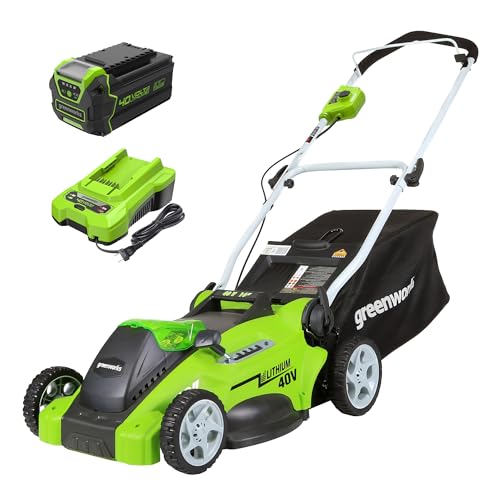
Battery self-propelled mowers are the better default when the lawn is cut regularly and the work usually takes less than an hour. They start immediately, produce no exhaust at the point of use, and need fewer routine service items. There is no carburetor to drain, spark plug to replace, or fuel can to manage. Brands such as EGO, Greenworks, Ryobi, and Toro offer battery mower platforms with interchangeable batteries across selected outdoor tools.
Our top picks



As an Amazon Associate we earn from qualifying purchases at no extra cost to you. Ratings are shown as listed on Amazon.
Gas remains practical when the lawn is large, damp, rough, or frequently left uncut. A gas mower can be refueled in minutes and can continue working as long as fuel is available. That matters when a battery mower would require a second charged pack. Gas models also tend to tolerate thick spring growth and wet leaves better, although mowing wet grass is harder on any machine and can create clumps.
Claimed battery runtimes are usually measured under lighter conditions than real mowing. A useful planning estimate is to treat a stated 60-minute runtime as roughly 35–50 minutes in dense grass when the self-propelled drive is operating. Cutting height, slope, blade sharpness, grass moisture, operator speed, and wheel resistance all affect the result.
Drive systems: front, rear, and all-wheel drive
Front-wheel drive
Front-wheel drive is usually the easiest to maneuver around trees, beds, and tight corners. Lifting or lightly pressing the handle can reduce traction at the front wheels, allowing the mower to pivot more easily. It is best for level or gently sloped lawns. On hills, the front wheels can lose grip, particularly when the grass is damp or the rear collection bag is full.
Rear-wheel drive
Rear-wheel drive is the safest general choice for sloped yards. The operator’s weight and the mower’s motor or engine are closer to the driven wheels, which helps maintain traction while climbing. Larger rear wheels also roll over shallow ruts more smoothly. The trade-off is a wider turning arc and slightly less nimble handling in small, crowded spaces.
All-wheel drive
All-wheel drive provides the most consistent traction on irregular slopes, loose soil, and wet sections, but it adds weight, mechanical complexity, and cost. It is worthwhile when a two-wheel-drive mower regularly spins its wheels or requires excessive pushing. For a mostly flat lawn, the added drive system rarely provides enough benefit to justify those compromises.
Look for a variable-speed control that can be adjusted without releasing the handle. A mower that moves too quickly encourages rushed turns and scalped patches; one that moves too slowly makes a large lawn unnecessarily tiring.
Cutting width and deck material
A wider deck reduces the number of passes, but it is not automatically faster. A 21-inch mower cuts about 10% more width per pass than a 19-inch model, while a 22-inch mower cuts about 16% more. However, the wider machine may be harder to fit between gates, beds, and storage shelves.
For a rectangular 8,000-square-foot lawn, the theoretical pass distance is approximately:
8,000 square feet ÷ 1.75 feet of cutting width = about 4,570 linear feet.
Allowing for overlap, turns, and obstacles, a 21-inch mower may travel roughly one mile during the job. A wider deck reduces that distance, but thick grass, slopes, and frequent maneuvering can erase much of the theoretical time saving.
- 18–20 inches: easiest to store and maneuver; suitable for small yards and narrow gates.
- 21–22 inches: the most useful all-purpose range for typical homes.
- 23 inches or more: faster on open lawns, but heavier and less convenient around obstacles.
Stamped steel decks are lighter and usually adequate for normal weekly mowing. They can rust if grass and moisture remain trapped underneath, especially where paint has been chipped. Fabricated or thicker steel decks are more resistant to impacts and vibration, but add weight. Polymer decks resist corrosion and can be easy to rinse, though they can crack after severe impacts or prolonged ultraviolet exposure. Whichever material you choose, deck airflow matters: a well-designed deck can collect and mulch effectively without requiring excessive motor power.
Runtime, charging, and fuel capacity
| Mower category | Typical energy or fuel supply | Practical mowing window | Storage consideration |
|---|---|---|---|
| Compact battery | 40V–56V, 4.0–5.0Ah battery | About 30–50 minutes in ordinary grass | Store battery indoors, away from heat and moisture |
| Mid-size battery | 56V–60V, 5.0–10.0Ah battery | About 45–90 minutes, depending on load | Allow charging space and keep a second pack only if needed |
| Heavy-duty battery | 60V–80V, often dual-battery operation | About 45–100 minutes | Higher replacement-battery cost and greater machine weight |
| Gas | Usually 0.3–0.6 gallon fuel tank | Often 45–90 minutes per tank | Requires fuel management, ventilation, and seasonal preparation |
Battery capacity is commonly estimated in watt-hours using voltage multiplied by amp-hours. A 56V, 5Ah battery contains approximately 280 watt-hours before operating losses. If a mower averages 500 watts under load, the theoretical runtime is about 34 minutes after allowing for usable capacity and efficiency. This explains why a larger battery helps, but also why thick grass can shorten runtime substantially.
Features worth paying for
- Single-point height adjustment: faster and more consistent than setting four wheels separately. A useful range is approximately 1–4 inches.
- Wash port or accessible deck: helpful for removing clippings, provided the manufacturer permits the cleaning method.
- Mulch, bag, and side-discharge capability: gives flexibility for dry clippings, tall grass, and leaf collection.
- Brushless motor: generally offers efficient operation and less routine motor maintenance than brushed designs.
- Large rear wheels: valuable on ruts, roots, and slopes, but not a replacement for traction control.
- Handle-mounted battery indicator: lets you judge whether to finish a section or change batteries before entering dense grass.
Storage and ownership realities
Measure the storage route, not just the storage location. A mower that fits beside a wall may not pass through a 30-inch gate or around a vehicle. Foldable handles reduce height, but check whether the mower can stand vertically without leaking oil or contacting the floor. Battery models are typically easier to store in a compact garage because the battery can be removed and charged on a shelf.
On gas models, stale fuel is one of the most common ownership problems. Use fresh fuel, follow the engine maker’s fuel guidance, and prepare the mower for extended storage. On battery models, avoid leaving the pack in a hot shed or freezing vehicle. Follow the battery manufacturer’s instructions for long-term charge level and charging temperature.
The blade usually wears before the motor or engine. Inspect it several times each season, especially after striking stones or edging hard ground. A dull or bent blade increases mowing time, worsens mulching, and can increase battery consumption. Replace or sharpen it according to the manufacturer’s instructions, disconnecting the battery or spark-plug lead before working underneath.
After mowing, clear clippings from the deck, drive wheels, cooling passages, and collection chute. Do not use a pressure washer around bearings, electrical connections, or the battery compartment. Common mistakes include mowing too low, forcing a mower through wet clumps, storing a dirty deck, and assuming the advertised runtime applies to maximum-load conditions.
Final buying recommendation
Choose a 21–22-inch rear-wheel-drive battery mower with a brushless motor if you have an average suburban lawn, regular mowing habits, and a place to charge indoors. Choose front-wheel drive when maneuverability matters more than hill performance. Choose all-wheel drive or a heavy-duty gas mower for persistent slopes, rough terrain, or long periods between cuts. Prioritize deck access, wheel traction, battery availability, and storage dimensions over decorative features: those are the details that determine whether the mower remains convenient after the first season.





Write Your Review
No reviews yet. Be the first to share your experience!