

Key takeaways
- Loading food before checking lid and burner clearance by rotating the spit manually.
- Trusting the motor’s maximum weight without balancing the food.
- Using a universal bracket on thin sheet metal without reinforcing or tightening it properly.
- Leaving forks and the spit coated in saltwater marinade overnight.
- Running all burners directly beneath the food, which can cause flare-ups and uneven cooking.
- Storing the rod where it can bend; even a slight bend causes wobble at slow speed.
The best rotisserie kits for grills are the ones whose spit length, motor capacity, and mounting brackets match your grill—not simply the kit with the highest advertised weight limit. For most 28- to 32-inch gas grills, a stainless-steel universal kit with a 36- to 40-inch spit, a 40-pound motor, and adjustable brackets is the most versatile choice; compact-grill owners should prioritize fit, while frequent cooks should pay extra for heavier forks, a rigid ring, and easy-to-remove dishwasher-safe parts.
Our top picks

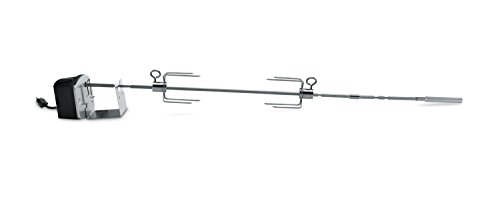
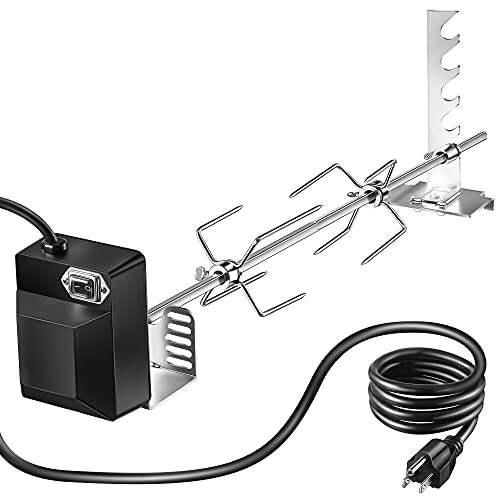

As an Amazon Associate we earn from qualifying purchases at no extra cost to you. Ratings are shown as listed on Amazon.
Quick comparison: which rotisserie kit fits your situation?
| Best for | Kit type or example | Typical spit length | Motor capacity | Most important advantage | Main limitation |
|---|---|---|---|---|---|
| Small two-burner grill | Compact universal kit | 24–31 inches | 20–30 lb | Less overhang and easier balancing | Limited room for large roasts |
| Typical three- or four-burner gas grill | Universal stainless-steel kit | 36–40 inches | 30–40 lb | Broad compatibility and useful cooking width | Brackets may require drilling or careful alignment |
| Large premium gas grill | Brand-specific rotisserie kit | 39–45 inches | 40–50 lb | Best fit around the hood and firebox | Usually costs more and may not transfer to another grill |
| Weber kettle charcoal grill | Weber charcoal rotisserie ring | Approximately 28–30 inches | Usually 20–40 lb | Ring preserves the kettle’s round cooking geometry | Less convenient to store than a simple spit kit |
| Kamado cooker | Kamado-specific motorized kit, such as JoeTisserie | Model-specific | Often 40–50 lb | Designed for the cooker’s ceramic rim and lid clearance | Not interchangeable across all kamado sizes |
Capacity figures are useful guidelines rather than permission to load the maximum weight. A long, unevenly shaped roast creates more strain than a compact chicken of the same weight, especially when the food is not centered.
Our picks by grill size and cooking style
Best overall for a standard gas grill: an adjustable universal stainless-steel kit
For a freestanding grill with roughly 28 to 32 inches of cooking width, choose a kit with a 36- to 40-inch round stainless-steel spit, two four-prong forks, an adjustable mounting system, and a motor rated for at least 30 pounds. This configuration accommodates chickens, pork loins, small turkeys, and roasts without leaving excessive bar length outside the grill.
The key advantage is adaptability. Slotted brackets can often be positioned on the grill’s side shelves or firebox frame, whereas a molded brand-specific bracket may only fit one grill family. Look for a spit diameter of about 9 to 12 millimeters and a solid, not hollow, rod if you regularly cook heavy food. The motor should run at a slow, steady rate—typically around 2 to 6 revolutions per minute—rather than rotating rapidly.
A universal kit is the sensible middle ground for occasional users. General market pricing is commonly about $60 to $150, depending on stainless-steel grade, motor strength, and bracket quality.
Best for a Weber kettle: a dedicated rotisserie ring
A Weber kettle rotisserie ring is preferable to trying to balance a long spit across the original lid opening. The ring adds a motor mount, spit supports, and a hinged access section while maintaining the kettle’s circular cooking chamber. It is particularly useful for whole chickens and smaller roasts that benefit from charcoal heat arranged around the perimeter.
Choose the ring made for your kettle diameter. A ring designed for a 22-inch kettle is not a safe substitute for one made for a 26-inch model: the mismatch can interfere with the lid seal, cooking height, and spit alignment. The ring also adds storage bulk, so measure the shelf or cabinet where it will live.
Best for a kamado: a model-specific kit
Kamado cookers need a kit that matches the ceramic rim and opening diameter. A product such as the Kamado Joe JoeTisserie is designed around particular Kamado Joe sizes, while other ceramic-cooker manufacturers offer their own model-specific systems. These kits usually include a circular stainless-steel frame rather than two flat side brackets.
Do not assume that a universal gas-grill kit will work on ceramic. Uneven support can place side loads on the motor, damage the rim, or prevent the lid from closing correctly. A dedicated kamado kit costs more—often roughly $200 to $400—but the proper fit is worth prioritizing when replacing a cracked ceramic component would be expensive.
Best for large loads: a premium brand-specific kit
Large gas grills from brands such as Napoleon and Weber often have optional rotisserie systems designed for the grill’s hood height, mounting holes, and cooking width. These kits are a strong choice for frequent cooks who prepare large poultry or multiple chickens, because the brackets usually align more cleanly than generic hardware.
Check the manufacturer’s stated load limit and the distance between the spit and the cooking grates. A generous 40- to 50-pound motor rating does not guarantee that the grill can safely hold a 20-pound turkey with adequate clearance. Brand-specific kits can cost approximately $100 to $300, and their replacement forks or motors may be less readily interchangeable than universal parts.
Five buying criteria that matter more than the accessory count
1. Spit length and usable width
Measure the grill’s internal width between the points where the brackets can actually sit. Then subtract about 4 inches for handle clearance, motor engagement, and the opposite support. For example, a grill with 44 inches between mounting points may offer roughly 40 inches of practical spit length.
Do not select a rod solely because it is longer. Excess rod can contact the hood, protrude dangerously, or make the assembly harder to balance. The food should sit near the center, with enough space to rotate without touching grates, burners, or the lid.
2. Motor capacity and torque
Rated weight is only part of motor performance. A motor turning a centered chicken experiences little resistance; an off-center roast produces a repeated load each rotation. For occasional poultry, 20 to 30 pounds is usually adequate. For large roasts, two chickens, or frequent use, choose 40 pounds or more and avoid running it near its limit.
A motor that stalls, reverses direction, or makes a clicking sound under load is being stressed. Unplug it, rebalance the food, and check that the spit is fully seated in both supports.
3. Mounting compatibility
Measure the firebox wall thickness, bracket spacing, and available clearance before ordering. Universal kits may use U-bolts, clamps, or slotted plates. These are flexible, but some require drilling and can loosen on thin sheet metal. Brand-specific kits usually have cleaner alignment and fewer installation surprises.
Also check whether the motor can be mounted on either side. Reversible mounting is valuable when one side shelf is blocked by a side burner, cabinet, or outdoor-kitchen wall.
4. Counterbalance design
Counterweights matter when the food is irregular, especially with a large bone-in roast or a bird whose cavity is not centered. A usable counterbalance system should slide along the spit and lock firmly without damaging the rod. Two smaller adjustable weights are often easier to tune than one fixed weight.
Before switching on the motor, rotate the loaded spit by hand. If it repeatedly falls to the same heavy side, reposition the forks or add counterweight. Proper balancing reduces vibration, protects the gears, and produces more even browning.
5. Cleanup and corrosion resistance
The parts that become difficult to clean are usually the forks, spit groove, retaining screws, and grease-catching area near the motor-side bracket. Stainless-steel forks with removable thumb screws are easier to wash than permanently assembled hardware. Dishwasher-safe parts are convenient, but hand washing can better preserve polished finishes and prevent detergent staining.
Never immerse the motor or spray it with a hose. Wipe it with a damp cloth, clean grease from the spit after each use, and dry all parts before storage. Even stainless steel can develop surface corrosion when salt, acidic marinades, and moisture remain on it.
A practical sizing calculation
Suppose your grill has 38 inches between suitable mounting points. Subtract 4 inches for handle and motor clearance:
38 inches − 4 inches = approximately 34 inches of usable rod length.
A 36-inch kit is therefore a better fit than a 42-inch kit, provided the end hardware does not add excessive length. For a 12-pound turkey, select a motor rated for at least 24 pounds rather than operating a 20-pound motor at its limit. That leaves a useful safety margin for uneven loading and friction.
Common ownership mistakes
- Loading food before checking lid and burner clearance by rotating the spit manually.
- Trusting the motor’s maximum weight without balancing the food.
- Using a universal bracket on thin sheet metal without reinforcing or tightening it properly.
- Leaving forks and the spit coated in saltwater marinade overnight.
- Running all burners directly beneath the food, which can cause flare-ups and uneven cooking.
- Storing the rod where it can bend; even a slight bend causes wobble at slow speed.
Bottom line
Choose an adjustable universal kit for a normal three- or four-burner grill, a dedicated ring for a Weber kettle, a model-specific system for a kamado, and a brand-matched kit when you own a large premium grill and cook heavy loads frequently. Prioritize correct spit length, a motor with capacity above your normal load, secure mounting, adjustable counterbalance, and parts that can be removed and cleaned. Those details determine whether a rotisserie becomes a dependable cooking tool or an awkward accessory used once.




Write Your Review
No reviews yet. Be the first to share your experience!