
Our Short List of 3

- Best for: Open lawns and long garden edges where animals approach from several directions.
- Model: 62100
- Coverage: up to 1,600 square feet
- Spray reach: up to 35 feet
- Operating modes: day only, night only, always
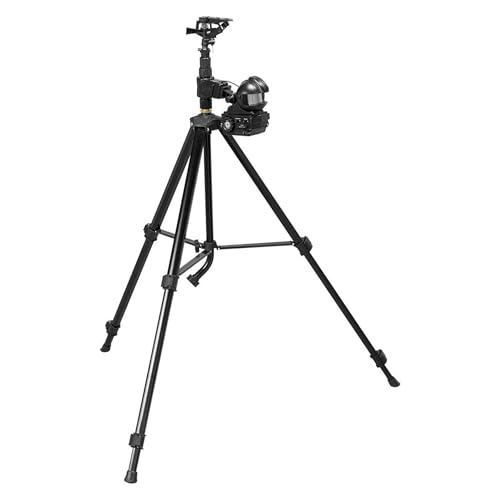
- Best for: Dense perennial beds, tall vegetable rows and hard soil where a spike mount sits too low.
- Model: 62120
- Mounting: metal tripod, extends to about 54 inches
- Sensor coverage: about 120 degrees
- Sprinkler type: impact head

- Best for: Long, open approach paths and fence lines where animals show up well before they reach the plants.
- Model: 5277
- Detection range: up to 100 feet
- Burst length: about 5 seconds
- Water per spray: 2 to 3 cups
All 4 Picks at a Glance
| Product | Specs | Action |
|---|---|---|
| Orbit Yard Enforcer 62100 |
| Check price on Amazon |
| Orbit Garden Enforcer 62120 |
| Check price on Amazon |
| Havahart Critter Ridder 5277 |
| Check price on Amazon |
 Hoont Cobra H988 |
| Check price on Amazon |
Key takeaways
- Compare four motion-activated sprinklers that startle deer, raccoons and cats with a burst of water, plus detection ranges, spray arcs and power options.
The real decision with a motion-activated sprinkler is not whether a jet of water startles animals, because it plainly does, but whether the sensor guarding your beds will fire at a raccoon crossing at 2 a.m. yet stay quiet when wind shakes the tomato vines all afternoon. Every model trades detection reach against false triggers, and spray force against the risk of soaking a path, a patio, or you. Choosing well means matching the sensor’s range and arc to the exact approach route your problem animal uses, rather than buying the longest advertised reach.
This roundup serves gardeners losing vegetables to deer and rabbits, pond owners harassed by raccoons and herons, and homeowners whose flower beds double as a neighborhood cat stop. The four sprinklers below were chosen from the names and specifications on their Amazon pages, spanning wide-coverage stake units, a tripod model for tall planting, a long-range infrared design, and a solar-powered jet sprayer for sunny, hose-only corners.
Quick Picks
As an Amazon Associate we earn from qualifying purchases.
| Product | Best for | Key spec from title |
|---|---|---|
| Orbit Yard Enforcer 62100 | Large lawns and garden edges needing day or night-only guarding | Multi-Angle Detection |
| Orbit Garden Enforcer 62120 | Tall beds and dense planting where a ground spike sits too low | Model 62120 |
| Havahart Critter Ridder 5277 | Long, open approach paths where animals appear far from the beds | Model 5277 |
| Hoont Cobra H988 | Sunny single beds, pond edges and trash corners far from outlets | Solar Powered |
How to Choose
Detection range and sensor arc
A passive infrared sensor reads moving heat, so its useful range depends on the size of the animal and the angle of approach. A deer crossing sideways at thirty feet presents a big, easy target, while a rabbit hopping straight toward the lens produces far less sideways movement and may get several feet closer before the valve trips. Match the rated range to your longest unguarded approach, then check the arc: a wide fan suits an open lawn edge, but a narrow wedge is better for a gate or a gap in a fence where animals funnel through one predictable line.
Spray reach, arc and burst length
Detection only matters if the water actually lands on the animal. Spray reach is set by your home’s water pressure as much as by the sprinkler head, so a model rated for a long throw on a strong municipal supply may dribble on a weak well line. Adjustable arcs let you cut the pattern off at a walkway or driveway instead of spraying everything in a full circle. Burst length matters too: a short, sharp blast startles and uses little water, while longer bursts suit stubborn deer that have learned to shrug off a quick splash at the edge of a bed.
Power source and battery life
Battery models ask for fresh cells a few times a season, and a unit that dies silently in July protects nothing, so note whether the design takes common AA cells you already keep at home. Solar models remove the battery chore but tie you to placement: the panel needs real sun, which is exactly what a shaded bed under trees may not get. Think about where the sprinkler must stand to watch the approach route, then work backward to the power source that survives there, instead of choosing solar or battery on principle and discovering the constraint in midsummer.
Mounting height and placement flexibility
A ground spike is quick to push in and easy to move, but in a mature perennial bed the sensor can end up staring into foliage, blind to anything behind the leaves. Tripod and elevated mounts lift both the sensor and the spray above low planting, which also helps on hard, rocky soil where a spike will not seat straight. Whatever the mount, the unit needs a clear line of sight down the animal’s path and a hose run that will not kink or cross a mower route. Plan the hose path before you buy, not after the first soaking.
The 4 Best Options
Orbit Yard Enforcer 62100
- Best for: Open lawns and long garden edges where animals approach from several directions.
- Model: 62100
- Coverage: up to 1,600 square feet
- Spray reach: up to 35 feet
- Operating modes: day only, night only, always
Open lawns and long garden edges where animals approach from several directions.
Small animals generate little heat contrast, so aim the sensor across the path rather than down it.
The Yard Enforcer is the wide-area workhorse of this group, built for the gardener whose problem arrives across open lawn rather than through one gap in the fence. Its sensor can be set to guard only by day, only by night, or around the clock, which is the single most useful scheduling trick in this category: night-only mode targets raccoons and deer while leaving daytime gardening, deliveries and dog play unmolested. The adjustable spray arc runs from a narrow wedge to a full circle, and a separate timed mode turns the unit into an ordinary sprinkler for a half-hour watering session.
Orbit Garden Enforcer 62120
- Best for: Dense perennial beds, tall vegetable rows and hard soil where a spike mount sits too low.
- Model: 62120
- Mounting: metal tripod, extends to about 54 inches
- Sensor coverage: about 120 degrees
- Sprinkler type: impact head
Dense perennial beds, tall vegetable rows and hard soil where a spike mount sits too low.
The tripod adds bulk, so confirm you have a level spot where the legs will not crowd the plants.
Where the Yard Enforcer stakes into the ground, the Garden Enforcer rides on a metal tripod, and that one change solves the most common placement failure in established gardens: a sensor buried at ankle height behind hostas, watching leaves instead of the path. Raised on the tripod, the infrared eye looks over low planting and the impact sprinkler head throws its startling burst above bed level, which also makes this the natural pick for hard or stony soil where pushing a spike straight is a fight. It suits vegetable plots with tall crops and perennial borders that fill in as the season builds.
Havahart Critter Ridder 5277
- Best for: Long, open approach paths and fence lines where animals show up well before they reach the plants.
- Model: 5277
- Detection range: up to 100 feet
- Burst length: about 5 seconds
- Water per spray: 2 to 3 cups
Long, open approach paths and fence lines where animals show up well before they reach the plants.
Infrared sensing weakens on very hot days when the air nears animal body temperature, so test the trigger at midday.
The Critter Ridder plays a different game from the Orbit pair: instead of blanketing a wide area, it watches a long corridor. Its infrared sensor is rated to detect animal heat and movement at up to one hundred feet under favorable conditions, so one unit can stand at the end of a driveway-side bed or along a fence line and still catch a groundhog ambling in from the far corner. Four sensitivity settings let you tune the trigger toward smaller or larger animals, each burst runs about five seconds and uses only a few cups of water, and a continuous setting doubles it as a plain sprinkler.
Hoont Cobra H988
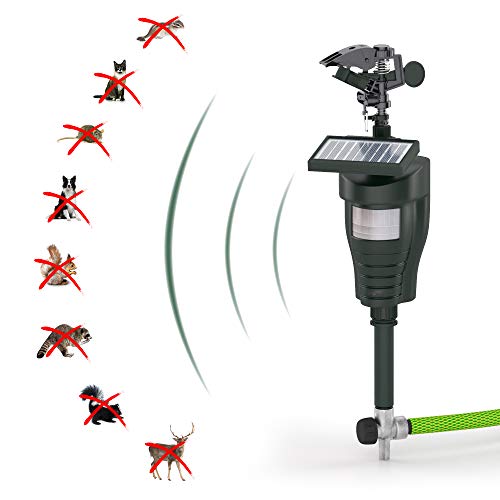
- Best for: One sunny bed, pond edge or trash corner where changing batteries would be a recurring chore.
- Model: H988
- Power: solar panel with rechargeable cells
- Detection range: about 30 feet
- Sensor field: about 120 degrees
One sunny bed, pond edge or trash corner where changing batteries would be a recurring chore.
The panel needs direct sun to keep the charge up, so a deeply shaded bed is the wrong home for it.
The Cobra is the pick for a sunny corner that needs a guard but has no patience for battery swaps. A solar panel keeps its rechargeable cells topped up, and the head answers detected movement with a forceful jet rather than a soft fan, a pointed answer for cats and raccoons working one defined spot: a pond edge, a trash enclosure, one raised bed. Detection reach is shorter than the stake units, around thirty feet with a claimed protected area near one thousand square feet, so think of it as a sentry for one address in the garden rather than a perimeter system for the yard.
Which One Fits Your Situation
Deer browsing the vegetable garden at night
Deer work after dark and approach across open ground, so night-only guarding with a wide arc fits best. The Orbit Yard Enforcer 62100 covers the largest area here and can rest through the day, while the Havahart 5277 suits gardens where deer enter down one long, visible lane. Set the sensor across the deer’s line of travel, not facing it, and move the unit a few feet every couple of weeks so the surprise never becomes scenery.
Raccoons raiding the pond or the sweet corn
Raccoons are bold, dexterous and quick to learn a static defense, which argues for a strong, sudden jet at the exact point of attack. The Hoont Cobra guards a pond edge or corn patch with a forceful blast and no battery routine to forget. If the raiding ground is broader, the tripod-mounted Garden Enforcer 62120 sees over the corn foliage and fires above it, keeping its sensor useful after the crop grows tall in late summer.
Cats using the flower beds as a litter box
Cats cross small spaces at close range, so detection reach matters less than a fast, well-aimed burst at bed height. The Cobra’s focused jet suits a single bed in sun, and the Garden Enforcer’s raised tripod works where the bed sits in shade or behind low shrubs. Keep sensitivity moderate: a hair-trigger setting will also fire at every songbird that hops through the mulch, training nothing but your water bill.
A big yard with several entry points
No single sprinkler watches a whole property, and animals route around a lone spray fan within days. Plan on overlapping coverage: a Yard Enforcer on the main lawn approach, a Critter Ridder watching the long fence line, and a Cobra at the one high-value bed. Stagger their arcs so an animal startled out of one zone lands in another, and rotate positions through the season to keep every approach uncertain.
Common Mistakes
- Aiming the sensor straight down the animal’s path, so a small animal walks toward the lens and gets close before its sideways heat movement finally trips the valve.
- Leaving the hose pressurized all season without checking the fittings, then finding a slow leak has softened the soil and tilted the stake out of alignment.
- Setting maximum sensitivity on day one, soaking every passing bird and breeze-blown shrub until the household starts switching the unit off entirely.
- Parking the sprinkler in one spot all summer, giving deer and raccoons time to map the spray boundary and simply feed a foot outside it.
- Forgetting the freeze: leaving water trapped in the valve body over winter cracks housings and seals, so drain and store the unit before the first hard frost.
Frequently Asked Questions
Will a motion-activated sprinkler scare my own dog or cat?
It will startle them the first few times, and that is how the learning works for pets too. The spray is ordinary hose water, harmless but unwelcome, and most pets quickly learn to give the guarded bed a wide berth. If your dog needs the yard, choose a model with a night-only or day-only mode, like the Yard Enforcer, and guard the hours when your pet is indoors.
How much water does one of these sprinklers actually use?
Very little per event, because each activation lasts only a few seconds. The Havahart 5277 uses roughly two to three cups per burst, and the other models here are in the same short-burst class. Even a busy night of repeated triggers adds up to less than a minute of ordinary sprinkler run time, though a badly aimed sensor firing at swaying branches all day can waste far more.
Can one sprinkler protect my whole garden?
Only if the garden is small and open. One unit watches a single arc from one position, and beds, shrubs and fences cast sensor shadows behind them. Larger gardens need two or more units with overlapping arcs at real entry points. Start with one at the worst-hit bed, watch where the animals shift, and add a second unit on that new route instead of guessing the layout in advance.
What should I do with the sprinkler in winter?
Drain it fully, disconnect the hose and bring the unit indoors before the first hard freeze. Water left inside the valve body expands as it freezes and can split the housing or ruin the seals, and batteries left in a freezing shed lose charge and may leak. Wipe the sensor lens clean before storing, and the sprinkler will be ready to stake out again when the first seedlings go in.
More from Amazon
Programs that pair well with the guide above. Offers and eligibility are set by Amazon and may change.
Collect the home and kitchen items you want in one registry that guests can shop from.
Create a wedding registrySet up recurring deliveries of everyday items on eligible products. Terms and savings are set by Amazon.
Explore Subscribe & SaveFree shipping on eligible items, Prime Video and more. Eligible new members can start with a free trial.
Start a Prime free trialAudiobooks and podcasts to listen to on the go. Eligible new members can start with a free trial.
Try Audible freeAs an Amazon Associate we earn from qualifying purchases.



Write Your Review
No reviews yet. Be the first to share your experience!