

Key takeaways
- Best overall for a patio: Ooni Koda 16, for its 16-inch cooking floor, simple gas operation, and fast preheat.
- Best value gas oven: Solo Stove Pi Prime, a 30 lb propane oven that is easy to move.
- Best for portability plus heat retention: Gozney Roccbox, with a thick stone and an insulated silicone-wrapped shell.
- Best for wood-fire flavor on a budget: Ooni Karu 2, a 12-inch wood, charcoal, and gas capable oven.
- Best for versatility: Ooni Karu 2 Pro, a 16-inch multi-fuel oven with a door.
- Best for big pies and hosting: Gozney Arc XL, a 16-inch propane oven with a removable stone.
- Best permanent-feeling centerpiece: Gozney Dome, a heavy, dome-shaped oven that holds heat for long cooking sessions.
- Best for New York-style pies: Halo Versa 16, which uses a rotating stone and dual burners at a lower peak temperature.
The Ooni Koda 16 is the best outdoor pizza oven for most patios because it is a no-assembly propane oven that fits a true 16-inch pie and preheats in about 20 minutes. The Solo Stove Pi Prime is the better pick if you want a lighter, cheaper 12-inch gas oven, and the Gozney Roccbox is the one to choose if you want a well-insulated, portable oven that can also burn wood. If you want to cook more than pizza, the Ooni Karu 2 Pro and Gozney Dome step up to multi-fuel flexibility and a door for roasting and baking.
Outdoor pizza ovens look similar in photos but behave very differently on a patio table or a stand. Fuel type, stone size, weight, and how the oven holds heat between pies decide whether it becomes a weekly habit or a garage ornament. This guide groups the current options by the criteria that actually change your results, gives each oven a spec line, and finishes with a worked sizing calculation so you can match an oven to the number of people you usually feed.
Our top picks

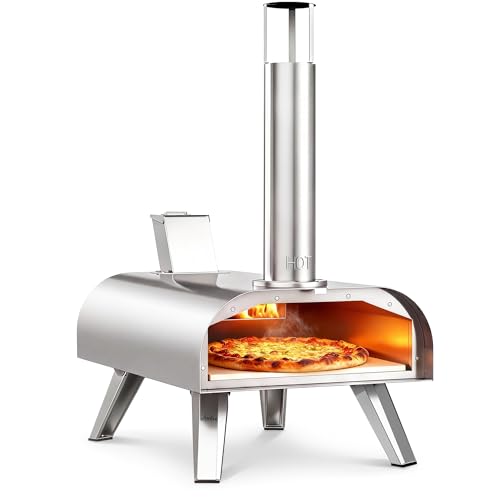

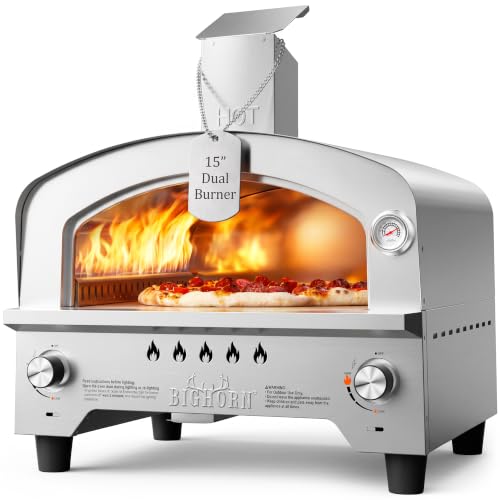
As an Amazon Associate we earn from qualifying purchases at no extra cost to you.
Quick answer: which outdoor pizza oven should you buy?
- Best overall for a patio: Ooni Koda 16, for its 16-inch cooking floor, simple gas operation, and fast preheat.
- Best value gas oven: Solo Stove Pi Prime, a 30 lb propane oven that is easy to move.
- Best for portability plus heat retention: Gozney Roccbox, with a thick stone and an insulated silicone-wrapped shell.
- Best for wood-fire flavor on a budget: Ooni Karu 2, a 12-inch wood, charcoal, and gas capable oven.
- Best for versatility: Ooni Karu 2 Pro, a 16-inch multi-fuel oven with a door.
- Best for big pies and hosting: Gozney Arc XL, a 16-inch propane oven with a removable stone.
- Best permanent-feeling centerpiece: Gozney Dome, a heavy, dome-shaped oven that holds heat for long cooking sessions.
- Best for New York-style pies: Halo Versa 16, which uses a rotating stone and dual burners at a lower peak temperature.
How we chose these ovens
This is a research-based guide. We compared manufacturer specifications, published third-party measurements, and the way major buying guides describe each oven, then kept only models that are sold as current products. Where sources disagreed on a number, we used the figure that appeared consistently, or described the spec by class instead of quoting a single value. We weighted five criteria:
- Cooking floor size. A 12-inch oven limits you to a single personal pie. A 16-inch oven handles a party-size pie or a small cast iron pan.
- Fuel and setup effort. Propane is the fastest to start and the easiest to control. Wood and charcoal add flavor and cost you attention.
- Heat recovery. What matters is how much heat the stone holds after the first pie, not the advertised maximum.
- Weight and footprint. A 30 lb oven can live in a closet and move to a table. A 130 lb oven needs a dedicated stand.
- Safety and patio fit. Exterior heat, stand requirements, and gas hookup matter on a deck or under a pergola.
A note on temperature claims: nearly every oven in this category advertises a peak of around 950 degrees Fahrenheit. Published third-party measurements of the stone surface have come in noticeably lower, in a range of roughly 750 to 870 degrees Fahrenheit across popular models. The advertised figure refers to the air in the dome. Treat it as a ceiling rather than a promise, and compare ovens on stone size, insulation, and burner design instead.
Outdoor pizza oven comparison table
| Oven | Fuel | Max pizza | Weight | Advertised max temp | Preheat (claimed) |
|---|---|---|---|---|---|
| Ooni Koda 16 | Propane (natural gas via conversion kit) | 16 in | 40.1 lb | 950 F | About 20 min |
| Solo Stove Pi Prime | Propane | 12 in | 30 lb | About 950 F | About 15-20 min |
| Gozney Roccbox | Propane, optional wood burner | 12 in | 44 lb | 950 F | About 20 min |
| Ooni Karu 2 | Wood, charcoal, optional gas burner | 12 in | Roughly 34 lb | 950 F | About 20 min |
| Ooni Karu 2 Pro | Wood, charcoal, gas | 16 in | Roughly 60 lb | 950 F | About 30 min |
| Gozney Arc XL | Propane | 16 in | 58.5 lb | 950 F | About 30 min |
| Gozney Dome | Wood, charcoal, gas (configuration dependent) | 16 in | Well over 100 lb | 950 F | About 35 min |
| Halo Versa 16 | Propane | 16 in | 43.2 lb | About 800 F | About 25 min |
Best gas ovens for fast, repeatable pizza nights
If your goal is pizza on a Tuesday evening with minimal fuss, a gas oven is the right class. Turn a knob, wait about 20 minutes, and cook. These three are the strongest options at different sizes and price tiers.
Ooni Koda 16
Spec line: Propane or natural gas (conversion kit) · 16-inch cooking floor · 40.1 lb · about 950 F advertised · cordierite stone around 15 mm · roughly 20-minute preheat · L-shaped burner
Best for: Households that want one oven that can handle a 16-inch pie, flatbreads, and cast iron without building anything or learning a fire.
Skip if: You want wood flavor, or you need to move the oven often and prefer something under 35 lb.
- Pros: Large floor for the weight, no assembly, L-shaped burner heats the back and side of the stone, widely recommended as a first serious oven.
- Cons: Gas only unless you bolt it into a different system, the opening is wide so heat escapes when you turn pies, and the exterior gets very hot.
Solo Stove Pi Prime
Spec line: Propane only · 12-inch cooking floor · 30 lb · about 950 F advertised · stone thickness not published · roughly 15-20 minute preheat · flame runs along the back and sides
Best for: Couples and small families who want a light, fast oven and are fine with personal-size pies.
Skip if: You regularly cook for four or more people, or you want a larger pie to share.
- Pros: Lightest oven in this guide, fast heat-up, good value, easy to store.
- Cons: The 12-inch floor limits pie size, and the manufacturer does not publish stone thickness, so heat retention across several pies is harder to judge from specs alone.
Halo Versa 16
Spec line: Propane · 16-inch rotating stone · 43.2 lb · about 800 F advertised · dual burner · roughly 25-minute preheat
Best for: New York-style pies and anyone who dislikes turning a pie by hand at very high heat.
Skip if: You want a Neapolitan-style leopard-spotted crust in under two minutes. The lower peak temperature suits a longer, gentler bake.
- Pros: The rotating stone keeps the base evenly browned, which helps beginners avoid burnt edges.
- Cons: More moving parts to clean, a lower ceiling than the 950 F class, and a heavier oven than the Pi Prime.
Best portable and heat-retaining ovens
Portable ovens trade size for flexibility. The thing to check is insulation. A thin shell loses heat the moment you open the door and slow-cooks the second pie. A thicker stone and a well-insulated shell recover faster.
Gozney Roccbox
Spec line: Propane burner, optional wood burner · 12-inch cooking floor · 44 lb · about 950 F advertised · 19 mm stone · roughly 20-minute preheat · silicone-wrapped insulated shell
Best for: People who want an oven they can carry to a friend’s house, with a stone thick enough to cook several pies back to back.
Skip if: You want a large pie, or you are sensitive to weight and prefer the lightest option.
- Pros: Thicker stone than many rivals, insulated exterior that is safer to be near than a bare steel shell, can add a wood burner for flavor.
- Cons: Heavier than the Pi Prime for the same 12-inch floor, and sources vary on whether the usable pizza size is closer to 11 or 12 inches.
Ooni Karu 2
Spec line: Wood, charcoal, optional gas burner · 12-inch cooking floor · roughly 34 lb · about 950 F advertised · cordierite stone · roughly 20-minute preheat
Best for: Buyers who want real fire and the option of gas for weeknights.
Skip if: You want to turn on a flame and cook with no tending.
- Pros: Light for a multi-fuel oven, multi-fuel flexibility, and a good introduction to wood-fired cooking.
- Cons: Wood and charcoal need practice to manage, and the gas burner is an extra purchase in most configurations.
Best large-format ovens for hosting
If you cook for a crowd, a larger floor and better heat retention matter more than weight. These ovens are less portable, so plan the location before you buy.
Ooni Karu 2 Pro
Spec line: Wood, charcoal, gas · 16-inch cooking floor · roughly 60 lb · about 950 F advertised · cordierite stone · glass-door style closure and built-in digital thermometer · roughly 30-minute preheat
Best for: Cooks who want both pizza and roasting, and who value a door to hold heat and run a hotter dome.
Skip if: You want a quick light oven or you are limited on storage.
- Pros: A door that keeps heat in, a built-in thermometer, and flexibility between fuels.
- Cons: Heavier and slower to preheat than the Koda 16, and the added features raise the price tier.
Gozney Arc XL
Spec line: Propane · 16-inch cooking floor · 58.5 lb · about 950 F advertised · roughly 20 mm removable stone · roughly 30-minute preheat · wide-flame burner
Best for: Hosts who want gas simplicity with a large cooking floor and a stone that can be lifted out for cleaning.
Skip if: You rarely need 16-inch pies. The Koda 16 does that job for less weight.
- Pros: Large floor, thick removable stone, polished build.
- Cons: Heavier than most gas competitors, with a longer preheat than smaller ovens.
Gozney Dome
Spec line: Wood, charcoal, gas depending on configuration · 16-inch cooking floor (larger XL variant also exists) · well over 100 lb · about 950 F advertised · dense dome with strong insulation · roughly 35-minute preheat
Best for: Buyers who treat the oven as a permanent patio feature and want long-session heat retention for cooking meat, bread, and vegetables after the pizza.
Skip if: You do not have a stand rated for a heavy oven, or you want to store it between uses.
- Pros: Excellent heat retention, dome shape for roasting, suits large gatherings.
- Cons: Heavy, expensive, and needs a rated stand or table. This is a purchase to plan, not impulse-buy.
Worked example: how big an oven do you need?
Pizza ovens are sold by diameter, but what you actually need is cooking area and throughput. Here is a simple calculation you can repeat for your own household. The inputs are assumptions you can change.
- Area of each size. A 12-inch pie has an area of about 113 square inches (pi times 6 squared). A 16-inch pie has an area of about 201 square inches (pi times 8 squared). The 16-inch pie has about 78 percent more pizza on it.
- Appetite assumption. Assume one adult eats about 90 square inches of pizza, roughly two thirds of a 12-inch pie. Six adults then need about 540 square inches.
- Pies needed. At 113 square inches per pie, that is 4.8, so five 12-inch pies. At 201 square inches per pie, that is 2.7, so three 16-inch pies.
- Time per pie. Assume about 1.5 to 2 minutes of bake time plus 1 minute to launch, turn, and retrieve, for roughly 3 minutes of cycle time per pie. Five pies take about 15 minutes of oven time. Three pies take about 9 minutes.
- Add recovery. If the stone drops in temperature and you pause 1 minute between pies, add about 4 minutes to the 12-inch plan and 2 minutes to the 16-inch plan. Your 12-inch oven finishes in about 19 minutes. The 16-inch oven finishes in about 11 minutes.
Reading the result: For two people, a 12-inch oven is fine. For four people, it is workable but you will be cooking while others eat. For six or more, a 16-inch oven reduces the number of pies by about 40 percent and noticeably shortens your time at the oven. If you regularly host, pay for the larger floor.
Decision logic: match your habits to an oven class
| If this describes you | Choose this class | Example models |
|---|---|---|
| Weeknight pizza for 2-3 people, want it simple | Light 12-inch gas | Solo Stove Pi Prime, Gozney Roccbox |
| Weekend pizza for 4-6 people | 16-inch gas | Ooni Koda 16, Gozney Arc XL, Halo Versa 16 |
| Want wood flavor and are willing to tend a fire | Multi-fuel | Ooni Karu 2, Ooni Karu 2 Pro, Gozney Dome |
| Want to roast and bake as well as make pizza | Door or dome oven | Ooni Karu 2 Pro, Gozney Dome |
| Need to travel with the oven | Under 45 lb | Solo Stove Pi Prime, Ooni Karu 2, Gozney Roccbox |
| Prefer thin New York style | Lower temp, rotating stone | Halo Versa 16 |
Gas vs. wood vs. multi-fuel: what changes in practice
Gas ovens
Gas ovens preheat quickly and hold a steady temperature without adding fuel. You adjust a knob. They are the right choice if you want pizza night to be easy. The trade-off is flavor: you will not get the smoky character of a wood fire, although a good stone and fermented dough produce a very good crust on gas alone. Natural gas is possible on some models with a conversion kit, which is useful if you have a gas line on your patio.
Wood and charcoal ovens
Wood and charcoal add flavor and heat in a way gas cannot, but they ask for attention. You build the fire, feed it small pieces every few pies, and manage ash. Expect a learning curve. If you enjoy fire cooking as a hobby, this is rewarding. If you want dinner in 30 minutes with no mess, it is not.
Multi-fuel ovens
Multi-fuel ovens let you start with gas for speed and switch to wood on weekends. The cost is a more complicated purchase: check whether the gas burner is included or sold separately and whether the oven has a chimney or door that changes how heat moves inside.
What to check before you buy
Stone size and material
Cordierite is the common stone material because it tolerates fast temperature swings. Thickness affects heat retention. A thicker stone, such as the 19 mm stone on the Gozney Roccbox or the roughly 20 mm stone on the Gozney Arc XL, stores more heat than thinner stones. Thinner stones heat up faster but may drop in temperature between pies.
Opening size and shape
A wide mouth makes it easy to launch and turn a pie, but loses heat faster. A narrow mouth holds heat but makes it harder to turn pies, especially for beginners. Ovens with a door let you close the mouth after loading.
Weight and where it will sit
A 30-40 lb oven can sit on a sturdy outdoor table. A 60 lb oven needs a rated stand or a solid counter. Anything over 100 lb should be placed on a dedicated stand rated for the load, never a lightweight folding table.
Accessories you will need
A launching peel, a turning peel, an infrared thermometer, and a dough scraper are the minimum. A cover protects the oven from weather when stored outdoors. A stand or cart makes a big difference to comfort and safety.
Safety guidance for outdoor pizza ovens
- Use outdoors only. Pizza ovens produce carbon monoxide. Never operate one in a garage, tent, covered porch with walls, or any enclosed space.
- Keep clearances. Follow the manual for distance from walls, railings, eaves, and plants. Do not place the oven under a low roof, awning, or pergola with flammable material above it.
- Use a heat-resistant surface. The oven body and the surface below it can get very hot. Do not set an oven on a wooden or composite table unless the manual says so and the stand has insulation.
- Check gas connections. After connecting a propane tank or changing a hose, brush soapy water on the fittings. Bubbles mean a leak. Shut off the supply and fix it before lighting.
- Light with the lid open and your face back. Ignite according to the manual and never lean over the burner during ignition.
- Keep children and pets away. The exterior can stay hot for a long time after cooking. Allow the oven to cool completely before covering it.
- Never leave it unattended. Turn off the gas at the tank, not just at the oven knob, once you are done.
- Keep a fire extinguisher nearby that is rated for grease and gas fires, and know how to use it.
Common mistakes beginners make
- Skipping the preheat. The stone needs time to soak heat. If the oven says it is ready after 10 minutes but the manual says 20, trust the manual and verify with an infrared thermometer.
- Overloading the pie. Heavy toppings cook unevenly in a 90-second bake. Use thin layers and pre-cook wet toppings.
- Using too much flour on the peel. Excess flour burns and makes the base bitter. Semolina or a thin dusting of flour works better.
- Not turning the pie. Most ovens have a hot spot near the flame. Turn the pie every 20 to 30 seconds.
- Cooking pies back to back without recovery time. If the stone surface drops, wait a minute before the next pie.
Frequently asked questions
What is the best outdoor pizza oven for beginners?
The Ooni Koda 16 is the easiest first oven for most people. It runs on propane, needs no assembly, and has a large 16-inch floor. The Solo Stove Pi Prime is the lighter, cheaper alternative with a 12-inch floor.
Is a gas or wood-fired pizza oven better?
Gas is better for convenience and consistency. Wood is better for flavor and the experience of cooking over a fire. Multi-fuel ovens like the Ooni Karu 2 let you switch between them depending on the night.
How hot do outdoor pizza ovens really get?
Most advertise about 950 degrees Fahrenheit in the dome. Published third-party measurements of the stone surface tend to be lower, roughly 750 to 870 degrees Fahrenheit, which is still hot enough for a pizza in two to three minutes.
Can I use a pizza oven under a covered patio?
Only if the area is open to the air and has noncombustible overhead clearance specified in the manual. Never use one in an enclosed space because of carbon monoxide, and avoid low wooden or fabric roofs.
Do I need a stand for my pizza oven?
Often yes. A light oven like the Solo Stove Pi Prime can sit on a sturdy heat-rated table, but heavier ovens such as the Gozney Arc XL or Gozney Dome need a stand or counter rated for their weight and heat.
What size pizza oven should I buy?
Choose a 12-inch oven for one to three people and a 16-inch oven for four or more. A 16-inch pie has about 78 percent more area than a 12-inch pie, so the larger oven shortens cooking time for a group.
Can pizza ovens cook anything besides pizza?
Yes. Most can cook flatbreads, vegetables, steaks, fish, and anything that fits in a cast iron pan. Ovens with a door or dome, such as the Ooni Karu 2 Pro and Gozney Dome, handle roasting more easily.
How long does a pizza oven take to heat up?
Compact gas ovens such as the Ooni Koda 16 and Solo Stove Pi Prime usually need about 15 to 20 minutes. Heavier or multi-fuel ovens often need 30 to 35 minutes to bring the stone to cooking temperature.
Final recommendation
For a typical patio, buy the Ooni Koda 16 if you cook for three or more people, or the Solo Stove Pi Prime if you cook for one or two and want the lightest option. Choose the Gozney Roccbox when you value a thick stone and a portable, insulated shell. If you want fire and are happy to tend it, the Ooni Karu 2 is the entry point and the Ooni Karu 2 Pro and Gozney Dome are the bigger commitments. Whichever you pick, place the oven on a stable, heat-rated surface in an open outdoor area, preheat fully, and keep the first few pies simple while you learn how your stone behaves.




Write Your Review
No reviews yet. Be the first to share your experience!