

Key takeaways
- Best all-around long-burn choice: A-MAZE-N 12-inch tube. Its roughly 12-inch length provides a useful balance of capacity, portability, and 4-6 hours of smoke in typical conditions.
- Best high-capacity value: LIZZQ 12-inch hexagonal tube. The six-sided design keeps the tube from rolling and gives it several stable resting positions on a grate.
- Best for small grills and cold smoking: A-MAZE-N 6-inch tube. Its shorter burn path is easier to manage in a compact chamber and generally supplies about 2-4 hours of smoke.
- Best short-session option: a 5-inch pellet tube such as the Pit Boss Pellet Smoker Tube. Expect a lower pellet load and roughly 2-3 hours of smoke, depending on the pellets and ventilation.
- Best for frequent, varied use: a 12-inch stainless-steel tube with a removable cap or cleaning brush. The accessory matters because ash buildup and damp pellets cause more failures than a modest difference in tube shape.
The best pellet tube smokers for most people are the A-MAZE-N 12-inch tube for long cooks, the LIZZQ 12-inch hexagonal tube for maximum capacity at a reasonable price, and a 6-inch tube such as the A-MAZE-N 6-inch when you need compact cold-smoking control.
A pellet tube is a perforated stainless-steel cylinder that smolders hardwood pellets rather than producing the heat of a pellet grill. It adds smoke to a gas grill, charcoal grill, pellet grill, cabinet smoker, or enclosed cold-smoking setup. The right choice depends less on brand than on tube length, usable burn time, airflow, and how much room remains around your food.
Our top picks
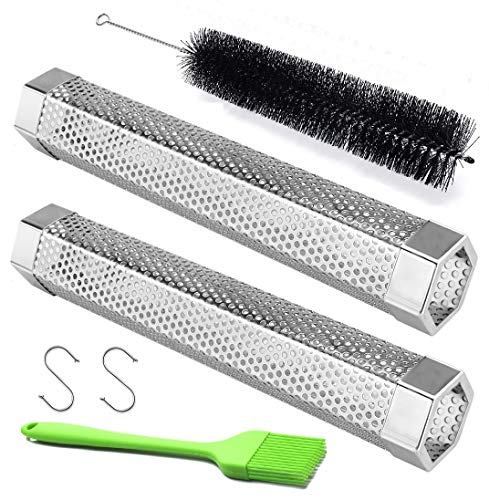


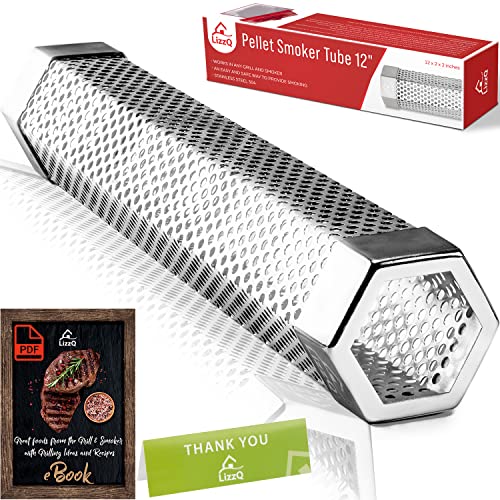
As an Amazon Associate we earn from qualifying purchases at no extra cost to you. Ratings are shown as listed on Amazon.
Best pellet tube smokers by use case
- Best all-around long-burn choice: A-MAZE-N 12-inch tube. Its roughly 12-inch length provides a useful balance of capacity, portability, and 4-6 hours of smoke in typical conditions.
- Best high-capacity value: LIZZQ 12-inch hexagonal tube. The six-sided design keeps the tube from rolling and gives it several stable resting positions on a grate.
- Best for small grills and cold smoking: A-MAZE-N 6-inch tube. Its shorter burn path is easier to manage in a compact chamber and generally supplies about 2-4 hours of smoke.
- Best short-session option: a 5-inch pellet tube such as the Pit Boss Pellet Smoker Tube. Expect a lower pellet load and roughly 2-3 hours of smoke, depending on the pellets and ventilation.
- Best for frequent, varied use: a 12-inch stainless-steel tube with a removable cap or cleaning brush. The accessory matters because ash buildup and damp pellets cause more failures than a modest difference in tube shape.
Head-to-head comparison
| Model or type | Approximate length | Typical smoke time | Smoke output | Best placement | Typical 2026 price range |
|---|---|---|---|---|---|
| A-MAZE-N 6-inch tube | 6 in / 15 cm | 2-4 hours | Moderate, easy to limit | Small grills, compact smokers, cold smoking | $20-$30 |
| A-MAZE-N 12-inch tube | 12 in / 30 cm | 4-6 hours | Moderate to strong | Large grills, pellet grills, cabinets, cold smoking | $25-$40 |
| LIZZQ 12-inch hexagonal tube | 12 in / 30 cm | 4-5 hours | Moderate to strong | Grates where rolling is a concern | $15-$30 |
| Pit Boss 5-inch tube | 5 in / 13 cm | 2-3 hours | Light to moderate | Small grills and short cooks | $15-$25 |
| Generic 12-inch stainless tube | 12 in / 30 cm | 3-6 hours | Varies substantially | Most grills and smokers | $10-$25 |
These are practical ranges rather than guarantees. A full tube does not always burn for the same duration: pellet density, humidity, wind, chamber temperature, and whether one or both ends are burning all change the result. Stainless-steel wall thickness and perforation pattern also affect how consistently the ember travels.
Tube length, smoke output, and burn time
Length mainly determines how many pellets can smolder in sequence. A 12-inch tube usually lasts about twice as long as a 6-inch tube, but it does not necessarily create twice the smoke intensity. Smoke output is governed by the size of the smoldering ember, airflow through the chamber, and pellet type.
For a large offset smoker or pellet grill, a 12-inch tube is the safer starting point because a small tube can be overwhelmed by the chamber volume. For cheese, fish, nuts, or butter in a compact enclosure, a 6-inch tube often gives better control. Too much smoke in a small chamber can produce a harsh, acrid surface instead of a cleaner wood aroma.
Hexagonal tubes have a practical advantage over round tubes: they are less likely to roll into a hot spot, drip tray, or grease channel. Round tubes are not a problem if they sit securely on a grate or in a shallow metal tray, but placement should never block burners, vents, or grease drainage.
Pellet compatibility: what actually matters
Most pellet tubes accept standard food-grade hardwood pellets made for pellet grills. Hickory, oak, maple, cherry, apple, pecan, and blended pellets are common choices. Avoid heating pellets, heating-pellet blends, pellets with binders not intended for cooking, or damp pellets that crumble easily.
- Hardwood blends: reliable for general-purpose smoke and usually easier to keep lit.
- Fruitwood pellets: useful for poultry, fish, cheese, and other foods where a softer aroma is preferred.
- Hickory or mesquite: stronger choices for beef and pork, but use less in a confined cold-smoking chamber.
- Very fine or broken pellets: more likely to restrict airflow and create an uneven burn.
Pellet diameter is usually less important than dryness and consistency. Before filling the tube, shake out excessive dust. Store opened pellets in a sealed, dry container; pellets absorb moisture quickly and can swell inside the tube.
Decision matrix: which size fits your situation?
| Your situation | Recommended tube | Why | Main compromise |
|---|---|---|---|
| First tube, mixed grilling and smoking | 12-inch stainless tube | Longer runtime and broad compatibility | May be excessive for a small kettle |
| Small gas grill or tabletop smoker | 5- or 6-inch tube | Fits without crowding food or vents | Requires more frequent refilling |
| Cold smoking cheese or fish | 6-inch tube | Lower smoke volume and easier control | Shorter sessions |
| Overnight pork or brisket session | 12-inch tube | Usually supplies several hours unattended | Smoke may become too heavy in a small chamber |
| Limited grate space or uneven surfaces | Hexagonal 12-inch tube | Resists rolling and offers stable orientation | Still needs a safe, heat-resistant location |
How to set up a pellet tube correctly
- Fill the tube loosely. Pour pellets to the desired level without packing them down. For a shorter session, fill only partway and leave the unused pellets dry.
- Light one end with a torch. Heat the pellets for about 30-60 seconds until a small flame appears. A long lighter can work, but a small torch is more dependable.
- Let the flame burn briefly. Allow approximately 5-10 minutes for the surface pellets to form a stable ember, then blow out the flame. Starting the tube inside a closed grill often gives poor ignition because oxygen is limited.
- Place it on a heat-resistant surface. Set it on a grill grate, a smoker rack, or a small metal tray. Keep it away from direct gas flames, electrical heating elements, grease, and food contact.
- Adjust ventilation. Leave enough intake and exhaust airflow to keep the ember alive. If the smoke becomes thick and bitter, open the exhaust and reduce the pellet load rather than sealing the chamber.
For cold smoking, keep the chamber temperature below the range that would soften or melt the food. In warm climates, use the tube in a separate cold-smoking cabinet or add a long, ventilated smoke path rather than placing it directly beside delicate food.
Ownership realities: cleaning, failures, and durability
The first parts to show wear are usually the end caps, welds, and perforations rather than the stainless-steel body. Repeated exposure to grease can clog holes; repeated high heat can discolor the metal without making it unsafe. Replace a tube if it develops sharp broken edges, a split seam, or unstable feet.
After each use, let the tube cool completely, empty the ash, and brush away residue. Do not soak a hot tube or store it while damp. A blocked hole pattern can starve the ember on the next session. If a tube repeatedly goes out, the likely causes are damp pellets, excessive pellet dust, insufficient exhaust airflow, or lighting only the outer surface without creating a deep ember.
A useful runtime calculation illustrates the trade-off. If a 12-inch tube burns approximately 1 cup of pellets per hour and a 20-pound bag contains roughly 80 cups, one bag provides about 80 tube-hours. At a general market pellet cost of $15-$25 per bag, fuel costs are approximately 19-31 cents per smoke hour, excluding the tube. Actual consumption can be higher in cold, windy conditions or when both ends are burning.
Final buying recommendation
Choose a 12-inch tube if you want one accessory for ordinary grilling, long smoking sessions, and larger chambers. Choose a 6-inch model if your priority is cold smoking or a compact grill where smoke can build quickly. Between comparable models, favor thick stainless steel, secure end caps, stable feet or a hexagonal body, and replacement availability over decorative features. The best pellet tube smoker is the one that fits your chamber with clear airflow around it and lets you control smoke volume without repeatedly relighting it.





Write Your Review
No reviews yet. Be the first to share your experience!