

Key takeaways
- Rib cooks: look for removable racks and at least 6 inches of usable vertical clearance, or plan to cut racks in half.
- Whole poultry: measure the distance between the drip tray and the next shelf; a tall turkey may need the upper rack removed.
- Jerky and fish: closely spaced shelves increase capacity, but leave gaps for airflow.
- Large pans: confirm the internal width and depth, not just the total square-inch figure.
- Hanging foods: check whether hooks or a hanging bar are included, rather than assuming the cabinet supports them.
The best vertical pellet smokers for most space-conscious cooks are the Camp Chef XXL Pro for maximum capacity, the Pit Boss 5-Series Vertical Pellet Smoker for the strongest balance of capacity and price, and a smaller vertical pellet cabinet for balconies, patios, or occasional use.
Vertical pellet smokers use an electrically powered auger and fan to feed hardwood pellets into a fire pot. Compared with horizontal pellet grills, their tall cabinet makes better use of patio space and gives you several rack levels for ribs, jerky, cheese, fish, and multiple pans. The trade-off is less room for large briskets or direct-flame grilling.
Our top picks


As an Amazon Associate we earn from qualifying purchases at no extra cost to you. Ratings are shown as listed on Amazon.
Best vertical pellet smokers by situation
| Best for | Recommended type or model | Why it fits | Main compromise |
|---|---|---|---|
| Largest cooks in a compact footprint | Camp Chef XXL Pro | About 2,400 sq. in. of rack space and multiple adjustable shelves | Tall, heavy, and more expensive than basic cabinets |
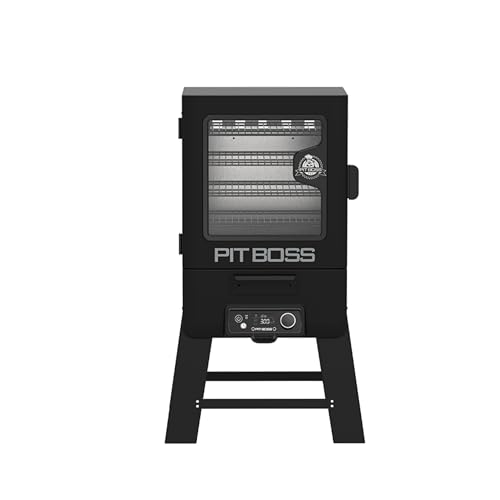
| Best all-round value | Pit Boss 5-Series Vertical Pellet Smoker | Roughly 1,500 sq. in. of cooking space, broad temperature range, and useful rack flexibility | Needs substantial clearance and a dedicated electrical outlet |
| Frequent family smoking | Pit Boss Pro Series 4-Series Vertical Pellet Smoker | Large cabinet, digital controls, and enough capacity for several racks of ribs or poultry | Its footprint and weight approach those of a small appliance cart |
| Small patio or occasional use | Compact vertical pellet cabinet | Typically 500–900 sq. in. of rack space and a smaller hopper | Fewer shelves and less recovery capacity after opening the door |
| Maximum flexibility rather than pellet convenience | Vertical charcoal or electric smoker | Often cheaper or narrower, with different fuel and heat-control characteristics | Not a pellet smoker and may require more active supervision |
Head-to-head comparison
| Model | Approx. cooking area | Temperature range | Pellet hopper | Rack arrangement | Approx. dimensions |
|---|---|---|---|---|---|
| Camp Chef XXL Pro | About 2,400 sq. in. | Approximately 150–350°F | About 22 lb | Four adjustable racks plus hanging and jerky accessories, depending on package | About 24 x 26 x 52 in. |
| Pit Boss 5-Series Vertical Pellet Smoker | About 1,500–1,600 sq. in. | Approximately 150–420°F | About 55 lb on some versions | Five cooking racks, with removable shelves | About 26 x 24 x 53 in. |
| Pit Boss Pro Series 4-Series Vertical Pellet Smoker | About 2,000 sq. in. | Approximately 150–420°F | Roughly 55 lb, depending on configuration | Several porcelain-coated or wire racks, commonly with adjustable positions | About 28 x 26 x 53 in. |
| Compact vertical pellet cabinet | About 500–900 sq. in. | Commonly 180–350°F | Usually 8–20 lb | Two to four narrow racks | Often 18–24 x 18–24 x 35–48 in. |
Specifications vary by generation, retailer package, and regional model number, so check the manufacturer’s dimensional drawing before ordering. The table is most useful for comparing scale rather than treating every measurement as interchangeable.
Camp Chef XXL Pro: the capacity choice
The Camp Chef XXL Pro is the strongest pick when the goal is to cook a large amount of food without buying a full-size horizontal smoker. Its tall cabinet can accommodate several racks of ribs, poultry, sausage, fish, or dehydrating trays at once. The adjustable shelves are especially useful because ribs need vertical clearance while jerky and wings benefit from closer rack spacing.
Its roughly 22-pound hopper is smaller than the unusually large hopper on some Pit Boss cabinets, but that is not automatically a disadvantage. A smaller hopper can reduce the amount of pellets left exposed to rain and humidity. The XXL Pro is best for cooks who value rack versatility and high capacity more than maximum heat for searing.
Pit Boss 5-Series: the practical all-rounder
The Pit Boss 5-Series Vertical Pellet Smoker is a sensible middle ground. It provides enough rack area for a family gathering while remaining narrower than many horizontal pellet grills. A broad advertised temperature range also makes it more versatile than a low-temperature-only cabinet, although vertical smokers are still primarily designed for smoking and roasting rather than steakhouse searing.
The large hopper is useful for overnight brisket or pork shoulder cooks because it reduces refilling. It also creates an ownership detail worth considering: pellets must be protected from moisture, and unused pellets should not be left in the hopper for long periods in damp weather. If you smoke only once or twice a month, a smaller hopper may actually produce less waste.
Pit Boss Pro Series 4-Series: for frequent large batches
The Pit Boss Pro Series 4-Series Vertical Pellet Smoker makes sense when you regularly cook for a crowd but lack room for a wide grill. Its cabinet-style layout offers much more usable storage than a compact model, and the adjustable racks let you switch between tall foods and densely packed trays.
Choose it over the 5-Series when the specific rack layout, controller features, or local availability suit you better—not simply because the model number sounds larger. Measure the full operating footprint, including the door swing, pellet-hopper access, rear exhaust, and space needed to roll the smoker away from a wall.
How much patio space do you really need?
Measure the proposed location in three dimensions. A smoker that occupies only about 4 square feet of floor area can still require a clear zone around it for ventilation and safe access. Leave at least several inches of clearance from noncombustible surfaces where the manual permits, and use more space around siding, railings, curtains, or other combustible materials.
For example, a cabinet measuring 26 by 24 inches has a nominal footprint of:
26 × 24 ÷ 144 = 4.3 square feet.
Add a 12-inch working strip in front of the door and hopper. The practical operating area can exceed 8 square feet, especially if the smoker must be pulled forward before opening. A compact smoker may save floor space, but its narrow racks can make a cook less efficient if you need to prepare several whole chickens or full-size pans.
Pellet use and running cost
Pellet consumption depends on outdoor temperature, wind, set temperature, food load, insulation, and how often the door is opened. A reasonable planning range for a vertical pellet smoker is about 0.5 to 1.5 pounds per hour, with cold or windy conditions pushing consumption higher.
At an assumed 1 pound per hour, an eight-hour pork-shoulder cook uses about 8 pounds of pellets. If pellets cost roughly $1 to $1.50 per pound, the fuel portion is approximately $8 to $12. Add electricity, rub, and disposable drip-pan materials separately. This estimate is more useful than relying on a hopper’s advertised runtime because a 55-pound hopper does not mean the smoker will always run for 55 hours.
Large hoppers mainly improve convenience. They do not necessarily make a smoker more economical, and they can encourage owners to store pellets inside the machine where humidity causes swelling and auger jams.
Rack layouts matter more than headline capacity
- Rib cooks: look for removable racks and at least 6 inches of usable vertical clearance, or plan to cut racks in half.
- Whole poultry: measure the distance between the drip tray and the next shelf; a tall turkey may need the upper rack removed.
- Jerky and fish: closely spaced shelves increase capacity, but leave gaps for airflow.
- Large pans: confirm the internal width and depth, not just the total square-inch figure.
- Hanging foods: check whether hooks or a hanging bar are included, rather than assuming the cabinet supports them.
Nominal cooking area can be misleading. Five narrow shelves may provide more total square inches than three wide shelves, yet wide shelves are easier for brisket, casserole pans, and foil trays. For space-conscious cooks, usable shelf shape is often a better buying criterion than the largest published number.
Temperature control: what to expect
Digital controllers make pellet smokers easier to operate than charcoal cabinets, but they are not laboratory ovens. The displayed temperature is usually measured at one point, while the top and bottom racks can run differently. Use a separate probe at the food level during your first few cooks and rotate racks only when necessary; frequent door opening causes both temperature swings and extra pellet consumption.
Choose a controller with a meat-probe port, low-temperature settings appropriate for your recipes, and an orderly shutdown cycle. Wi-Fi can be useful for alerts, but it does not remove the need to inspect the hopper, grease path, and fire pot.
Ownership realities and maintenance
- Clean the fire pot: vacuum ash after several cooks or whenever ignition becomes slow. Excess ash can restrict airflow and cause temperature errors.
- Protect the auger: damp pellets swell and are a common cause of feed jams. Store pellets in a sealed, dry container.
- Manage grease: scrape the drip tray periodically and keep the drain clear. Grease buildup is both a cleanliness problem and a fire risk.
- Inspect the door seal: gaskets compress, tear, or loosen before the cabinet itself wears out. A leaking door wastes heat and pellets.
- Watch the igniter: hot-rod igniters are wear parts. Symptoms include pellets feeding without producing a flame or repeated failed starts.
- Cover, but ventilate: use a weather-resistant cover only after the smoker is cool, and avoid trapping condensation against painted steel.
Painted steel cabinets can last for years when kept dry, but shelves, grease trays, seals, temperature probes, fans, and igniters generally age sooner than the outer body. Stainless-steel interiors are easier to wipe clean, while porcelain-coated racks resist sticking but can chip if scraped aggressively.
Final buying recommendation
Buy the Camp Chef XXL Pro if you need the most flexible rack space in a relatively narrow footprint. Choose the Pit Boss 5-Series if you want a capable family-size smoker with a large hopper and broad temperature range. Step up to the Pit Boss Pro Series 4-Series for frequent large-batch cooking, provided your patio can handle its height and working clearance. For occasional cooks or genuinely tight patios, choose a compact cabinet and accept fewer shelves rather than forcing a large smoker into an unsafe location.




Write Your Review
No reviews yet. Be the first to share your experience!