

Key takeaways
- Best for jewelry and glasses: A compact 600–800 ml cleaner at approximately 40 kHz, with a short 3–8 minute cycle and a gentle removable basket.
- Best general household choice: A 2–3 liter stainless-steel cleaner with adjustable temperature, 5–30 minute timing, and a drain or easy-pour tank.
- Best for tools and workshop parts: A 6-liter or larger unit with a 40 kHz transducer, 100–200 watt ultrasonic output, a sturdy basket, and a heater that can be switched off.
- Best for frequent use: A commercial-style cleaner from an established manufacturer such as Branson, with replaceable baskets and serviceable controls.
- Best low-cost option: A basic countertop cleaner with a 600–750 ml tank, fixed 3–5 minute cycles, and no heater, provided your items do not require long or heated cleaning.
Best Ultrasonic Cleaners
The best ultrasonic cleaner for most households is a 2-to-3-liter stainless-steel unit with a 40 kHz frequency, adjustable heat, a removable basket, and a timer of at least 30 minutes; smaller 600–800 ml cleaners suit occasional jewelry cleaning, while tools and larger household parts need a deeper 6-liter tank or more.
Quick picks by cleaning situation
- Best for jewelry and glasses: A compact 600–800 ml cleaner at approximately 40 kHz, with a short 3–8 minute cycle and a gentle removable basket.
- Best general household choice: A 2–3 liter stainless-steel cleaner with adjustable temperature, 5–30 minute timing, and a drain or easy-pour tank.
- Best for tools and workshop parts: A 6-liter or larger unit with a 40 kHz transducer, 100–200 watt ultrasonic output, a sturdy basket, and a heater that can be switched off.
- Best for frequent use: A commercial-style cleaner from an established manufacturer such as Branson, with replaceable baskets and serviceable controls.
- Best low-cost option: A basic countertop cleaner with a 600–750 ml tank, fixed 3–5 minute cycles, and no heater, provided your items do not require long or heated cleaning.
What separates the best ultrasonic cleaners
Tank size and usable capacity
Tank capacity is not the same as usable cleaning space. A nominal 3-liter tank may hold only about 2.2 liters once the basket and safe fill line are taken into account. Items must be completely submerged without touching the tank floor, so measure the largest object rather than choosing by volume alone.
Our top picks



As an Amazon Associate we earn from qualifying purchases at no extra cost to you. Ratings are shown as listed on Amazon.
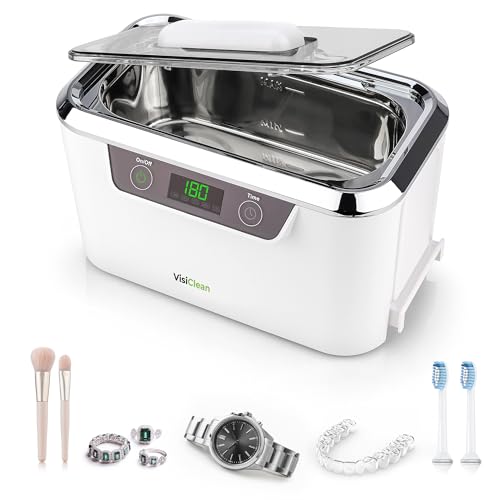
A 600–800 ml tank is convenient for rings, watch bracelets, eyeglasses, razor heads, and small removable parts. It becomes frustrating with multiple items or anything wider than the basket. A 2–3 liter model is more versatile for household hardware, kitchen parts, reusable grooming accessories, and several pieces of jewelry at once. For long tools, carburetor components, or batches of screws and fittings, a 6-liter tank provides useful working room.
Frequency: 40 kHz is the practical middle ground
Frequency affects bubble size. Lower frequencies generally produce larger, more forceful bubbles, which can help with robust metal parts but may be too aggressive for delicate finishes. Higher frequencies create smaller bubbles and are commonly preferred for finer, more detailed objects.
| Frequency | Typical strength | Best suited to | Trade-off |
|---|---|---|---|
| 25–28 kHz | More aggressive cavitation | Heavy metal parts and workshop components | More noise and greater risk to soft finishes |
| 40 kHz | Balanced cleaning | Jewelry, tools, glasses, hardware, and household parts | Not the specialist choice for every material |
| 80 kHz | Gentler, finer cavitation | Delicate small parts and intricate surfaces | Usually slower and less effective on heavy grime |
For one cleaner that handles mixed household jobs, 40 kHz is usually the sensible choice. Frequency alone does not determine performance: transducer quality, tank shape, liquid depth, temperature, and the cleaning solution matter just as much.
Heating controls are more important than a high maximum temperature
Heat helps loosen oils and some embedded dirt, but it can damage adhesives, loosen stones set with glue, accelerate tarnish, or make vapors unpleasant. Look for a heater with a selectable range around 35–80°C (95–176°F), rather than a unit that simply heats to one fixed temperature.
A useful cleaner should allow ultrasonic cleaning with the heater off. For jewelry, plastics, painted parts, and anything containing adhesive, room-temperature or mildly warm water is often the safer starting point. For greasy metal tools, 50–60°C can reduce cleaning time, but never leave a heater running unattended.
Cleaning cycles and controls
Fixed three-minute cycles are adequate for occasional jewelry cleaning, but a cleaner used for tools should offer several settings, such as 3, 5, 10, 15, 20, and 30 minutes. A digital timer is easier to repeat accurately than a vague dial, while a physical power switch can be useful when gloves or wet hands are involved.
Do not assume that a longer cycle is always better. Ultrasonic energy can gradually wear coatings, loosen weakly attached components, and heat the bath. Start with the shortest effective cycle, inspect the item, and repeat if necessary.
Head-to-head comparison of useful cleaner types
| Cleaner type | Typical tank | Frequency | Heating and timing | Best use | Typical market range |
|---|---|---|---|---|---|
| Compact jewelry cleaner | 600–800 ml | 40 kHz | Usually no heat; 3–8 minutes | Jewelry, glasses, small grooming parts | $25–$70 |
| Mid-size countertop cleaner | 2–3 liters | 40 kHz | 35–80°C; 1–30 minutes | General household use and small tools | $70–$180 |
| Large workshop cleaner | 6–10 liters | 28–40 kHz | Heater switch and 1–30 minute timer | Tools, fittings, engine and mechanical parts | $150–$400 |
| Commercial stainless unit | 10–30 liters | 28–40 kHz | Independent heat, timer, drain options | Frequent or batch cleaning | $400–$1,500+ |
Basket design, noise, and everyday usability
A removable basket is essential. It keeps objects away from the tank floor, where vibration may cause scratches or create uneven cleaning, and it makes rinsing easier. For jewelry, choose a fine-mesh basket with rounded edges. For tools, a rigid perforated basket is better because it supports heavier loads without flexing.
Check the basket’s internal dimensions rather than its external dimensions. A basket listed as 240 mm long may have only 205 mm of usable length once its handles and sloped sides are considered. A lid is also valuable: it reduces splashing, limits odor, and slightly lowers perceived noise.
Ultrasonic cleaners commonly produce a high-pitched hum or buzz. Compact units can sound sharper because the tank resonates close to the user’s ears; larger insulated machines may sound lower but can be louder overall. A listed sound level around 50–65 dB is reasonable for countertop use, although manufacturer measurements are not always comparable. Place the unit on a stable rubber mat, keep the lid closed, and avoid running it beside a quiet work area.
Decision matrix: choose by your actual workload
| Your situation | Recommended specification | Why |
|---|---|---|
| Small space, use once a month | 600–800 ml, 40 kHz, no heater | Low storage demand and adequate for small objects |
| Beginner cleaning mixed household items | 2–3 liters, 40 kHz, adjustable heat and timer | Forgives sizing mistakes and supports repeatable settings |
| Weekly tools or hardware | 6 liters or more, metal basket, 100–200 W ultrasonic output | Handles heavier loads and reduces batch splitting |
| Delicate jewelry and several finishes | 40–80 kHz, fine basket, heater that can be disabled | Provides gentler options and better separation from the tank |
| Daily or commercial use | Stainless commercial unit with drain and replaceable parts | Improves emptying, cleaning, and long-term serviceability |
How to use an ultrasonic cleaner without shortening its life
- Inspect the item first. Remove batteries, loose stones, leather, paper labels, and parts that cannot be immersed. Do not clean watches unless the manufacturer specifically permits immersion.
- Fill to the marked level. Use water and a compatible low-foaming cleaning solution. Do not operate the transducers with an empty or underfilled tank.
- Degas the liquid. Run the cleaner for 5–10 minutes with the basket empty. Dissolved air absorbs ultrasonic energy and makes the first cleaning cycle less effective.
- Load the basket loosely. Keep items separated and below the liquid line. Never place objects directly on the tank bottom.
- Start cool and short. Try 3–5 minutes at room temperature, then inspect and repeat. Increase heat or time only when the material and finish allow it.
- Rinse and dry promptly. Residue left behind can dull surfaces or encourage corrosion on ordinary steel. Dry crevices with a lint-free cloth or low-pressure air.
- Empty and wipe the tank. Unplug the cleaner, pour through the recommended outlet if fitted, and wipe away sediment. Never immerse the machine housing.
Durability and ownership costs
The tank and basket usually outlast the controls, lid hinges, drain seals, and heater. A cleaner used twice weekly for 10 minutes runs for about 17 hours per year, so a basic unit may be sufficient. A workshop machine used for two 20-minute cycles each weekday reaches roughly 173 hours annually, making cooling, warranty support, replaceable baskets, and a robust switch more important than a very low purchase price.
Cleaning solution is the recurring cost. If a 3-liter tank uses a diluted solution costing $0.60 per fill and you replace it after four uses, the fluid cost is about $0.15 per use. Concentrated chemicals may reduce cost per fill but can attack stainless steel, seals, or finishes if the dilution is wrong. Use only solutions labeled for ultrasonic cleaners, and avoid flammable liquids in a countertop ultrasonic bath.
Bottom line
Choose a compact 40 kHz cleaner for occasional jewelry and small household items, a heated 2–3 liter model for the broadest home use, and a 6-liter-plus stainless unit for tools and repeated batches. Prioritize usable basket dimensions, adjustable heat, multiple timer settings, and easy draining over decorative features or an unusually high power figure. The safest and most effective cleaner is the one that matches the object’s size and material, starts with a short cool cycle, and can be cleaned and maintained after every use.




Write Your Review
No reviews yet. Be the first to share your experience!