

Key takeaways
- Compare the best platform bird feeders for cardinals, doves and jays, with tray sizes, seed capacities, drainage and mounting details for every yard.
The real decision with a platform feeder is not whether birds will use it — cardinals, doves, jays and sparrows land on almost any open tray — but how much weather and mess you are signing up for. An open platform exposes seed to every rain shower, so tray size, drainage and material decide whether you get a busy feeding station or a soggy, moldy one you abandon by midwinter. Bigger trays feed a crowd but waste more seed; smaller ones stay fresher but need daily refills.
This roundup serves backyard birders who want ground-feeding species that tube feeders shut out, patio watchers with limited space, and anyone tired of refilling a tiny tray. The four feeders below were chosen from the names, dimensions and capacities published on their Amazon pages, and they span cedar trays, recycled-plastic platforms and a large-capacity hanging model.
Quick Picks
As an Amazon Associate we earn from qualifying purchases.
| Product | Best for | Key spec from title |
|---|---|---|
| Nature’s Way Bird Products CWF3 Cedar Platform Tray Bird Feeder | Gardeners who want a lift-out tray for fast cleaning | 12″ x 12″ tray |
| Woodlink Going Green Platform Bird Feeder Model GGPLAT | Eco-minded yards that want a tray that never rots | Model GGPLAT |
| Kingsyard Platform Bird Feeder, Recycled Plastic Tray, Brown | Busy feeding stations that empty smaller trays daily | 3.5 lbs capacity |
| Wild Wings WWCF23 Cedar Hanging Tray Bird Feeder | Small patios that need a compact cedar tray | Fresh Seed Tray |
How to Choose
Tray Size and Bird Traffic
Tray footprint decides how many birds can feed at once and how much squabbling you will watch. A 12-inch square tray lets a cardinal, two juncos and a sparrow work the same pile of seed without constant displacement, while a 10-inch tray suits a quiet patio where one or two birds visit at a time. Measure your hanging spot before ordering: a wide tray on a short hook can swing into a window or rail. If mourning doves are your target, favor the larger footprints, because doves feed in loose groups and abandon cramped trays quickly.
Drainage and Seed Freshness
Rain is the platform feeder’s biggest weakness, because an open tray collects water exactly where the seed sits. Look for a perforated or mesh seed surface that lets water pass straight through instead of pooling, and raised edges that keep seed from washing over the side in a downpour. Removable trays matter here too: a tray that lifts out can be dumped, scrubbed and dried in minutes, while a fixed floor forces you to scrape wet hulls in place. In wet climates, drainage quality matters more than capacity, because spoiled seed gets discarded either way.
Material and Weather Resistance
Cedar is the traditional choice because it resists rot and insects naturally, and it weathers to a soft gray that blends into a garden. Recycled plastic lumber goes further: it cannot rot, split or fade the way wood does, and it hoses clean without absorbing odors. Metal mesh trays are the lightest option and drain instantly, but thin frames can bend under a raccoon or a pile of wet snow. Match the material to your winters — cedar and recycled plastic both survive freeze-thaw cycles, while bargain painted steel usually rusts at the seams first.
Mounting Style and Placement
Most platform feeders hang from a cable or chains, some sit on the ground, and a few mount on a pole or post. Hanging trays sway less when they use three or four chains instead of a single central hook, and sway matters because seed spills from a swinging tray. Ground trays suit doves and juncos best but put seed within reach of every neighborhood cat and raccoon. Pole mounting with a baffle is the strongest defense against squirrels. Whichever style you pick, place the tray a few feet from shrubs so birds get an escape route without giving cats a launch pad.
The 4 Best Options
Nature’s Way Bird Products CWF3 Cedar Platform Tray Bird Feeder
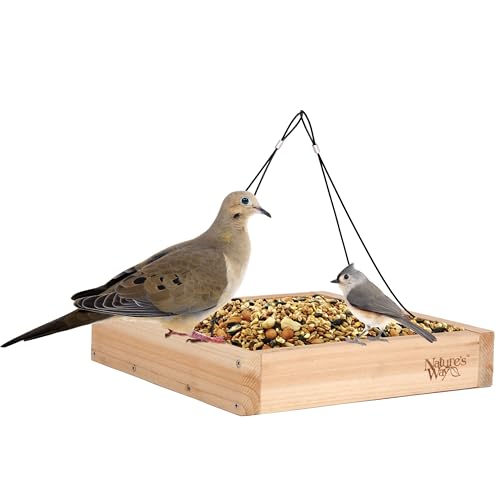
The CWF3 is the classic cedar tray done carefully: a 12-inch square platform with extra spacing that lets cardinals and jays feed without folding themselves into a tube feeder’s posture. Its Fresh Seed tray lifts straight out of the frame, so the weekly scrub takes minutes instead of becoming a chore you skip. Stainless steel screws and a powder-coated galvanized steel tray keep rust away from the seed, and the vinyl-coated hanging cable will not fray the way plain wire does. It suits birders who want one dependable cedar tray as the center of a feeding station.
Specs
- Dimensions: 12″L x 12″W x 2.25″H
- Capacity: 3 quarts
- Material: Premium cedar with stainless steel screws
- Seed tray: Removable Fresh Seed tray, powder-coated galvanized steel
- Mounting: Hanging, vinyl-coated steel cable
- Model number: CWF3
Best for: Birders who clean on a schedule and want the tray to lift out for scrubbing.
Watch out for: The open cedar tray is fully exposed to rain, so check seed after storms and expect the wood to gray over time.
ASIN: B00C61VR2G
Woodlink Going Green Platform Bird Feeder Model GGPLAT
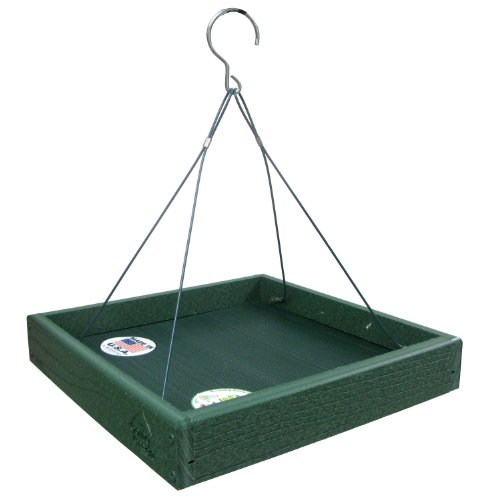
Woodlink builds the GGPLAT frame from up to 90 percent post-consumer recycled plastic, which removes rot from the equation entirely — this is the tray you hang and forget about for years. A metal screen feeding surface drains rain straight through, and the generous footprint gives larger birds like pigeons and mourning doves room to land alongside smaller songbirds. Cable holes at the corners keep the platform level and balanced in wind, so seed stays put instead of sliding to one edge. Choose it if your last wooden tray rotted out and you do not want a repeat.
Specs
- Dimensions: 12.75″L x 12.63″W x 2.13″H
- Capacity: not stated
- Material: Up to 90 percent post-consumer recycled plastic with metal screen tray
- Mounting: Hanging mount
- Color: Green
- Model number: GGPLAT
Best for: Yards in wet climates where wooden trays have rotted before.
Watch out for: The listing does not publish a seed capacity, so compare tray area rather than volume when sizing your refill routine.
ASIN: B002W8PVWK
Kingsyard Platform Bird Feeder, Recycled Plastic Tray, Brown

Kingsyard’s platform feeder is built around capacity: the tray holds up to 3.5 pounds of seed, nuts or mealworms, which keeps a busy station running through a weekend away. Four chains hold the tray steady so it does not spin or tip when several birds land at once, and the metal mesh bottom vents moisture away from the seed. The recycled plastic construction shrugs off rain, snow and sun without cracking or fading, and the feeder arrives pre-assembled — hang it and fill it. It is the pick for high-traffic yards where smaller trays run dry by noon.
Specs
- Dimensions: 11.34″L x 11.34″W x 2.68″H
- Capacity: 3.5 lbs
- Material: Recycled plastic (WPC composite) with metal mesh bottom
- Mounting: Hanging, four-chain suspension
- Assembly: Pre-assembled
- Color: Brown
Best for: Busy feeding stations that empty a small tray before the day is over.
Watch out for: The tray is open with no squirrel defense, so hang it on a baffled pole if squirrels rule your yard.
ASIN: B09PGZPW7Y
Wild Wings WWCF23 Cedar Hanging Tray Bird Feeder

The WWCF23 shrinks the cedar tray formula to a 10-inch square that fits balconies and small patios where a full-size platform would dominate. It uses the same Fresh Seed tray idea as its larger Nature’s Way relatives — the perforated tray lifts out for cleaning and lets rain drain through instead of soaking the seed — and the cedar is dipped in a natural preservative that resists fading, mold and water damage. Rust-free hardware and a vinyl-coated steel cable handle the hanging duties. Pick it when space, not capacity, is your binding constraint.
Specs
- Dimensions: 10″L x 10″W x 2″H
- Capacity: 1.5 quarts
- Material: Cedar wood with rust-free hardware
- Seed tray: Removable Fresh Seed tray
- Mounting: Hanging, vinyl-coated steel cable
- Model number: WWCF23
Best for: Balconies and compact patios that still want cardinals at the tray.
Watch out for: The smaller tray and 1.5-quart capacity mean frequent refills in an active yard.
ASIN: B00PKWN6ZY
Which One Fits Your Situation
You Want Cardinals and Jays Without a Tube Feeder
Cardinals will not cling to a tube, so give them a flat landing strip. The Nature’s Way CWF3 pairs a 12-inch tray with spacing that accommodates larger birds, and the Woodlink GGPLAT offers an even wider recycled-plastic surface for mixed flocks. Either one, loaded with sunflower seed or safflower, turns a finch-only station into a cardinal stop within days.
Your Last Tray Rotted or Grew Mold
Switch materials instead of repeating the cycle. The GGPLAT’s recycled plastic frame cannot rot and its screen floor drains instantly, while the Kingsyard’s mesh-bottomed composite tray vents moisture from below. Both hose clean in seconds. If you prefer wood, the CWF3’s lift-out tray at least makes the anti-mold scrub fast enough to actually happen.
You Have a Balcony or a Very Small Patio
The Wild Wings WWCF23 is the fit here: a 10-inch cedar tray that hangs from a single cable and will not overwhelm a railing-side setup. Its smaller capacity is a reasonable trade when your feeding station is three steps from the door and refills are painless. Add a small hook-mounted baffle if pigeons discover it.
Squirrels Empty Every Feeder You Hang
No open tray is squirrel-proof, so win on placement instead. Hang the Kingsyard or the GGPLAT from a pole fitted with a baffle, well clear of fences and branches, and fill with safflower, which squirrels largely ignore while cardinals still eat it. The four-chain Kingsyard hangs level on a pole hook, which helps the baffle do its job.
Common Mistakes
- Filling the tray to the brim before a rainy week, then leaving the soaked seed to mold in place instead of dumping it.
- Hanging a wide tray within jumping range of a fence or deck rail, which hands squirrels a launch pad no baffle can fix.
- Choosing the biggest tray for a quiet yard, so seed sits for weeks, absorbs moisture and stops attracting birds.
- Skipping the weekly scrub because the tray looks clean, while hull dust and droppings build up in the mesh.
- Mounting a tray directly against a window, which invites fatal window strikes when a hawk scatters the flock.
Frequently Asked Questions
What seed works best in a platform feeder?
Black oil sunflower seed is the most reliable starting point, drawing cardinals, chickadees, jays and finches to the same tray. Add safflower if squirrels or grackles dominate, since both tend to leave it alone while cardinals still eat it readily. White millet scattered on the tray suits juncos and sparrows, and a few in-shell peanuts will bring jays and woodpeckers investigating within the hour.
How often should a platform feeder be cleaned?
Empty and scrub the tray about once a week in normal weather, and more often during wet spells when seed gets soaked. Dump any seed that smells sour or shows mold immediately, wash the tray with warm soapy water, and let it dry fully before refilling. A removable tray makes this routine quick enough that it actually happens, which is the main health protection your birds get.
Will a platform feeder attract birds that tube feeders miss?
Yes — that is its main purpose. Cardinals, mourning doves, juncos, towhees and sparrows all prefer feeding on a flat surface and either cannot or will not cling to tube perches. An open tray also accepts foods tubes cannot handle, like fruit pieces, mealworms and whole corn, so a single platform widens the species list of a yard more than any other feeder style.
Where should I hang a platform feeder?
Hang it roughly five feet off the ground, within a few feet of shrubs or a brush pile so birds can dive for cover, but not so close that a cat can ambush from the branches. Keep it at least ten feet from any surface a squirrel can jump from, or use a baffled pole. A spot visible from a window rewards you without disturbing the birds.
More from Amazon
Programs that pair well with the guide above. Offers and eligibility are set by Amazon and may change.
Collect the home and kitchen items you want in one registry that guests can shop from.
Create a wedding registrySet up recurring deliveries of everyday items on eligible products. Terms and savings are set by Amazon.
Explore Subscribe & SaveFree shipping on eligible items, Prime Video and more. Eligible new members can start with a free trial.
Start a Prime free trialAudiobooks and podcasts to listen to on the go. Eligible new members can start with a free trial.
Try Audible freeAs an Amazon Associate we earn from qualifying purchases.




Write Your Review
No reviews yet. Be the first to share your experience!