

The quietest patio heaters are electric infrared models, because they have no fan, no flame and no gas regulator. The Dr. Infrared Heater DR-238 is the best quiet pick for most covered patios, the Bromic Tungsten Smart-Heat is the premium option, and a freestanding tripod such as the Heat Storm Tradesman suits renters and flexible layouts. Propane heaters can be quiet too, but they hiss and burn, so infrared electric is the safe choice for silent evenings.
Our top picks


As an Amazon Associate we earn from qualifying purchases at no extra cost to you.
Quick comparison of the best quiet patio heaters
| Pick | Best for | Power | Mounting | Price range |
|---|---|---|---|---|
| Dr. Infrared Heater DR-238 | Best overall quiet heater | 1,500W carbon infrared | Wall mount, remote, 9-hour timer, IP55 | Mid |
| Dr. Infrared Heater DR-239 | Best for larger covered spaces | 3,000W | Wall or ceiling, IP55 | Mid to upper-mid |
| Bromic Tungsten Smart-Heat | Best premium | 4,000 to 6,000W | Wall or ceiling, remote or smart switch | Premium |
| Bromic Platinum Smart-Heat 2300W | Best all-round premium | 2,300W | Wall or ceiling | Premium |
| Paraheeter QHA-15DB | Best weatherproof | 1,500W | Wall mount, IP65 | Upper-mid |
| Heat Storm Tradesman Tripod | Best flexible position | Up to 1,500W | Tripod stand | Budget to mid |
| Dimplex DIR Series | Best wall-mounted commercial style | Varies by 36 or 51 inch size | Wall mount | Premium |
Why electric infrared is quieter
Gas patio heaters create sound from the burner, regulator and flame. Electric infrared heaters use a heating element that glows, producing heat that travels as radiant energy straight to people and objects. There is no fan to hum and no combustion to hiss. The only noise is the occasional tick of the metal casing as it expands and cools. Many roundups note that the “quiet” claim comes from this design rather than from measured decibel readings, so treat it as a design property.
Best overall: Dr. Infrared Heater DR-238
The DR-238 is the most frequent quiet pick. It is a 1,500W carbon infrared heater with a remote, a timer that runs up to nine hours and IP55 weather resistance. Reviewers say the heat is fan-free, without a hair-dryer blast, and it works well on covered porches, garages and patios. The most common complaint is mounting bracket quality, so use a stud finder and quality screws.
Who it suits: homeowners who want silent heat on a covered patio. Main trade-off: 1,500W covers a small seating zone, not a whole patio.
Best for larger covered spaces: Dr. Infrared DR-239
The DR-239 is a 3,000W wall or ceiling unit with IP55 protection. It needs a 240V circuit in many configurations, so plan for an electrician.
Best premium: Bromic Tungsten Smart-Heat
The Tungsten series is a high-output, wall- or ceiling-mounted infrared heater that produces heat in seconds and can be wired to a smart switch or remote. Models run from 4,000 to 6,000W. The 6,000W dual-quartz version is marketed for around 160 square feet. These heaters are used in restaurants and upscale patios, and they require a licensed electrician.
Main trade-off: high cost and installation, plus a bright orange glow in the evening.
Best all-round premium: Bromic Platinum Smart-Heat 2300W
The Platinum 2300W is a lower-wattage Bromic that works with a standard installation and still delivers fast radiant heat, and one roundup names it the overall pick. It provides a good balance of power and noise-free operation.
Best weatherproof: Paraheeter QHA-15DB
With an IP65 rating, the Paraheeter handles more exposed spots than IP55 models. Pick it if the heater will see rain or spray.
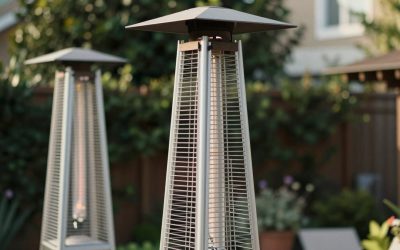
Best flexible position: Heat Storm Tradesman Tripod
A tripod heater plugs into a standard outlet and can be aimed at the seating area. It is useful if you rent or if you move furniture often.
Main trade-off: exposed legs can be knocked over, and cords need to be managed.
How much heat do you really need? A worked example
Electric heaters turn nearly every watt into heat, and 1,500W is about 5,100 BTU. A rule of thumb in outdoor heating guides is that infrared heaters cover a circle with a radius of roughly 3 to 5 feet per 1,500W. For a 10 by 12 foot patio with a seating group in one corner, a single 1,500W heater aimed at the group may feel warm in mild weather. For a larger area or colder temperatures, plan on 3,000W or more, or two heaters from different angles.
| Space | Typical need | Setup |
|---|---|---|
| Two chairs and a small table | 1,500W | One DR-238 on the wall |
| Seating for four to six | 3,000W | One DR-239 or two 1,500W |
| Dining area, 160 sq ft | 4,000 to 6,000W | Bromic Tungsten |
Check your circuit capacity first: a 15-amp, 120V circuit supports roughly 1,800W continuous load, so a 1,500W heater should have a circuit to itself.
Installation and safety checklist
- Confirm the heater is rated for outdoor or covered use, with an IP55 or higher rating if exposed to weather.
- Keep the clearances listed in the manual from walls, ceilings, furniture and plants.
- Mount at the recommended height, usually 7 to 9 feet for wall units.
- Use a dedicated circuit with a GFCI outlet.
- For hardwired units, hire a licensed electrician.
Running cost: a worked example
Electric heaters convert almost all power into heat, so the running cost is straightforward. A 1,500W heater uses 1.5 kilowatt-hours per hour, which is 6 kilowatt-hours over a four-hour evening. A 3,000W unit doubles that. Multiply by your local electricity rate to find the cost, and use a timer, such as the nine-hour timer on the DR-238, so the heater cannot be left on by accident.
| Heater | Energy per hour | Energy for 4 hours |
|---|---|---|
| 1,500W (DR-238) | 1.5 kWh | 6 kWh |
| 2,300W (Bromic Platinum) | 2.3 kWh | 9.2 kWh |
| 3,000W (DR-239) | 3.0 kWh | 12 kWh |
| 6,000W (Bromic Tungsten) | 6.0 kWh | 24 kWh |
Quiet heater mistakes to avoid
The first mistake is mounting too high. Infrared heat weakens with distance, so a heater mounted at 12 feet delivers noticeably less warmth than one at 8 feet. The second is placing it behind a wall corner or beam, which blocks the radiant path. The third is buying on watts alone: a 1,500W heater with a narrow reflector can feel warmer in one spot than a 3,000W unit that spreads heat widely.
Finally, remember that quartz elements glow bright orange and may be distracting at night. Carbon infrared elements such as the one in the DR-238 give a softer, dimmer glow, which many people prefer for relaxed evenings.
Frequently Asked Questions
Are electric patio heaters really silent?
They are far quieter than gas heaters because they have no fan or flame, though you may hear a faint tick as the metal warms.
Do infrared heaters work in wind?
Better than convection heaters, because infrared heats people and objects directly rather than warming the air. Strong wind still reduces comfort.
Can I use an infrared heater on an uncovered patio?
Only if it is rated for the exposure. Models with IP55 or higher can handle splashes, but covered use extends life.
How much does it cost to run a 1,500W heater?
Multiply 1.5 kilowatts by your local rate per kilowatt-hour: four hours of use is 6 kilowatt-hours.
Do electric heaters need an electrician?
Plug-in models do not, but hardwired or 240V models do. Follow local code.








Write Your Review
No reviews yet. Be the first to share your experience!