

Key takeaways
- Short-wave infrared: heats people and nearby surfaces quickly, making it useful for exposed patios. It tends to produce a brighter glow.
- Medium-wave infrared: offers a balance of warmth, response time, and visible light. It is a strong choice for breezy outdoor seating.
- Long-wave infrared: produces softer, less visible heat and is often comfortable under a covered patio, but it usually needs more shelter and closer positioning.
The best electric patio heaters for most homes are 1,500–3,000-watt infrared models: choose a 1,500-watt unit for a small covered seating area, 2,400–3,000 watts for a larger patio, and a weather-rated ceiling or wall model when you want quiet, instant heat without the clearance and ventilation concerns of gas.
Our top picks


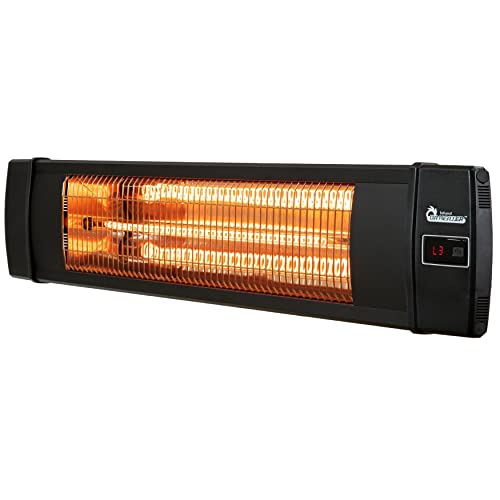

As an Amazon Associate we earn from qualifying purchases at no extra cost to you. Ratings are shown as listed on Amazon.
Quick picks by patio situation
| Patio situation | Best heater type | Recommended output | Why it fits |
|---|---|---|---|
| Small, covered balcony or dining nook | Compact wall-mounted infrared heater | 1,500–1,800 W | Heats a focused zone without using valuable floor space |
| Four- to six-person covered patio | Long-wave or medium-wave ceiling heater | 2,000–3,000 W | More even overhead coverage and no tipping risk |
| Open patio with occasional breezes | Medium-wave infrared heater with reflector | 2,400–3,200 W | More effective at delivering warmth across moving air |
| Renter or flexible seating area | Freestanding portable infrared heater | 1,500–2,500 W | Can be aimed at a table or moved into storage |
| Premium built-in outdoor kitchen or lounge | Recessed or surface-mounted premium heater | 2,400–4,000 W | Clean appearance, concealed wiring, and broad installation options |
What separates the best electric patio heaters?
Wattage and usable heating radius
Wattage indicates electrical consumption and heating capacity, but it does not guarantee a particular temperature over a precise area. Wind, ceiling height, wall placement, clothing, and the heater’s beam angle matter just as much.
As a practical starting point, a 1,500-watt heater usually creates a comfortable focused zone of roughly 30–50 square feet outdoors. A 2,000–2,400-watt model can serve about 50–80 square feet, while a 3,000-watt model may cover approximately 80–120 square feet in a sheltered layout. These are comfort zones rather than room-heating promises.
For a 10-by-10-foot patio, one centrally mounted 2,400-watt heater may work well under a low, enclosed cover. On an open 10-by-10-foot patio, two 1,500-watt heaters positioned at opposite sides can distribute warmth better than one powerful unit aimed from a corner.
Infrared heating technology
- Short-wave infrared: heats people and nearby surfaces quickly, making it useful for exposed patios. It tends to produce a brighter glow.
- Medium-wave infrared: offers a balance of warmth, response time, and visible light. It is a strong choice for breezy outdoor seating.
- Long-wave infrared: produces softer, less visible heat and is often comfortable under a covered patio, but it usually needs more shelter and closer positioning.
Head-to-head comparison of leading heater formats
| Format | Typical wattage | Typical effective zone | Mounting and controls | Best use |
|---|---|---|---|---|
| Portable tower or stand heater | 1,500–2,500 W | 30–80 sq. ft. | Floor-standing; manual, remote, or timer | Renters and changeable seating layouts |
| Wall-mounted panel | 1,500–2,400 W | 30–70 sq. ft. | Wall bracket; remote or hardwired switch | Small covered patios |
| Ceiling-mounted bar | 2,000–3,200 W | 50–120 sq. ft. | Ceiling brackets, chains, or recessed kit | Dining tables and permanent installations |
| Premium recessed heater | 2,400–4,000 W | 70–150 sq. ft. | Recessed ceiling or wall; thermostat or smart control may be available | Designed outdoor rooms and kitchens |
Weather ratings and covered-patio installation
Do not treat “outdoor” in a product name as a complete installation specification. Look for an IP rating, which describes resistance to solids and water. IP24 provides protection against splashing water, while IP55 offers stronger protection against dust and water jets. IP65 is more resistant to water ingress, but the heater can still require a roof, drainage plan, and protection from severe weather.
A covered patio is usually the easiest location because it reduces wind losses. However, the heater still needs the manufacturer’s minimum clearance from ceilings, walls, curtains, timber, plastic, and furniture. A recessed model may require a specific enclosure depth and airflow gap; it should not simply be placed inside a homemade box.
For an open patio, prioritize a heater designed for exposed installation, a stable mount, and a directional reflector. Keep portable heaters away from puddles and never leave a freestanding unit where it can be knocked over by children, pets, or strong wind.
Running costs: a simple calculation
Electric heaters are easy to price because nearly all the electricity becomes heat at the point of use. The formula is:
Cost per hour = kilowatts × electricity price per kilowatt-hour.
For example, a 2,400-watt heater uses 2.4 kilowatt-hours in one hour. At an electricity rate of $0.30 per kilowatt-hour, it costs about $0.72 per hour. Used for three hours on 40 evenings, the seasonal cost would be approximately $86.40 before taxes or utility fees.
A 1,500-watt heater at the same rate costs about $0.45 per hour. Two 1,500-watt heaters, however, consume the same total power as one 3,000-watt heater. The choice is therefore about heat distribution and control, not an automatic energy saving.
Controls worth paying for
- Multiple power levels: useful for reducing output after the patio warms up or when only one person needs heat.
- Remote control: convenient for ceiling-mounted units, where reaching a switch is impractical.
- Timer: prevents a heater being left on overnight and is particularly valuable for a rental property or busy household.
- Thermostat: more useful in an enclosed outdoor room than on an open patio, where wind can cause constant cycling.
- Smart-home compatibility: helpful only when the heater’s electrical installation and control module are approved for that use. Do not place a high-wattage heater on an ordinary smart plug unless the plug is specifically rated for the continuous load.
Brands and product lines to investigate
Established outdoor-heating ranges include Bromic Smart-Heat products, Infratech W and SL series heaters, and Heatstrip Classic and Elegance models. Their configurations vary by wattage, finish, control package, and installation kit, so compare the exact model rather than relying on a brand-wide reputation. Premium lines commonly offer cleaner recessed installations and better control integration, while generic bar heaters can provide good value when their electrical certification, clearances, warranty, and IP rating are clearly documented.
Typical market pricing in 2026 is about $150–$400 for a basic portable or wall-mounted heater, $400–$1,000 for a better-built mounted model, and $1,000–$3,000 or more for premium recessed systems once brackets, controls, and electrical work are included.
Durability and ownership details that listings omit
The heating element is often the first consumable component. Short-wave lamps can eventually lose output or fail, and replacement cost depends on the model. Reflectors collect dust and soot in covered outdoor kitchens, reducing directional performance. Painted steel can corrode at coastal properties, while stainless steel still benefits from regular cleaning because salt deposits can stain and pit surfaces.
- Turn the heater off and let it cool before cleaning.
- Wipe the reflector and housing with a soft, dry or lightly damp cloth; avoid abrasive pads.
- Inspect cords, plugs, brackets, and mounting screws at the beginning of each season.
- Keep portable heaters covered and dry when stored, but do not cover a unit while it is warm.
- Do not use an extension cord unless the manufacturer permits it and the cord is rated for the heater’s full load.
Final buying recommendation
For a covered patio, choose a 2,000–2,400-watt ceiling or wall-mounted infrared heater with at least two power levels and a timer. For an open or windy patio, choose medium- or short-wave infrared, use a directional reflector, and consider two smaller units for more even coverage. If you move furniture often, a stable portable model is worth the compromise; if the heater will stay in one place for years, spend more on certified weather resistance, replaceable elements, proper mounting hardware, and professional electrical installation.


Write Your Review
No reviews yet. Be the first to share your experience!