

Key takeaways
- The best sewing kits for kids compared: pre-punched felt kits for young beginners, stitch-teaching hand sewing kits, and first sewing machines for tweens.
The real decision behind a first sewing kit is how much of the work your child can safely do alone. Pre-cut felt kits with plastic needles and pre-punched holes trade genuine technique for independence: a young child finishes a plush unaided, but learns lacing more than sewing. Kits with metal needles, printed patterns, and several named stitches teach skills that carry over to real projects, yet they demand patience and an adult nearby. Machine kits sit at the far end of that scale, adding batteries, threading, and fabric feeding to the learning curve.
This guide serves three groups: parents of five- to seven-year-olds who need a frustration-free first project, families with elementary-age children ready to learn actual stitches, and buyers shopping for tweens who have outgrown hand sewing. Every product below was chosen from the names and specifications published on its Amazon page, with project counts, needle types, and included components checked against the listing rather than the box art.
Quick Picks
As an Amazon Associate we earn from qualifying purchases.
| Product | Best for | Key spec from title |
|---|---|---|
| KRAFUN My First Sewing Kit | A first project a young child can finish solo | 7 easy DIY projects |
| Craft-tastic Let’s Learn to Sew Mini Sewing Kit | Learning real stitches by hand | Ages 7+ |
| Klutz Sew Mini Treats | Kids who would rather make tiny plush food | More than 18 food plushies to stitch and stuff |
| Made By Me My Very Own Sewing Machine | The step up to a first working machine | Battery powered first sewing machine, ages 8+ |
| Cool Maker Exclusive Neon Stitch ‘N Style Fashion Studio | Fashion accessories sewn on a guided machine | Sews 8 stylish projects |
How to Choose
Needle Type Decides How Much Supervision You Owe
Plastic jumbo needles cannot pierce skin or fabric, so they only work where the holes already exist, and they let a young child sew without anyone hovering. Metal needles open up real sewing on plain fabric, but they come with pins and sharper points that call for an adult in the room, at least for the first sessions. Read the listing’s contents list before buying: it states plainly whether the needles are plastic or metal, and that single detail predicts how independent the activity will actually be in your house.
Pre-Cut Pieces Versus Pattern Skills
Some kits hand over felt shapes that are already cut out and punched with holes, so the child’s whole job is threading, stitching the edges, and stuffing. Others include paper patterns that must be pinned, traced, and cut before any sewing starts, which doubles the skill being taught and roughly doubles the time per project. Neither approach is better in the abstract. Match it to the child: a short attention span needs the first finished plush quickly, while an older, methodical kid may find pre-punched holes boring within one afternoon.
Project Count and Theme Drive Follow-Through
A kit with seven projects in it can be finished inside a fortnight of rainy afternoons, while one promising eighteen or more makes can anchor a whole season of craft time. Count matters less than theme, though. Children persist with subjects they already care about, so a food-obsessed nine-year-old will stitch tiny cupcakes long after a generic animal kit would have been shelved. Check what the finished objects actually are: pillows and bags get used, while purely decorative pieces need a display plan or they quietly become clutter by the third make.
Hand Sewing or a First Machine
Hand kits cost little, store in a drawer, and teach the stitches every later project depends on. A child’s first machine adds genuine excitement and produces stronger seams, but it also adds setup friction: batteries to load, a cartridge or bobbin to manage, and fabric that must be guided steadily. Machine kits also consume fabric, so the included sheets run out fast. Decide whether you want a self-contained activity that ends when the box empties, or a hobby starter that expects you to keep feeding it material and encouragement over the coming months.
The 5 Best Options
KRAFUN My First Sewing Kit

Everything in this box is engineered so a young beginner cannot really fail. The felt shapes arrive pre-cut and pre-punched, the needle is a large plastic one, and the seven projects, among them a bag, a pillow, an ornament, and a card holder, are stitched with colorful embroidery thread and finished with peel-and-stick decorations. A step-by-step visual manual carries a child who cannot yet read fluently, and the stuffing is included, so each plush is genuinely finished rather than abandoned half-closed.
Specs
- Projects: 7 stuffed animal dolls and a plush pillow craft set, including a bag, ornament, pillow, mini card holder, and organizer
- Needles: safe plastic sewing needles
- Materials: pre-cut and pre-punched felt shapes, embroidery thread, soft plush stuffing, self-adhesive felt decorations
- Instructions: step-by-step visual instruction manual
- Item dimensions: 10.24 x 10.24 x 1.57 inches
- Item weight: 115 grams
- Manufacturer recommended age: not stated
Best for: children roughly five to seven who want to complete a plush entirely by themselves.
Watch out for: the plastic needle only fits the pre-punched holes, so this kit teaches lacing and finishing rather than transferable stitching technique.
Craft-tastic Let’s Learn to Sew Mini Sewing Kit

This is the hand-sewing kit on the list that behaves like a short course. The full-color booklet works through more than nine projects while teaching the running stitch, blanket stitch, whip stitch, and basic embroidery, then shows how to sew on buttons and patches and use stuffing and elastic. Two metal needles and fifteen pins are included alongside felt, canvas, and cotton fabric, and the measuring tape and pins stay useful long after the box’s own projects are done, which makes it a bridge to sewing with household fabric scraps.
Specs
- Projects: 9 or more, covering running stitch, blanket stitch, whip stitch, and embroidery
- Needles: 2 metal needles, plus 15 pins and 3 metal safety pins
- Materials: 5 pieces of acrylic felt, 1 piece of canvas fabric, 1 piece of cotton fabric, 48 yards of cotton thread, 1 yard of elastic cord, 1 yard of cotton twine, 6 plastic buttons, polyester stuffing
- Tools kept after the projects: measuring tape, pins, needles, printed pattern, instruction booklet
- Item dimensions: 10 x 2 x 10 inches
- Item weight: 12.8 ounces
- Age from title: 7 and up
- Manufacturer: Ann Williams Group
Best for: seven- to ten-year-olds who want to learn stitches they can reuse on their own projects.
Watch out for: real needles and pins carry functional sharp points, so plan on supervising until your child handles them carefully by habit.
Klutz Sew Mini Treats
Klutz builds the whole kit around a 48-page book that teaches tracing, cutting, threading, and stuffing through more than eighteen tiny felt food plushies, from a lime and a toaster pastry to a pizza slice with a face. Paper patterns are included, so children measure their own progress against real pattern work rather than pre-punched shortcuts. Thirty pre-cut felt eyes and cheeks keep the finishing step easy and give every treat its expression, and the generous floss and felt supply means a botched first attempt does not end the fun.
Specs
- Projects: more than 18 food plushies to stitch and stuff
- Book: 48-page instruction book with 3 pages of paper patterns
- Materials: 12 sheets of acrylic felt, 32 yards of cotton floss, 30 pre-cut acrylic felt eyes and cheeks, 1 ounce of polyfill stuffing
- Needles: 2 embroidery needles
- Scissors: not included
- Item dimensions: 8.54 x 10.51 x 1.93 inches
- Item weight: 15.5 ounces
- Manufacturer recommended age: 10 to 18 years
- Item model number: 532035
Best for: detail-loving kids around ten and up who enjoy miniature makes and following a book.
Watch out for: scissors are required but not included, and the tracing and cutting stages assume steadier hands than the felt-plush kits above.
ASIN: 0545906520
Made By Me My Very Own Sewing Machine
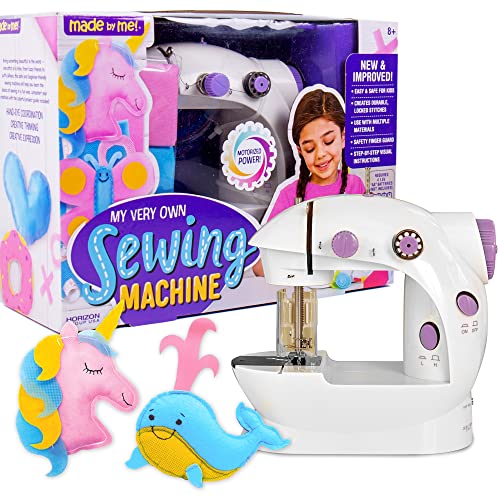
When hand stitching starts to feel slow, this battery-powered machine is the natural next rung. It arrives pre-threaded, which removes the most frustrating setup step, and the fully illustrated instructions walk a beginner through winding a bobbin, locking stitches, and checking seam quality. Suggested projects include a patchwork pillow, a tic-tac-toe game, fabric bookmarks, and fuzzy creatures. Fabric sheets, three spools of thread, a measuring tape, a metal needle threader, and fiberfill are in the box, so the first seams can happen the same day it is opened.
Specs
- Machine: portable, battery powered, pre-threaded and ready to use
- Includes: sewing machine, metal needle threader, fiberfill, fabric sheets, measuring tape, 3 spools of thread, fully illustrated instructions
- Project ideas in the listing: patchwork pillow, tic-tac-toe game, fabric bookmarks, fuzzy creatures
- Item dimensions: 9 x 4.5 x 12.5 inches
- Item weight: 2.41 pounds
- Item model number: 213319
- Manufacturer: Horizon Group USA
- Manufacturer recommended age: 6 years and up; title targets ages 8 and up
- Batteries: not stated
Best for: children eight and older who have mastered hand stitches and want machine-made seams.
Watch out for: confirm the battery situation before gifting, because the listing does not state whether batteries are included, and keep spare fabric ready once the included sheets are used up.
Cool Maker Exclusive Neon Stitch ‘N Style Fashion Studio

This studio turns a sewing machine into a fashion workshop for kids who care more about wearing the result than about technique drills. A pre-threaded cartridge removes threading entirely, and smart-stitch sensors start and stop the needle as fabric reaches the edge, which forgives the wobbly feeding every beginner does. Two printed fabric sheets become eight accessories, including a sunglasses case, a bow clip, a clutch, a lip balm holder, and a saddle bag, and water transfer prints decorate the finished pieces. Everything packs back into the machine’s storage drawer between sessions.
Specs
- Projects: 8 accessories, including a sunglasses case, bow clip, clutch, lip balm holder, saddle bag, and plushie
- Machine features: pre-threaded thread cartridge, smart-stitch fabric sensors, storage drawer
- Includes: sewing machine, 1 thread cartridge, 1 stamper, 2 sewing clips, 1 ruler, 1 threader tool, 2 printed fabric sheets, 2 sheets of decorative water transfer prints, 2 clasps, 1 hair clip, flat fabric elastic, elastic, instruction guide
- Batteries: 4 AA batteries required
- Item dimensions: 8 x 5.13 x 8 inches
- Item weight: 1.78 pounds
- Manufacturer recommended age: 8 to 14 years
- Item model number: 6065484
- Manufacturer: Spin Master
Best for: fashion-minded kids eight and up who want finished accessories rather than practice pieces.
Watch out for: the four AA batteries are required and the two printed fabric sheets set a hard limit on the included projects, so budget for batteries and extra fabric from the start.
Which One Fits Your Situation
A First Craft for a Five- or Six-Year-Old
Start with the KRAFUN kit. Its plastic needle, pre-punched holes, and picture-led manual remove every step that typically makes a young child quit, and the seven projects are short enough that the first stuffed animal gets finished in one sitting. That early completed plush does more for a second session than any amount of encouragement.
A Child Who Wants to Learn Real Sewing
Choose between the Craft-tastic kit and Sew Mini Treats based on temperament. Craft-tastic teaches four named stitches with reusable tools and suits a child who likes lessons in order. The Klutz book suits an independent reader who would rather trace patterns and work through eighteen tiny projects at their own pace, checking the book when a step goes wrong.
A Tween Who Has Outgrown Hand Sewing
The two machines split by interest. Made By Me’s sewing machine is the straighter path toward general sewing, with bobbins, stitch locking, and projects like a patchwork pillow that transfer to ordinary fabric. The Cool Maker studio fits a child motivated by accessories and decoration, where sensor-guided stitching and water transfer prints keep the fashion output high while the technique stays guided.
A Gift That Has to Last for Weeks
Sew Mini Treats is the long game: eighteen-plus projects, a book worth rereading, and enough felt and floss to survive mistakes. The Craft-tastic kit is the other durable choice because its tape, pins, and needles remain useful with scrap fabric after the box projects end. Either way, add a pair of child-safe scissors if the recipient does not already own some.
Common Mistakes
- Buying a metal-needle kit for a child who still mouths small parts or cannot be supervised, when a plastic-needle kit would have been the safe match.
- Forgetting to check what is missing from the box, such as scissors for pattern kits or AA batteries for the machine studios.
- Choosing purely by the cutest theme while ignoring whether the projects need cutting skills your child has not built yet.
- Assuming a pre-punched felt kit teaches measuring and cutting, when those steps were done at the factory.
- Giving a machine kit with no plan for more fabric, so the hobby stalls the day the included sheets run out.
Frequently Asked Questions
What age can a child start using a sewing kit?
Most children can manage a pre-punched felt kit with a plastic needle around age five, since the holes and pictures do the guiding. Real needles, pins, and pattern cutting usually land better from seven or eight upward, and book-led kits with small pieces reward the patience of a ten-year-old. Match the kit to the child rather than the birthday.
Do kids’ sewing kits use real needles?
Some do and some deliberately do not. Kits aimed at the youngest sewers use large plastic needles that only pass through pre-punched holes. Kits teaching genuine stitches include metal needles and often pins, which is why their listings carry sharp-point warnings. The contents list on the product page tells you exactly which kind you are buying.
Can a toy sewing machine actually sew real fabric?
Yes, within limits. Battery-powered kids’ machines like the two in this guide drive a real needle and lock stitches into light fabrics such as cotton and felt, which covers pillows, bookmarks, and small accessories. They are not built for denim, thick layers, or large garments, so treat them as training machines rather than replacements for a full-size model.
What should I buy alongside a first sewing kit?
A pair of scissors sized for a child’s hand is the most common missing item, since several kits assume you own some. After that, a small stock of felt sheets and embroidery floss extends any kit’s life, and machine kits also need the right batteries on hand. A simple box for needles, pins, and thread prevents the sharp pieces from migrating into the carpet.
More from Amazon
Programs that pair well with the guide above. Offers and eligibility are set by Amazon and may change.
Collect the home and kitchen items you want in one registry that guests can shop from.
Create a wedding registrySet up recurring deliveries of everyday items on eligible products. Terms and savings are set by Amazon.
Explore Subscribe & SaveFree shipping on eligible items, Prime Video and more. Eligible new members can start with a free trial.
Start a Prime free trialAudiobooks and podcasts to listen to on the go. Eligible new members can start with a free trial.
Try Audible freeAs an Amazon Associate we earn from qualifying purchases.

Write Your Review
No reviews yet. Be the first to share your experience!