

Key takeaways
- Compare the best science kits for kids, from volcano and crystal labs to slime chemistry sets, with experiment counts, age ranges, and included tools.
The real decision with a kids’ science kit is not how impressive the box looks, but how much of the advertised experiment count a child can actually run with what is inside. Some kits supply materials for every project, while others pad the number with ideas that need ingredients from your kitchen. Age fit matters just as much: a chemistry-heavy set frustrates a six-year-old, and a simple slime lab bores a fifth grader within a weekend.
This roundup serves parents of younger children who need short, guided activities, families with eight-to-twelve-year-olds ready for volcanoes and crystals, and gift buyers who want one box to last for months. Every product below was chosen from the names, experiment counts, age ranges, and component lists printed on its Amazon page, so the comparison reflects what each listing actually promises rather than marketing from elsewhere.
Quick Picks
As an Amazon Associate we earn from qualifying purchases.
| Product | Best for | Key spec from title |
|---|---|---|
| National Geographic Earth Science Kit | Kids hooked on rocks, volcanoes, and crystals | 100+ science experiments & activities |
| Doctor Jupiter Ultimate Science Kit | The longest experiment runway in one box | 135+ experiments |
| Discovery Planet Earth Science Kit | Earth science variety with household extensions | 65 experiment STEM lab |
| SNAEN 220+ Lab Experiments Science Kit | Younger children and wide age ranges | 220+ lab experiments |
| Thames & Kosmos Ooze Labs: Alien Slime Lab | Slime fans aged six and up | 10 experiments with slime |
How to Choose
Count Supplied Experiments, Not Headline Numbers
Headline counts blend two very different things: experiments with materials in the box and bonus ideas that rely on household supplies. The National Geographic kit, for example, lists 15 supplied activities plus a guide with more than 85 extra projects using common materials, while the Discovery kit splits its 65 into 25 supplied and 40 DIY. Neither approach is wrong, but a child who wants to start today needs the supplied count to be high. Check the listing’s own breakdown before assuming a bigger number means more afternoons of activity.
Match the Age Range to the Child, Not the Gift Occasion
Manufacturer age ratings signal reading level, chemical strength, and how much adult help the projects assume. Kits rated eight and up, like the Doctor Jupiter Ultimate, use real reagents and multi-step reactions that reward patience. Sets starting at six, such as the Ooze Labs Alien Slime Lab, keep steps short and materials non-hazardous. Buying above a child’s rating usually means a parent performs while the child watches; buying below it means the novelty fades fast. The listing’s stated minimum age is the most honest filter you have.
Decide Between a Theme and a Sampler
Focused kits go deep on one fascination: earth science sets dig, erupt, and grow crystals, while slime labs explore polymers and viscosity. Sampler kits spread smaller numbers of experiments across chemistry, physics, and earth science, which suits children whose interests change weekly. Think about what the child already gravitates toward. A rock collector will return to a geology kit for months, whereas a sampler’s breadth wins with a child who has not yet found a favorite subject. The component list on the listing shows which pattern a kit follows.
Check the Tools and Consumables Included
Reusable lab tools, such as flasks, test tubes, measuring cylinders, and stands, stretch a kit’s life because they support experiments beyond the manual. Consumables like crystal powder, plaster, and reagents run out, and not every brand sells refills. Read the included-components list carefully: a kit with durable tools and modest consumables can anchor a home lab that grows, while a consumables-only box is finished when the last packet is used. Also confirm whether safety goggles are included or must be bought separately.
The 5 Best Options
National Geographic Earth Science Kit

Earth science is the whole story here: children build and erupt a volcano, grow a crystal, spin dueling water tornadoes, and dig through gemstone and pyrite bricks, then start a rock collection with the included specimens. A full-color learning guide explains the geology behind each result, which makes the kit work as a homeschool earth-science unit as much as a toy. The extra guide adds more than 85 further experiments using common household materials, so the 15 supplied activities are a starting point rather than the ceiling.
Specs
- Experiments: 100+ experiments and activities in total; 15 activities with included materials
- Includes: crystal growing kit, gemstone and pyrite dig bricks, gemstones with storage case, tornado tubes, volcano plaster kit
- Model number: NGMEGAEARTH
- Dimensions: 8.66 x 3.15 x 12 inches
- Item weight: 2.6 pounds
- Manufacturer recommended age: 8 years and up
- Safety note: choking hazard, small parts
Best for: Kids aged eight and up who collect rocks and want volcano, crystal, and dig projects in one box.
Watch out for: Most of the headline count comes from the household-materials guide, so check that split before expecting 100 supplied projects.
ASIN: B082ZLM39R
Doctor Jupiter Ultimate Science Kit

This is the volume pick: more than 135 experiments covering color changes, glowing water, underwater volcanoes, and soap making, presented in an illustrated step-by-step manual with time estimates for planning sessions. The chemicals arrive in separate leak-proof bottles, which keeps storage tidy between projects, and the reusable tools, including a conical flask, measuring cylinder, and test tube stand, give it a proper lab feel. A bonus booklet adds still more activities built around common household items, stretching the box across an entire season of weekends.
Specs
- Experiments: 135+ experiments, plus a bonus experiment booklet
- Includes: measuring cylinder, conical flask, spatula, stirring sticks, test tube stand, funnel, tray, soap moulds, food colours, food essences, glow powder, baking soda, citric acid
- Model number: DJ Parent
- Dimensions: 11.4 x 9.84 x 1.77 inches
- Item weight: 650 g
- Manufacturer recommended age: 8 years and up
- Safety note: certain experiments require adult supervision
Best for: Older kids who burn through activities quickly and want a deep, chemistry-leaning experiment library.
Watch out for: The flat box is mostly consumables and paper goods, so plan a storage bin for the tools once it is opened.
ASIN: B0C248WX35
Discovery Planet Earth Science Kit
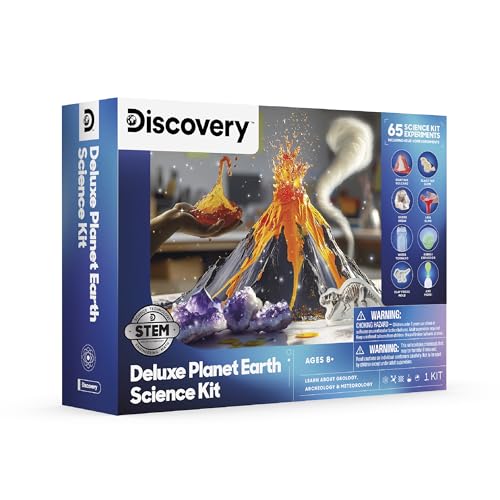
Discovery splits its 65 activities into 25 experiments with supplied materials and 40 DIY projects that use common household items, and it is upfront about that split on the listing. The themes stay on earth science throughout: a DIY volcano, tornado, fossils, crystals, and slime, with tools such as a volcano mold, fossil molds, and excavation bricks. Because the DIY half needs no special supplies, the kit keeps giving after the boxed experiments are done, which suits families who like a guidebook model over a consumables model.
Specs
- Experiments: 65 total, with 25 experiments with supplied materials and 40 DIY household activities
- Includes: ingredients, instruction guide, materials, and tools, including volcano mold, fossil molds, and excavation bricks
- Model number: 1019074
- Manufacturer: Merchsource
- Material: plastic
- Dimensions: 12.5 x 3 x 9 inches
- Item weight: 2 pounds
- Manufacturer recommended age: 8 years and up
- Safety note: contains chemicals; adult supervision required
Best for: Families who want earth-science breadth and are happy to extend play with household-item projects.
Watch out for: Only 25 experiments come with materials included, so younger or impatient kids may stall at the DIY half.
ASIN: B0FCMZY38V
SNAEN 220+ Lab Experiments Science Kit

SNAEN aims at the widest age spread in this roundup, with a title that addresses children from three to twelve years old. The 48-piece set carries the materials for more than 120 experiments, including volcanoes, crystal growing, and color reactions, and the listing describes expanding the count to 220+ with additional experiment combinations. Instruction cards walk through each project and explain the principle behind it, and the included goggles, test tubes, measuring cups, and droppers make the setup feel like a real first laboratory for younger scientists.
Specs
- Experiments: materials for 120+ experiments included; expandable to 220+ per the listing
- Piece count: 48 pieces
- Includes: safety goggles, test tubes, measuring cups, droppers, balloons, chemicals, and instruction cards
- Age range: 3 to 12 years per the listing title
- Dimensions: not stated
- Item weight: not stated
- Manufacturer: SNAEN
Best for: Households with siblings of different ages who need one kit everyone can join in with.
Watch out for: The 220+ figure counts expansions beyond the included materials, so judge the kit on its 120+ supplied experiments.
ASIN: B0C4LLY3LC
Thames & Kosmos Ooze Labs: Alien Slime Lab

Ten experiments, one theme, done properly: this kit builds a small lab station where children mix, test, and dissect batches of alien slime, including glow-in-the-dark and color-changing varieties. The 24-page manual wraps each assignment in a light science-fiction storyline while teaching real vocabulary such as viscosity, molecules, and polysaccharides. With 28 pieces, non-hazardous chemicals, and an age floor of six, it is the gentlest entry point here, and the station can later combine with other Ooze Labs sets to form a larger lab.
Specs
- Experiments: 10 experiments
- Piece count: 28 pieces
- Manual: 24-page, full-color illustrated manual
- Assembled lab station size: approximately 8.4 x 11.5 x 11 inches
- Materials: non-hazardous chemicals; station base, test tubes, scalpel, petri dish, pipette, syringe, spatula
- Manufacturer recommended age: 6 years and up
- Product dimensions: not stated
- Item weight: not stated
Best for: Six-to-eight-year-olds who love slime and do best with short, story-driven activities.
Watch out for: Ten experiments is the smallest count here, so heavy users will finish it in a few sessions.
ASIN: B07P8BD9LF
Which One Fits Your Situation
You Are Buying for a Child Under Eight
Start with the Ooze Labs Alien Slime Lab, which is rated from age six, uses non-hazardous materials, and keeps every project short. The SNAEN kit is the other realistic option because its listing covers younger children, though an adult should still run the mixing steps. The eight-and-up kits in this roundup will mostly turn the child into a spectator, so save those for later birthdays.
Your Child Burns Through Activities in a Week
Choose the Doctor Jupiter Ultimate Science Kit, whose 135-plus experiments and bonus booklet offer the deepest bench here. The National Geographic Earth Science Kit is the other long-haul option: its 15 supplied activities are backed by more than 85 household-material experiments in the extra guide. Either box can anchor a school term of weekend projects instead of a single holiday afternoon.
Earth Science Is the Current Obsession
The National Geographic kit is the purest geology play, with dig bricks, a crystal to grow, and specimens for a rock collection. The Discovery Planet Earth kit covers similar ground, volcano, fossils, weather, and crystals, but trades some supplied materials for 40 DIY projects. Pick National Geographic for supplied materials, and Discovery for guided variety once the boxed experiments run out.
Siblings of Different Ages Will Share It
The SNAEN kit’s wide stated age range and card-based instructions make it the easiest to share, since younger children can handle the pouring and watching while older ones read steps aloud. The National Geographic kit also shares well because its dig and volcano projects naturally split into roles. Keep the Doctor Jupiter set for one older child, since its chemical steps need consistent adult supervision.
Common Mistakes
- Judging a kit only by its headline experiment count without checking how many projects include materials in the box.
- Buying an eight-and-up chemistry set for a five-year-old, then having to perform every step yourself.
- Ignoring whether safety goggles are included, and discovering on the day that they must be ordered separately.
- Letting consumable powders and reagents get mixed or damp in storage, which ruins the remaining experiments.
- Throwing away reusable lab tools with the packaging, even though they support experiments well beyond the manual.
Frequently Asked Questions
How many experiments should a good kids’ science kit have?
There is no magic number, because counts mix supplied projects with household-material ideas. A kit with 15 to 25 fully supplied experiments gives most children several weekends of activity, especially when a guide adds more projects afterward. Judge by the supplied count and the topic fit rather than the largest number printed on the box.
Do these kits need adult supervision?
Yes, at least for setup and chemical steps. Listings for the eight-and-up kits state that certain experiments require adult supervision, and even the younger sets involve mixing powders and liquids that a grown-up should oversee. Plan to be present for the first run of any new experiment type, then let confident older children repeat favorites independently.
Are the chemicals in kids’ science kits safe?
The kits here use non-hazardous or food-adjacent materials, and the younger sets say so explicitly on their listings. That does not make them edible: powders such as citric acid and baking soda are mild, but they still need careful handling, hand washing, and storage away from toddlers and pets. Follow each manual’s cautions on the individual containers.
What age is best to start with a science kit?
Story-driven sets with non-hazardous materials work from about age six, when children can follow short illustrated steps. Fuller chemistry and earth-science kits suit ages eight and up, matching their reading level and patience for multi-stage projects. Starting slightly early with heavy adult help is fine, but a kit matched to the stated age range gets used more.
More from Amazon
Programs that pair well with the guide above. Offers and eligibility are set by Amazon and may change.
Collect the home and kitchen items you want in one registry that guests can shop from.
Create a wedding registrySet up recurring deliveries of everyday items on eligible products. Terms and savings are set by Amazon.
Explore Subscribe & SaveFree shipping on eligible items, Prime Video and more. Eligible new members can start with a free trial.
Start a Prime free trialAudiobooks and podcasts to listen to on the go. Eligible new members can start with a free trial.
Try Audible freeAs an Amazon Associate we earn from qualifying purchases.


Write Your Review
No reviews yet. Be the first to share your experience!