

Key takeaways
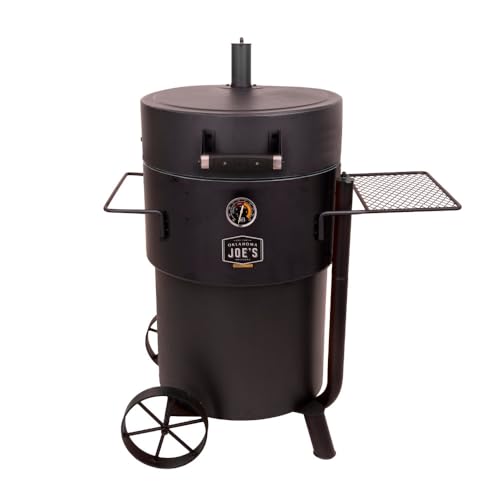
- Best for beginners and repeatable cooks: Oklahoma Joe’s Bronco. Its sealed lid, adjustable intake, exhaust, ash pan, and porcelain-coated cooking components make temperature management less mysterious than on a basic drum smoker.
- Best for simple, high-capacity hanging cooks: Pit Barrel Cooker Classic. Its 18.5-inch barrel uses hooks and a cooking grate, so ribs, chicken, and pork can be arranged vertically without buying a separate hanging rack.
- Best for serious backyard capacity: Gateway Drum Smoker 55-gallon models. A larger cooking chamber and multiple grate positions suit brisket cooks, competition-style barbecue, and entertaining.
- Best for a value-focused large drum: Hunsaker Drum Smoker. Its vortex-style basket and adjustable airflow are designed to promote even heat while using a standard 55-gallon format.
- Best for occasional cooks with limited storage: a compact 30-gallon drum smoker. It takes less patio space and fuel than a 55-gallon model, but it gives up brisket and rib capacity.
The best drum smokers for most backyard cooks are the Oklahoma Joe’s Bronco for controllable, all-day smoking, the Pit Barrel Cooker Classic for simple hanging cooks, and a 55-gallon Gateway or Hunsaker drum for large briskets and frequent entertaining. The right choice depends less on brand than on drum size, steel thickness, airflow control, fuel usage, portability, and whether you want to assemble or modify anything.
Our top picks


As an Amazon Associate we earn from qualifying purchases at no extra cost to you. Ratings are shown as listed on Amazon.
Best drum smokers by barbecue setup
- Best for beginners and repeatable cooks: Oklahoma Joe’s Bronco. Its sealed lid, adjustable intake, exhaust, ash pan, and porcelain-coated cooking components make temperature management less mysterious than on a basic drum smoker.
- Best for simple, high-capacity hanging cooks: Pit Barrel Cooker Classic. Its 18.5-inch barrel uses hooks and a cooking grate, so ribs, chicken, and pork can be arranged vertically without buying a separate hanging rack.
- Best for serious backyard capacity: Gateway Drum Smoker 55-gallon models. A larger cooking chamber and multiple grate positions suit brisket cooks, competition-style barbecue, and entertaining.
- Best for a value-focused large drum: Hunsaker Drum Smoker. Its vortex-style basket and adjustable airflow are designed to promote even heat while using a standard 55-gallon format.
- Best for occasional cooks with limited storage: a compact 30-gallon drum smoker. It takes less patio space and fuel than a 55-gallon model, but it gives up brisket and rib capacity.
Head-to-head comparison
The figures below are typical published or nominal specifications for commonly sold configurations. Accessories, stands, shelves, and regional versions can change weight and capacity, so confirm the exact model before ordering.
| Type or example | Cooking area and capacity | Steel and build | Temperature control | Approx. empty weight | Best fit |
|---|---|---|---|---|---|
| Pit Barrel Cooker Classic | 18.5-inch grate; typically 8 hanging hooks; about 2 whole briskets when arranged carefully | 30-gallon steel barrel; porcelain-coated components | Fixed exhaust with adjustable intake; designed for a relatively narrow operating range | About 60 lb | Simple ribs, chicken, pork shoulder, and party cooking |
| Oklahoma Joe’s Bronco | 18-inch grate; about 284 sq. in. of primary grate space, with additional rack or hanging capacity depending on setup | 18-gauge steel body; porcelain-coated cooking surfaces | Adjustable intake, exhaust, and sealed lid; ash pan helps reduce airflow leaks | About 145 lb | Beginners who want more control and a stable cart |
| Gateway Drum Smoker, 55-gallon class | Two or more 22-inch-class grates; commonly accommodates 3–4 briskets depending on racks and spacing | Heavy-gauge welded steel; insulated or double-wall options may vary | Adjustable intake and exhaust; some versions offer digital-controller compatibility | Roughly 130–180 lb | Frequent cooks, large families, and competition-style quantities |
| Hunsaker Drum Smoker, 55-gallon class | 22-inch-class grate; commonly supports multiple pork shoulders or 3–4 briskets with suitable racks | Heavy-gauge steel; removable vortex basket and cooking racks | Adjustable intake and exhaust, with airflow directed around the basket | Roughly 100–150 lb | Large cooks where even heat and fuel efficiency matter |
| Compact 30-gallon drum smoker | 18-inch or smaller grate; usually 1 brisket or 2–3 pork shoulders | Often 16–18 gauge steel; quality varies substantially | Usually one intake and one exhaust damper | About 50–90 lb | Small patios, couples, and occasional barbecue |
What matters more than the advertised grate area
Cooking capacity
A drum’s diameter determines whether food fits without crowding. An 18-inch grate has approximately 254 square inches of geometric surface area, while a 22-inch grate has approximately 380 square inches—about 50% more. That extra diameter matters more than a tall interior if you cook brisket, whole chickens, or several racks of ribs flat.
Hanging capacity changes the calculation. A 30-gallon cooker can hold several racks of ribs vertically, but hooks need clearance below the lid and above the charcoal basket. A 55-gallon cooker gives more vertical room and usually accommodates extra grates, but it also needs more fuel and is much harder to move.
Steel thickness and heat stability
Thicker steel generally loses heat more slowly when the lid is opened or the weather turns cold. It also resists dents and distortion better. However, steel thickness is not the only durability factor: welded seams, lid fit, paint quality, the charcoal basket, and the damper hardware can matter just as much.
Thin drums can work well in mild weather, particularly when the lid seals tightly. In cold or windy climates, expect faster temperature swings and consider a heavier body, a windbreak, or an insulated cover designed for the cooker. Never wrap a charcoal smoker in an improvised combustible material.
Temperature control
Simple drum cookers often run well with a mostly closed intake and a partially open exhaust. They are efficient because the compact chamber needs relatively little oxygen. That efficiency is convenient, but a cooker with limited vents gives you less ability to correct a temperature spike.
The Bronco, Gateway, and Hunsaker-style designs are better choices if you want to make deliberate adjustments during a long cook. Look for a vent that can be closed nearly airtight, an exhaust that does not bind, and an ash system that keeps spent charcoal from blocking airflow. A digital controller can help on compatible models, but it does not eliminate the need to manage fuel, leaks, and weather.
Decision matrix: match the smoker to your routine
| Your situation | Recommended direction | Why | Main compromise |
|---|---|---|---|
| Budget-conscious, cooks once or twice a month | Compact 30-gallon drum or Pit Barrel Cooker Classic | Lower purchase cost, modest charcoal demand, simple setup | Less precise adjustment and less room for flat brisket cooking |
| New to charcoal smoking and wants repeatability | Oklahoma Joe’s Bronco | Accessible dampers, ash pan, cart, and sealed-lid design | Heavy for its cooking diameter and not especially easy to store |
| Smokes several times a month for family or guests | Hunsaker or Gateway 55-gallon class | More rack positions, larger baskets, and room to grow | Higher cost, fuel consumption, and footprint |
| Small patio, apartment storage, or frequent relocation | 30-gallon drum with wheels or compact stand | More manageable footprint and easier transport | Shorter cooking runs and less clearance for hanging food |
| Competition-style cooks or large brisket batches | 55-gallon Gateway or Hunsaker model | Large diameter, multiple grates, and adjustable airflow | Requires a permanent, level location and careful moving |
Fuel efficiency and a realistic cost calculation
Drum smokers usually consume less charcoal than a large horizontal offset because the chamber is compact and the fire receives limited oxygen. A typical cook may use roughly 4–8 lb of charcoal for a 6–8 hour session in a well-sealed 30-gallon cooker, or about 6–12 lb in a larger 55-gallon model. Cold temperatures, wind, frequent lid opening, and a large initial fire can push usage higher.
For example, assume a 30-gallon cooker uses 6 lb of charcoal per cook and charcoal costs $1.25 per pound. The fuel cost is 6 × $1.25, or $7.50 per cook. If a 55-gallon cooker uses 9 lb at the same price, its fuel cost is $11.25 per cook. Over 30 cooks, the larger cooker uses about $112.50 more fuel. That difference is modest if you regularly cook for a crowd, but unnecessary if most cooks are two chicken halves and a small pork shoulder.
Assembly, portability, and patio space
Compact drum smokers may arrive mostly assembled, while cart-based models can require fitting legs, handles, shelves, wheels, dampers, and thermometers. Allow 30–90 minutes for a typical bolt-together cooker, then check every fastener after the first few heat cycles. Poorly tightened handles and wheel hardware are common sources of wobble.
Weight changes the ownership experience. A 60-pound cooker can be moved by one strong adult with care; a 140-pound cooker is better treated as a permanent appliance. Measure the route from storage to the cooking area, including gates and steps. Leave clearance around the smoker for the lid, hot surfaces, and safe access to vents. Use it only outdoors on a stable, noncombustible surface, away from structures and overhanging branches.
Setup and maintenance that prevent common problems
- Season the cooking surfaces. Wash manufacturing residue from grates and lightly coat them with cooking oil before a controlled hot burn.
- Start with a modest charcoal load. Excess lit charcoal is the quickest route to an overshoot. Add unlit fuel around the lit section if the design uses a basket arrangement.
- Adjust the intake gradually. Wait 10–15 minutes between changes. Rapid, repeated adjustments make it difficult to tell whether the cooker is responding to the current change or the previous one.
- Keep the exhaust open unless the manufacturer specifies otherwise. Closing the exhaust can trap stale smoke and make the fire harder to control.
- Remove ash after each long cook. Ash can obstruct the basket and intake, causing erratic temperatures. Empty it only when fully cold and place it in a metal container.
- Inspect the first-wear parts. Check gasket material, damper screws, wheel hardware, charcoal baskets, hooks, and the thermometer. Surface rust can be cleaned and protected; perforation around the bottom or severe lid warping is a replacement issue.
Do not store charcoal inside the cooker where it can absorb moisture, and do not extinguish a hot fire by pouring water into the drum. Water can damage finishes, create steam burns, and leave wet ash that promotes corrosion.
Final recommendation
Choose the Pit Barrel Cooker Classic when uncomplicated hanging barbecue and moderate capacity are your priorities. Choose the Oklahoma Joe’s Bronco when you are learning charcoal control or want a more adjustable, cart-based cooker. Move to a Gateway or Hunsaker 55-gallon drum when you cook large quantities often enough to justify the weight, space, and extra fuel. For a small patio or occasional use, a well-sealed compact drum is usually a better purchase than an oversized cooker that is difficult to store and rarely filled.



Write Your Review
No reviews yet. Be the first to share your experience!