

Key takeaways
- Single-level grate: simplest to access and easiest to clean, but it offers little separation between food zones.
- Upper warming rack: increases capacity for buns, vegetables, or finished food, though it may reduce clearance for tall roasts.
- Split grate: lets you combine direct and indirect heat, and removable sections make it easier to add charcoal or a diffuser.
- Two-chamber layout: an offset smoker gives the clearest separation between smoking and grilling, but airflow management is more demanding.
Best Grill Smoker Combos for Backyard Cooking
The best grill smoker combo for most backyards is a mid-size pellet grill with at least 700 square inches of cooking space, but charcoal gravity-fed cookers are the stronger choice if high-heat searing matters more than push-button convenience.
These cookers combine a direct-heat grilling surface with an indirect-smoking zone, but they do not all balance those jobs equally. Before buying, compare the cooking-area layout, fuel system, temperature control, smoking capacity, searing performance, cleanup, assembly, and the amount of patio space the cooker will occupy.
Our top picks

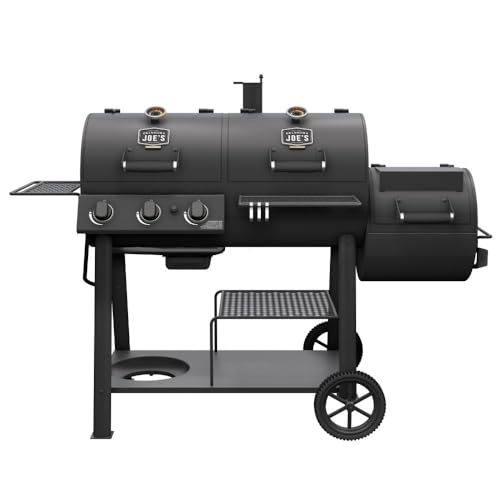
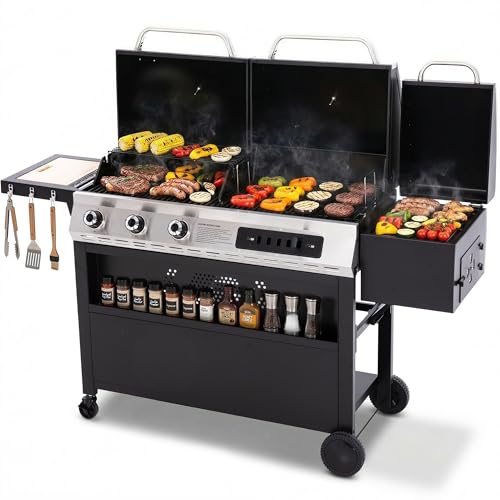

As an Amazon Associate we earn from qualifying purchases at no extra cost to you. Ratings are shown as listed on Amazon.
Quick comparison of the leading types
| Example or cooker type | Cooking area | Fuel | Temperature range | Approx. footprint | Best for |
|---|---|---|---|---|---|
| Traeger Pro 780 | 780 sq. in. | Wood pellets | 180–450°F | Approx. 55 × 49 in. | Convenient smoking and family-size grilling |
| Weber Searwood XL 600 | About 972 sq. in. | Wood pellets | 180–600°F | Approx. 59 × 32 in. | Pellet cooking with stronger high-heat capability |
| Masterbuilt Gravity Series 600 | 600 sq. in. | Lump charcoal or briquettes | 180–700°F | Approx. 56 × 31 in. | Smoke flavor and steakhouse-style searing |
| Kamado-style ceramic cooker, 18–24 in. | 250–450 sq. in. primary area | Lump charcoal | 225–700°F or higher | Approx. 22–28 in. diameter | Fuel efficiency, baking, roasting, and compact patios |
| Offset smoker-grill, 1,000–1,400 sq. in. | 1,000–1,400 sq. in. | Split wood or charcoal | 225–700°F, operator-controlled | Approx. 65–75 × 30–40 in. | Large cooks and traditional barbecue |
Published dimensions can vary by handle position, chimney, shelves, and side tables. Measure the cooker with its shelves extended, then leave additional clearance for the lid and safe airflow.
Best choices by backyard situation
| Your situation | Most suitable choice | Why | Main compromise |
|---|---|---|---|
| New to smoking | Pellet grill | Automatic feed and electronic temperature control reduce fire-management work. | Requires electricity and produces less intense smoke than a wood-fired offset. |
| Steaks several times a month | Gravity charcoal cooker or kamado | Charcoal reaches higher direct-heat temperatures and adds stronger browning. | Lighting, ash management, and vent adjustments take more attention. |
| Small patio or balcony-sized footprint | 18-inch kamado | Vertical, insulated construction delivers useful capacity in a compact space. | Its round grate is less efficient for ribs, sheet pans, and large batches. |
| Weekly cooking for four to six people | 600–800 sq. in. pellet or gravity cooker | Enough room for dinner plus a separate indirect zone or upper rack. | Wider carts can consume more patio space than expected. |
| Large parties and briskets | 1,000+ sq. in. offset or large pellet grill | Long racks and multiple shelves accommodate large cuts and batches. | Higher purchase price, longer warm-up, and more difficult cleaning. |
Pellet grills: the easiest all-rounder
Pellet grills are the most approachable grill-smoker combinations. An auger feeds compressed hardwood pellets into a burn pot, while a controller regulates the fan and feed rate. That gives you repeatable low-temperature cooking without manually adjusting vents every few minutes.
The layout is usually a broad primary grate with a smaller upper rack. This is convenient for burgers, chicken, ribs, and a pork shoulder, although the entire surface is often indirect heat. For searing, look for a model with a dedicated sear plate, open-flame mode, or a maximum temperature around 600°F. A basic 450°F pellet grill can brown food, but it will not match a charcoal grate directly over glowing fuel.
Traeger Pro 780-type cookers suit families that want abundant cooking area and app-assisted temperature monitoring. The Weber Searwood XL 600-type design is more attractive to buyers who want pellet convenience but place greater emphasis on high-heat grilling. Camp Chef Woodwind Pro-style systems are worth considering when adjustable smoke intensity and a more flexible fuel setup are priorities.
Gravity charcoal: the best head-to-head rival to pellets
Gravity-fed charcoal cookers use a tall hopper to supply charcoal to a controlled fire. A fan regulates airflow, so they can hold smoking temperatures with far less intervention than a traditional kettle or offset smoker. At the same time, they can reach substantially higher temperatures for burgers, chicken skin, and steaks.
The Masterbuilt Gravity Series 600 is a useful example of this category: its 600-square-inch grate is smaller than many large pellet grills, but its charcoal fire provides a more convincing sear. The hopper also makes long cooks practical. Lump charcoal gives a stronger, less uniform flavor than pellets, while briquettes tend to provide steadier burn characteristics.
The trade-off is maintenance. Ash can accumulate in the firebox, fans and seals need protection from grease and rain, and charcoal ignition is less immediate than pressing a pellet grill’s start button. Keep spare batteries or a suitable power source available if the controller depends on electricity.
Kamado cookers: compact and exceptionally efficient
A ceramic kamado is technically a grill, smoker, and outdoor oven in one. Thick walls retain heat, so a moderate amount of lump charcoal can support a long smoking session. With a heat diffuser, it handles brisket and pork shoulder; without one, the lower grate provides very hot direct heat for searing.
The limitation is usable shape rather than advertised square inches. An 18-inch circular grate has about 254 square inches before accounting for food spacing. That is ample for four steaks or a modest roast, but awkward for several racks of ribs unless you add a raised rack. A 24-inch model offers far more flexibility but becomes heavy, expensive, and difficult to move.
Traditional offsets: maximum capacity, maximum involvement
Offset smokers provide a separate firebox and a long horizontal cooking chamber. They offer excellent capacity and authentic wood-smoke character, particularly for briskets, ribs, and whole pork shoulders. They also demand the most skill: fire size, wood moisture, airflow, weather, and meat placement all affect the result.
Many inexpensive offsets use thin steel that loses heat quickly and develops hot spots near the firebox. A heavier steel body improves stability but increases both cost and weight. Choose this format because you enjoy managing a fire, not because it appears to offer the most square inches per dollar.
What cooking-area layout should you choose?
- Single-level grate: simplest to access and easiest to clean, but it offers little separation between food zones.
- Upper warming rack: increases capacity for buns, vegetables, or finished food, though it may reduce clearance for tall roasts.
- Split grate: lets you combine direct and indirect heat, and removable sections make it easier to add charcoal or a diffuser.
- Two-chamber layout: an offset smoker gives the clearest separation between smoking and grilling, but airflow management is more demanding.
For a household that cooks one main dish at a time, 500–700 square inches is usually more useful than an oversized grate. Large surfaces take longer to heat and encourage inefficiently spreading food across empty space.
Ownership realities: cleanup, assembly, and wear
Expect to spend 45–120 minutes assembling a cart-style cooker, depending on its weight and the number of shelves, wheels, and electronic components. Large pellet and gravity cookers are much easier to assemble with two people. Ceramic cookers may arrive mostly assembled, but moving them safely still requires care because the body is extremely heavy and brittle.
The parts most likely to wear first are porcelain-coated grates, grease trays, heat shields, door gaskets, pellet-hopper components, and temperature probes. Replacement grates and drip trays are usually easier to find for established brands, which is an important ownership advantage over obscure low-cost models.
After every few cooks, scrape the grates and empty grease. Vacuum loose ash only when the cooker is completely cold. Pellet grills particularly need fire-pot ash removed every two to three long cooks; excessive ash can restrict airflow and cause ignition problems. Never pressure-wash an electronic controller, fan, thermometer probe, or ceramic interior.
A practical size calculation
Suppose six diners each need one 6-ounce burger, and you want 50% extra space for turning and a few vegetables. Twelve burgers at roughly 20 square inches each require about 240 square inches; with the extra working room, plan on at least 360 square inches of usable grate area. That makes a compact kamado workable for the meal, while a 600–800-square-inch cooker gives you room for buns, sides, and a second course.
Final buying recommendation
Choose a pellet grill for repeatable temperatures, easy weeknight smoking, and the broadest beginner appeal. Choose a gravity charcoal cooker when searing and charcoal flavor deserve equal billing. Choose a kamado when patio space and fuel efficiency matter most. Choose an offset only if traditional wood-fired barbecue and active fire management are part of the enjoyment.
Before ordering, tape the cooker’s full footprint onto your patio, including open shelves and lid clearance. That simple check often matters more than another 200 square inches of advertised cooking area.



Write Your Review
No reviews yet. Be the first to share your experience!