

Key takeaways
- Slope is measured as rise divided by run: an 80% slope rises 8 ft for every 10 ft of horizontal distance, about 38.7 degrees.
- Drive layout matters more than battery size on hills: pick all-wheel drive (AWD or 4WD), not a 2WD robot with a good motor.
- Maker ratings describe the maximum the machine can climb, not a comfortable everyday mowing grade; leave headroom, and expect wet grass to cut the real limit.
- Wire-free models need a clear view of the sky (RTK) or good light (vision), so tree-covered slopes can favor a boundary-wire machine.
- Slopes strand robots in two places: at the turn at the top and where wheels meet loose soil, so check wheel traction and charging-station placement before buying.
The best robot lawn mowers for steep slopes are all-wheel-drive models, because a two-wheel-drive robot usually spins its drive wheels on a hill long before it runs out of battery. Mammotion, Dreame, roborock, MOVA and Husqvarna all sell AWD or 4WD mowers whose listings advertise climbing ability in the 70% to 80% range, which is roughly 35 to 38.7 degrees. If your lawn has a bank, a terraced yard or a sloping side garden next to the patio, those are the machines worth shortlisting.
Our top picks


As an Amazon Associate we earn from qualifying purchases at no extra cost to you.
Key takeaways
- Slope is measured as rise divided by run: an 80% slope rises 8 ft for every 10 ft of horizontal distance, about 38.7 degrees.
- Drive layout matters more than battery size on hills: pick all-wheel drive (AWD or 4WD), not a 2WD robot with a good motor.
- Maker ratings describe the maximum the machine can climb, not a comfortable everyday mowing grade; leave headroom, and expect wet grass to cut the real limit.
- Wire-free models need a clear view of the sky (RTK) or good light (vision), so tree-covered slopes can favor a boundary-wire machine.
- Slopes strand robots in two places: at the turn at the top and where wheels meet loose soil, so check wheel traction and charging-station placement before buying.
Quick comparison: AWD robot mowers for hills
This table is the shortlist at a glance. Figures come from the product listings and maker pages as of November 2026; always confirm the current spec on the listing before you buy, because robot mower models are revised often.
| Pick | Best for | Listed slope | Listed lawn size | Navigation |
|---|---|---|---|---|
| Mammotion LUBA 3 AWD 3000 | Mid-size sloped yards | All-wheel drive, 80% class | 0.75 acre | LiDAR, NetRTK, AI vision |
| Mammotion LUBA mini 2 AWD 1500H | Small hilly lots | 80% | 0.37 acre | LiDAR, dual-camera AI vision |
| DREAME A3 AWD 2000 | Hilly yards, fast charging | 38.7 degrees / 80% | Check listing | LiDAR, AI vision |
| DREAME A3 AWD Pro 3500 | Larger hills without RTK | 38.7 degrees / 80% | 0.87 acre | 3D LiDAR, dual AI vision |
| roborock RockMow X130H | RTK-based 4WD mowing | Check listing | Check listing | Full-band RTK, quad vision |
| MOVA LiDAX Ultra 3000 AWD | Dual-map yards | AWD, check listing | 0.75 acre | 3D LiDAR, AI dual vision |
| Husqvarna Automower 435X AWD | Steep, complex lawns with wire | All-wheel drive, check maker page | Check maker page | Boundary wire |
How We Chose
We have not personally run these machines on a hillside. This list is research-based: we compared the listing text, the maker pages and the published slope ratings, then filtered for all-wheel or four-wheel drive, a stated slope rating or a clear steep-yard positioning, and a current 2026 model. Where a listing did not state a figure, we say “check the listing” rather than guess. Because a maker’s slope number is a ceiling, we also weighed the practical factors that decide whether a robot copes on a real hill: drive layout, wheel design, how the machine navigates, and whether it can recover when it slips.
Reading slope ratings: percent, degrees and your own yard
Most robot mower makers quote slope as a percentage, while a few quote degrees. The two are linked by simple geometry, and it pays to convert before you compare listings.
| Percent | Degrees | Rise over 10 ft run | What it feels like |
|---|---|---|---|
| 20% | 11.3 | 2 ft | Gentle lawn slope; most robots cope |
| 35% | 19.3 | 3.5 ft | Noticeable hill; many 2WD robots top out around here |
| 45% | 24.2 | 4.5 ft | Steep; needs a mower built for slopes |
| 70% | 35.0 | 7 ft | Very steep bank; AWD territory |
| 80% | 38.7 | 8 ft | Maker-rated maximum on top AWD models |
To measure your own slope, set a straight board on the lawn, level it, and measure the drop from the board to the ground at 10 ft. A 3 ft drop over 10 ft is a 30% slope, about 16.7 degrees. A phone inclinometer app gives degrees directly; multiply the tangent of that angle by 100 to get the percentage. Measure the steepest spot on the route the robot must travel, not the average of the whole lawn.
One caution: maker figures such as the 80% slope on the Mammotion and Dreame AWD listings describe the maximum slope the robot is rated to climb. Third-party reviewers have described the same machines as feeling closer to 35 degrees in practice, so plan around the high end of the rating only if your steepest section is short and dry.
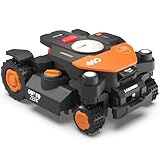
1. Mammotion LUBA 3 AWD 3000: Best for mid-size sloped yards
- Mammotion LUBA 3 AWD 3000 robot lawn mower
- All-wheel drive · perimeter-wire-free · 0.75 acre listed coverage
- 360-degree LiDAR · NetRTK · AI vision navigation
- Cleaning stand offered as a separate bundle option
Best for: a quarter to three-quarter acre property where the slopes are the problem, not the lawn size. The LiDAR plus NetRTK plus vision combination is meant to keep positioning stable when a single sensor loses signal.
Skip if: your slope sits under dense tree cover, or you want a low-cost entry; this is the premium end of the list.
Pros:
- AWD layout built for climbing and for holding line across a slope
- Three navigation sources instead of one
- No perimeter wire to bury on a bank
Cons:
- Higher entry cost than the mini and mid-range options
- RTK-based mapping still depends on an open view of the sky for the antenna
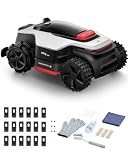
2. Mammotion LUBA mini 2 AWD 1500H: Best small yard with a steep bank
- Mammotion LUBA mini 2 AWD 1500H (2026 listing)
- AWD · 80% slope · 0.37 acre listed coverage
- 360-degree LiDAR · dual-camera AI vision
- Compact body for narrow side-yard paths
Best for: a smaller lawn or a terraced garden where the legs of the route are short and steep. The compact size helps in tight patio-side passages where a big machine would struggle to turn.
Skip if: your property is a half acre or more; the listed coverage is the limit to respect.
Pros:
- Carries the same 80% listing as its larger siblings in a smaller package
- Easier to lift and move than the full-size AWD machines
- Suits irregular small lawns
Cons:
- Small coverage ceiling; a big hill plus a big lawn needs a larger model
- Smaller body means less margin on rough, rutted ground
3. DREAME A3 AWD 2000: Best for hilly lots that need quick recharges
- DREAME A3 AWD 2000 LiDAR robot lawn mower
- AWD · rated for 38.7-degree (80%) slopes in the listing
- 45-minute fast charge stated on the listing
- Bundles with cleaning and blade sets are offered
Best for: hilly yards where the mower has to get back to work quickly after docking. A short charge time helps when a steep property takes the battery down faster than a flat one.
Skip if: you need a verified coverage figure for a larger yard; check the listing for the current area rating before you commit.
Pros:
- Explicit 80% slope listing with AWD
- Fast charging reduces downtime on slow, steep jobs
- Wire-free LiDAR and vision mapping
Cons:
- Several near-identical bundle listings; compare what is actually in the box
- Mid-range area rating, so not for very large lawns
4. DREAME A3 AWD Pro 3500: Best for bigger hills without RTK
- DREAME LiDAR A3 AWD Pro 3500 wire-free robot mower
- 4WD · 38.7-degree (80%) slope listing · 0.87 acre listed coverage
- 3D LiDAR · dual AI vision · no RTK station
- Dual-disc cutting, 15.8 in width
Best for: larger sloped lawns, and for yards where an RTK antenna has a poor sky view. Navigation here leans on LiDAR and cameras, so tree canopy matters less than on an RTK-only machine.
Skip if: your lawn is under a quarter acre; the extra capacity is wasted.
Pros:
- Larger listed coverage with the 80% slope rating
- No RTK base station to site and power
- Dual-disc cutting deck for a wider swath
Cons:
- Vision navigation can be affected by low sun, deep shade or heavy rain
- Premium positioning
5. roborock RockMow X130H: Best RTK-based 4WD
- roborock RockMow X130H wire-free 4WD robot mower
- 4WD · full-band RTK · quad-vision navigation
- Auto mapping; check the listing for slope and coverage figures
Best for: open, sunny slopes where RTK locks cleanly, and for buyers who want a full-band satellite receiver rather than a camera-first system.
Skip if: you need a confirmed slope rating before purchase and cannot find one on the listing; ask the maker.
Pros:
- 4WD drive layout with satellite positioning
- Four cameras give obstacle awareness at close range
- No boundary wire to maintain
Cons:
- RTK performance depends on open sky and a stable antenna position
- Slope rating not stated in the listing text we could read
6. MOVA LiDAX Ultra 3000 AWD: Best for yards with separate zones
- MOVA LiDAX Ultra 3000 AWD robot lawn mower
- AWD · RTK-free wire-free navigation · up to 0.75 acre listed
- Dual maps · 360-degree 3D LiDAR · AI dual vision
Best for: properties with a front lawn and a back lawn separated by a slope or path, since the listing highlights dual maps.
Skip if: you want a maker-quoted slope number in the headline; check the full listing and the MOVA site.
Pros:
- No RTK station needed
- Dual maps for two separate lawn areas
- LiDAR plus vision gives two navigation inputs
Cons:
- Newer brand in this category, so long-term parts and support history is shorter
- Slope rating should be confirmed before buying for a very steep bank
7. Husqvarna Automower 435X AWD: Best wired option for steep, complex lawns
- Husqvarna Automower 435X AWD robotic lawn mower
- All-wheel drive · boundary-wire installation like the other X-line Automowers
- Check the Husqvarna page for current slope and area ratings
Best for: lawns where satellite or vision systems struggle, such as heavy tree cover, shaded banks or narrow passages. A wire loop does not care about sky view or light.
Skip if: you do not want to lay and maintain a boundary wire, or if you want a quick wire-free setup.
Pros:
- AWD from a long-established robot mower maker
- Wire navigation works under trees and in deep shade
- Strong dealer and parts network in many regions
Cons:
- Installation takes time, especially on a slope where wire must be pegged securely
- Exact slope and area figures should be confirmed on the maker page
Also consider
- Husqvarna 410iQ: half-acre wire-free model with a 45% slope listed. Fine for moderate hills, not for a bank near 70%.
- roborock RockMow X115H: wire-free 4WD with full-band RTK and quad-vision navigation; confirm slope and area figures on the listing.
- WORX Landroid Vision Cloud: wire-free, 1/4 acre listed; check the listing for slope rating before choosing it for a hill.
- ECOVACS GOAT O1000: RTK plus vision navigation for up to a quarter acre; check the slope rating on the listing.
Robot mower buying guide for steep slopes
Choose drive layout first
On a hill, traction decides everything. A 2WD robot pushes with two wheels and steers on the rest; when the grass is damp or the soil is loose, the drive wheels spin and the machine digs a rut. AWD and 4WD machines share the load across all four wheels, and the better ones use large lugged tires. If your steepest section is above roughly 35% (19.3 degrees), treat AWD as a requirement rather than a luxury.
Leave a margin under the maker rating
A practical rule: if your steepest spot is 60% (31 degrees), a machine rated for 80% leaves comfortable headroom. If your steepest spot is 78%, even a machine rated for 80% will be near its limit in wet weather. The listing figure is the climbing maximum on a firm, dry, short grass surface. Wet blades of grass act like a lubricant under the tires.
Match navigation to your yard
| Navigation | Works well when | Struggles when |
|---|---|---|
| RTK satellite | Open sky over the whole lawn | Tall trees, house walls close to the lawn edge |
| LiDAR plus vision | Mixed shade, no antenna wanted | Heavy rain, dusk, strong low sun |
| Boundary wire | Trees, shade, narrow passages | You do not want to install or repair wire |
Plan the charging station
Put the dock on the flattest spot you have, with a straight approach of at least a few feet. Many slope problems are really docking problems: the robot arrives at a slight angle on a hillside, slips, and cannot align. Check the maker’s guidance on the approach length and level pad.
Think about the lawn edges and cutting height
Slopes often have uneven edges where the mower can scalp the grass. Start with a higher cutting height for the first few weeks, then lower it in steps. A taller lawn also gives the wheels more grip than a very short one.
Budget for service
Robot mowers on slopes wear their wheels and blades faster than on flat ground. Keep a pack of spare blades, check the wheel tread each month, and clean the underside regularly. The listings for these models often come with cleaning kits or blade sets; compare what is in the box.
Check connectivity and anti-theft
Several of these machines offer 4G or Wi-Fi. A sloped yard can be far from the router, so check whether the mower works without a Wi-Fi signal at the lawn itself, and whether it has a PIN or anti-theft lock.
Worked example: matching a hillside yard to a model
Take a back garden of about 0.4 acre that drops from the patio to a fence. You measure three spots with a level and a tape: the top terrace drops 2 ft over 10 ft (20%), the middle bank drops 5.5 ft over 10 ft (55%, about 28.8 degrees), and a short ramp beside the steps drops 7 ft over 10 ft (70%, 35 degrees). The ramp is only 6 ft long, but it is the section that decides which machine you can use.
| Section | Measured slope | Degrees | What it demands |
|---|---|---|---|
| Top terrace | 20% | 11.3 | Any robot mower |
| Middle bank | 55% | 28.8 | AWD or 4WD with good tire tread |
| Ramp by the steps | 70% | 35.0 | A model rated 80% or better, or leave it to a trimmer |
The sensible shortlist is an 80%-rated AWD machine with enough area rating for 0.4 acre: the Mammotion LUBA 3 AWD 3000, the DREAME A3 AWD Pro 3500 or the MOVA LiDAX Ultra 3000 AWD all list at least 0.75 acre, so the lawn size sits well inside the ceiling. The LUBA mini 2 AWD 1500H lists 0.37 acre, which is slightly under this yard, so it would need a smaller lawn. If the ramp is the only section near 70%, you can also draw a no-go zone around it in the app and trim that strip by hand, which keeps the robot working inside its comfortable range.
Slope mowing realities that listings do not mention
- Wet grass is the real limit. A rating given for dry, short grass can drop sharply after rain or heavy dew. Schedule mowing for the afternoon and use the rain-delay setting so the robot waits until the surface dries.
- Wheels wear the soil as well as the tire. Repeated passes along the same path polish a groove into the slope. Many apps let you vary the mowing direction or path offset; use it so wheel tracks do not stack up.
- Turning at the top is where robots slip. A turn on a crest puts weight on one side. Leave a flat run-off of a few feet at the top and bottom of the bank where you can.
- Clippings build up. A robot cuts very small pieces that fall back into the lawn, but a slope can collect them in the downhill ruts. Cleaning the wheels and underside once or twice a month prevents clogged treads.
- Edges need a human. Even the best AWD robot leaves a thin strip beside walls, steps and retaining blocks. Plan a battery trimmer pass every few weeks.
Frequently Asked Questions
Can a robot lawn mower handle an 80% slope?
Some AWD and 4WD models are rated for it. The Mammotion LUBA and Dreame A3 AWD families both advertise an 80% slope, about 38.7 degrees. That figure is a maximum, so expect better results on dry, short grass and be careful with wet or loose ground.
Why do robotic lawn mowers get stuck on hills?
The usual causes are wheel slip on wet grass, a turn at the top of a slope where one wheel loses grip, and loose soil that the drive wheels dig into. Choosing AWD, using a taller cutting height and keeping the wheels clean all reduce the problem.
How do I stop a robot lawn mower slipping on slopes?
Raise the cutting height, schedule mowing for dry periods, clean the wheel treads, and check whether the maker sells spiked or deeper-tread wheel options for your model. Avoid sending the robot across the steepest bank at an angle; mapping the route to climb straight up and down is usually steadier.
Do all-wheel-drive robot mowers need a boundary wire?
No. Many AWD models are wire-free and use RTK, LiDAR or vision. The Husqvarna Automower 435X AWD is the wire-based option in this list. Wire is still a good choice under trees or in shade.
Is a 2WD robot mower enough for a gentle slope?
For slopes up to about 20% to 30%, many 2WD models cope, as long as the lawn is dry. Above that, look at AWD. Check the maker’s rating, and keep a margin.
Should I get a remote-control tracked mower instead?
If the slope is too steep for any wheeled robot and you are willing to operate it yourself, a tracked remote-control mower may suit better. A robot is the right choice when you want automatic, scheduled mowing.
Which One Should You Buy?
For a small, steep yard, the Mammotion LUBA mini 2 AWD 1500H is the most targeted pick. For a half-acre or more with hills, the DREAME A3 AWD Pro 3500 or the Mammotion LUBA 3 AWD 3000 are the strongest-fit machines on the list. Choose the roborock RockMow X130H when your lawn has a wide-open sky view, the MOVA LiDAX Ultra 3000 AWD when you have separate lawn zones, and the Husqvarna Automower 435X AWD when trees or shade rule out satellite and vision navigation. Whichever you pick, confirm the slope and area rating on the maker page for your steepest spot before ordering.
Sources
- Mammotion product pages (LUBA 2 AWD, LUBA 3 AWD, LUBA mini 2 AWD)
- Dreame yard care product pages (A3 AWD series)
- roborock RockMow product pages
- Husqvarna Automower product pages
- Retail product listing specifications for each model named above
Last updated: November 2026
More from Amazon
Programs that pair well with the guide above. Offers and eligibility are set by Amazon and may change.
Collect the home and kitchen items you want in one registry that guests can shop from.
Create a wedding registrySet up recurring deliveries of everyday items on eligible products. Terms and savings are set by Amazon.
Explore Subscribe & SaveFree shipping on eligible items, Prime Video and more. Eligible new members can start with a free trial.
Start a Prime free trialAudiobooks and podcasts to listen to on the go. Eligible new members can start with a free trial.
Try Audible freeAs an Amazon Associate we earn from qualifying purchases.




Write Your Review
No reviews yet. Be the first to share your experience!