

The best LED face masks for most people are the Omnilux Contour Face for a simple red-and-near-infrared routine, the CurrentBody LED Face Mask Series 2 for deeper wavelength coverage and a flexible fit, and the Dr Dennis Gross SpectraLite FaceWare Pro if a three-minute treatment matters more than comfort.
LED masks are not interchangeable light panels: wavelength, irradiance, coverage, fit, and treatment discipline all affect whether a device is practical for your skincare goal. The figures below are manufacturer-published specifications or commonly stated product specifications; models and bundles can change, so check the current manual before buying.
Our top picks
 Shark CryoGlow LED Face Mask
- CryoGlow is an at-home LED face mask combining…
- MOST AWARDED LED MASK IN THE U.S.*: Real…
- Developed by Shark Beauty alongside optical light experts…
 Shark CryoGlow LED Face Mask
- CryoGlow is an at-home LED face mask combining…
- MOST AWARDED LED MASK IN THE U.S.*: Real…
- Developed by Shark Beauty alongside optical light experts…
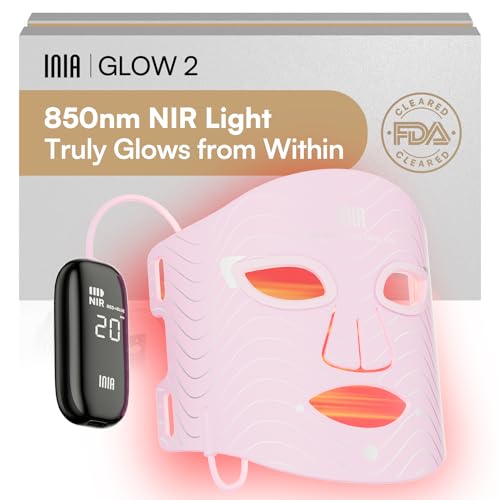 INIA Red Light Therapy Mask for Face
- Dual-Wavelength Revitalization: The INIA Red Light Mask combines…
- 4 Light Modes, Fully Customizable Routines: Personalize your…
- Visible Results with 220 High-Energy LED Chips: Step…
| Product | Key specs | |
|---|---|---|
| Shark CryoGlow LED Face Mask | CryoGlow is an at-home LED face mask combining… MOST AWARDED LED MASK IN THE U.S.*: Real… Developed by Shark Beauty alongside optical light experts… | Check price |
| Shark CryoGlow LED Face Mask | CryoGlow is an at-home LED face mask combining… MOST AWARDED LED MASK IN THE U.S.*: Real… Developed by Shark Beauty alongside optical light experts… | Check price |
| INIA Red Light Therapy Mask for Face | Dual-Wavelength Revitalization: The INIA Red Light Mask combines… 4 Light Modes, Fully Customizable Routines: Personalize your… Visible Results with 220 High-Energy LED Chips: Step… | Check price |
 iRestore Red Light Therapy for Face | The Most Powerful Red Light Mask for Visible… Advanced Triple-Wavelength Technology: Powered by 3 scientifically backed… Designed for Comfort and Multitasking: Lightweight yet sturdy,… | Check price |
As an Amazon Associate we earn from qualifying purchases at no extra cost to you.
Best LED face masks by situation
| Best for | Recommended type or model | Why it fits | Main compromise |
|---|---|---|---|
| First-time buyer focused on fine lines | Omnilux Contour Face | 633 nm red and 830 nm near-infrared; 10-minute sessions; flexible silicone design | Usually requires more frequent use than a three-minute mask |
| Widest wavelength coverage | CurrentBody LED Face Mask Series 2 | 633 nm, 830 nm, and 1072 nm; approximately 30 mW/cm² irradiance; 10-minute sessions | Higher price than basic red-light masks |
| Shortest routine | Dr Dennis Gross SpectraLite FaceWare Pro | Three-minute preset combining red, near-infrared, and blue light | Rigid shell can feel less adaptable to different face shapes |
| Redness-prone or easily irritated skin | Red and near-infrared-only mask | Avoids adding blue light unless it has a specific place in your routine | Does not offer a blue-light mode |
| Occasional use or shared household | Rechargeable mask with removable controller | No need to remain beside a wall outlet; easier to wipe and store | More parts can be misplaced or require charging |
How the wavelengths differ
Red light: usually around red 630–660 nm
Red light is the most common starting point for an at-home facial mask. It is selected for general cosmetic skincare routines, particularly the appearance of uneven tone, dullness, and fine lines. A mask using 633 nm is not automatically better than one using 660 nm; output power, distance from the skin, coverage, and consistent use matter just as much.
Near-infrared light: commonly 810–850 nm
Near-infrared light is less visible and is included in many masks alongside red LEDs. Omnilux Contour uses 830 nm, while CurrentBody Series 2 combines 830 nm with 1072 nm. These wavelengths can make a mask more versatile, but additional wavelengths do not guarantee superior visible results. Look for measured irradiance and a clear treatment schedule rather than counting wavelengths alone.
Blue light: often around 415 nm
Blue light is included in combination masks such as the Dr Dennis Gross FaceWare Pro. It is generally chosen for blemish-focused routines rather than broad anti-aging use. Blue light can be more irritating or drying for some people, and people taking photosensitizing medicines or managing a light-sensitive condition should ask a healthcare professional before using it.
Head-to-head: Omnilux Contour versus CurrentBody Series 2
These are the closest choices for someone who wants a red-and-near-infrared mask without a blue-light program. Omnilux keeps the specification relatively focused: 633 nm red light and 830 nm near-infrared light, with a typical 10-minute session and approximately 30 mW/cm² irradiance. Its soft silicone construction conforms well to many faces and folds for storage.
CurrentBody Series 2 adds 1072 nm to 633 nm and 830 nm. It also lists approximately 30 mW/cm² irradiance and a 10-minute treatment. The extra wavelength may appeal to buyers who want the broadest documented spectrum, but it should not outweigh fit. A mask that presses against the nose, leaves the jaw uncovered, or slides away from the cheeks will be less useful in everyday ownership.
Choose Omnilux when simplicity, a soft fit, and a focused routine are priorities. Choose CurrentBody when the additional 1072 nm specification, flexible coverage, and included rechargeable control system justify its generally higher market price.
When the three-minute mask wins
The Dr Dennis Gross SpectraLite FaceWare Pro uses a rigid face-shaped shell and a three-minute preset. Its commonly listed modes include red light around 630 nm, near-infrared around 880 nm, and blue light around 415 nm. That short session is valuable for people who already have a multi-step skincare routine and know they will skip a 10-minute treatment.
The trade-off is fit. Rigid masks can hold a repeatable distance from the face, but they are less forgiving of a narrow nose, prominent cheekbones, or a different-than-average jawline. Inspect the eye openings and strap adjustment before purchasing. If the mask leaves bright LEDs pointed directly toward the eyes, discontinue use and consult the instructions or the manufacturer.
What specifications actually matter
- Irradiance: This is the light power delivered to the skin, commonly stated in milliwatts per square centimetre. Compare it with the treatment time; a high number is not automatically better.
- Energy dose: A rough calculation is irradiance multiplied by time. At 30 mW/cm² for 10 minutes, the nominal dose is 18 J/cm²: 0.03 W/cm² × 600 seconds. Real exposure can vary with curvature, gaps, and automatic dimming.
- Coverage: Check whether LEDs reach the temples, upper lip, jaw, and sides of the neck. A mask can have many LEDs but still leave edge areas untreated.
- Eye protection: Look for molded eye shields, recessed LEDs, or clearly defined safety instructions. Do not assume that closed eyelids are sufficient protection, particularly with blue-light modes.
- Fit: Adjustable straps, flexible silicone, and a controller that does not pull the mask sideways improve adherence. A close fit also reduces light leakage.
- Charging: A rechargeable controller is convenient, but check whether it uses a standard USB cable, how long a charge lasts, and whether the mask can operate while plugged in.
How to choose by routine and budget
| Your priority | Useful specification | Practical choice |
|---|---|---|
| Lowest purchase cost | Red-only or red plus near-infrared; transparent irradiance data; no unnecessary app | Basic flexible red-light mask, often roughly $150–$300 |
| Balanced long-term ownership | About 30 mW/cm², 10-minute timer, rechargeable controller, wipe-clean silicone | Omnilux Contour or a comparable red/NIR model, often roughly $300–$450 |
| Minimum time per session | Three- to five-minute automatic program | Dr Dennis Gross FaceWare Pro or a comparable short-session model |
| Multiple skincare goals | Independent red, near-infrared, and blue settings with clear safety guidance | Combination mask, generally roughly $400–$600 |
For example, a $350 mask used three times weekly for six months costs about $4.49 per use: 26 weeks × 3 sessions equals 78 uses, and $350 divided by 78 is approximately $4.49. If a $500 mask remains in a drawer because its 10-minute routine is inconvenient, the cheaper device has the better real-world value.
How to use and maintain an LED mask
- Cleanse and dry the skin. Use the mask on bare skin unless the manual specifically permits a compatible product underneath.
- Inspect the cable, eye openings, and LEDs before each session.
- Secure the mask without overtightening. The light should sit evenly across the face rather than digging into the nose or cheeks.
- Use the automatic timer and follow the manufacturer’s weekly schedule. More time is not necessarily more effective and may increase irritation.
- Wipe the skin-contact surface with a soft, slightly damp cloth after use. Follow the manual for disinfectants; harsh solvents can cloud plastic, weaken silicone, or damage printed markings.
- Store the mask flat or in its supplied case, with the cable loosely coiled. Repeated sharp folding is a common cause of cable and silicone wear.
The parts most likely to wear first are the head strap, charging lead, controller connector, and silicone around the nose. Replacement straps and cables may be available, but LED panels and batteries are usually not user-serviceable. Avoid using a mask while it is wet, sleeping in it, or charging it beneath bedding.
Safety and realistic expectations
LED masks are cosmetic devices, not substitutes for diagnosis or treatment. Results depend on the device, skin, routine, and consistency, and visible changes may be gradual. Stop if you experience persistent burning, marked swelling, eye discomfort, or a rash. Ask a dermatologist or other qualified healthcare professional before use if you have a photosensitive condition, take photosensitizing medication, have an eye disorder, are pregnant, or are considering blue light for a specific skin concern.
For most buyers, the final decision is simple: choose a comfortable red-and-near-infrared mask if your main goal is a manageable general skincare routine; choose a blue-light combination model only when that mode is relevant and medically appropriate; and choose the shortest session you will actually complete rather than the mask with the most impressive-looking specification sheet.




Write Your Review
No reviews yet. Be the first to share your experience!