

Key takeaways
- Compare five outdoor pond thermometers for fish ponds by temperature range, wireless reach and reading style, from a submersible unit to a WiFi float.
A pond thermometer answers a narrower question than most buyers expect: not how warm the water feels at the surface on an afternoon, but what temperature the fish are living in at depth. A floating analog dial reads the top few inches, a submersible unit reads where koi winter, and a wireless sensor lets the number be checked from the kitchen instead of a January walk to the pond edge. The wrong choice is not a broken thermometer; it is a reading taken from the wrong layer of water.
This guide serves koi keepers, goldfish pond owners and anyone wintering fish in a water garden who needs to know when to stop feeding and when to watch for a freeze. It covers a submersible unit, two floating analog thermometers, a wireless float with an indoor receiver and a WiFi model with a console. Every model below was chosen from the names and specifications on its Amazon page, with temperature range, cord length and wireless reach checked against the listing.
Quick Picks
As an Amazon Associate we earn from qualifying purchases.
| Product | Best for | Key spec from title |
|---|---|---|
| Aquascape Submersible Pond Thermometer 74000 | Reading water temperature at depth | Submersible pond thermometer |
| Laguna Floating Thermometer | Quick daily checks at the pond edge | Celsius and Fahrenheit scale |
| INKBIRD IBS-P01R Wireless Floating Thermometer | Checking pond temperature from indoors | Wireless floating pool thermometer |
| Ambient Weather WS-50-F007PF WiFi Smart Floating Thermometer | Remote monitoring with alerts | WiFi smart floating thermometer |
| Pentair R141036 Tube Thermometer | A simple tethered reading in a small pond | 3-feet cord |
How to Choose
Read the Depth Your Fish Actually Use
Pond water stratifies, so the surface and the bottom can sit several degrees apart, and a reading from the wrong layer misleads every decision that follows. In summer the top inches warm fastest under direct sun, while in winter the deepest water stays the most stable and is where koi rest. A floating thermometer measures the upper layer, which suits feeding decisions in shallow goldfish ponds, but a deep koi pond needs a submersible unit or a weighted sensor that reaches the zone the fish occupy. Match the thermometer to the depth that matters, not to the depth that is easiest to reach.
Analog Dials, Digital Floats or Wireless Sensors
The reading style decides how often the temperature actually gets checked, and that habit matters more than a fraction of a degree of accuracy. An analog dial needs a walk to the pond edge and a clear view of the scale, which is fine for owners who already visit daily. A digital float adds a backlit-style screen that reads from a few steps away. A wireless sensor with an indoor receiver or a WiFi console moves the reading inside the house, so cold snaps get noticed on a January morning without going outside. Choose the style that fits the checking routine, because a thermometer that never gets read protects nothing.
Temperature Range and Cold-Climate Margins
A pond thermometer earns its keep at the extremes, so the published range deserves a close look before anything else. Koi and goldfish slow down sharply as water drops toward freezing, and feeding must stop well before the surface ices over, so a unit that reads below freezing gives warning that a narrow-range dial cannot. The Aquascape submersible unit reads down to 20 degrees below zero Fahrenheit, while the Laguna and Ambient models start at 30 and 32 degrees respectively, which is adequate for mild winters but thin for hard freezes. Check the low end of the range against the coldest nights the pond will face.
Tethers, Cords and Staying Put
A thermometer that drifts into the skimmer, tangles in a waterfall or disappears under a lily pad is a thermometer that stops working, so anchoring is a real buying criterion rather than a detail. Floating models need a tether string or anchoring cord long enough to tie off at the pond edge, and the cord should be checked for wear each season because sun and water degrade it. Tube thermometers hang from a cord into the water and suit small ponds where the unit can be retrieved by hand. Wireless floats need a clear path to the receiver, since walls and foliage shorten the stated range.
The 5 Best Options
Aquascape Submersible Pond Thermometer 74000

The Aquascape 74000 is the pick for owners who want the temperature where the fish actually spend winter, rather than a surface reading that flatters a sunny afternoon. It sinks below the surface on a nylon tether, so the reading comes from depth, and the dual Fahrenheit and Celsius scale reads from 20 degrees below zero to 120 degrees Fahrenheit. That wide span covers hard freezes as well as summer heat, and the simple sealed design has no batteries or electronics to fail in the cold. It suits koi ponds where the wintering depth is the number that matters.
Specs
- Model: 74000
- Type: Submersible pond thermometer
- Temperature range: -20 to 120 degrees Fahrenheit (-28 to 48 degrees Celsius)
- Scale: Dual Fahrenheit and Celsius
- Tether: Included nylon string for anchoring
- Power: None required
- Dimensions: not stated
Best for: Koi ponds where the temperature at wintering depth decides feeding and freeze protection.
Watch out for: The reading happens at the pond edge, so confirm the tether reaches a spot where the unit can be pulled up and read without wading in.
Laguna Floating Thermometer

The Laguna floating thermometer is the straightforward choice for a daily glance at the pond edge, with a large viewing window and a dual scale that reads in both Fahrenheit and Celsius. Its range runs from 30 to 120 degrees Fahrenheit, which covers the normal keeping season and mild frosts, and the yellow casing stays easy to spot among plants. A feeding zone indicator printed on the dial gives a quick cue for when food is appropriate, and the included anchoring cord keeps the float from drifting into the skimmer. No batteries or setup are involved, so it works through power cuts and winter storms alike.
Specs
- Model: PT945
- Type: Floating analog thermometer
- Temperature range: 30 to 120 degrees Fahrenheit (0 to 50 degrees Celsius)
- Scale: Dual Fahrenheit and Celsius with feeding zone indicator
- Tether: Included anchoring cord
- Housing: Light all-plastic construction, yellow casing
- Power: None required
Best for: Goldfish ponds where a fast daily reading at the edge is enough and simplicity matters most.
Watch out for: The 30-degree low end stops short of hard-freeze readings, so pair it with a wider-range unit if winters regularly drop well below freezing.
INKBIRD IBS-P01R Wireless Floating Thermometer

The INKBIRD IBS-P01R suits owners who want the pond temperature without a daily trip to the water, because the floating sensor sends its reading to an indoor receiver up to 300 feet away. The sensor reads from 40 degrees below zero to 158 degrees Fahrenheit, a span wide enough for the coldest nights and the hottest afternoons, and the receiver also shows indoor temperature and humidity. The housing is rated IPX7 waterproof, and the display switches between Fahrenheit and Celsius. It is the practical middle ground between a basic float and a full WiFi system.
Specs
- Model: IBS-P01R, 2nd generation
- Type: Wireless floating thermometer with indoor receiver
- Temperature range: -40 to 158 degrees Fahrenheit (-40 to 70 degrees Celsius)
- Wireless range: Up to 300 feet
- Waterproof rating: IPX7
- Display: Digital, Fahrenheit and Celsius switchable
- Power: Batteries, not included
- Gateway compatibility: IBS-M1 and IBS-M2
Best for: Ponds within sight of the house where the temperature should be checked from indoors each morning.
Watch out for: Walls, foliage and patio glass shorten the wireless range, so test the receiver placement before relying on the reading during a cold snap.
Ambient Weather WS-50-F007PF WiFi Smart Floating Thermometer

The Ambient Weather WS-50-F007PF is the pick for owners who want the pond temperature on a console indoors with history and alerts, rather than a single number glimpsed at the edge. The floating sensor reports water temperature from 32 to 140 degrees Fahrenheit to a display console over a wireless link rated at 300 feet in open line of sight and about 100 feet under most conditions. The console tracks minimum and maximum readings, supports calibration against a known reference, and can monitor up to eight channels. It fits larger properties where the pond sits far from the back door.
Specs
- Model: WS-50-F007PF
- Type: WiFi smart floating thermometer with display console
- Water temperature range: 32 to 140 degrees Fahrenheit
- Indoor temperature range: 32 to 140 degrees Fahrenheit
- Wireless range: 300 feet line of sight, about 100 feet under most conditions
- Channels: Up to 8 selectable
- Console features: Minimum and maximum tracking, calibration support
- Alerts: Remote monitoring and alerts via console
Best for: Larger ponds set well away from the house where remote monitoring and temperature history matter.
Watch out for: The 32-degree low end means the sensor stops reporting just as water nears freezing, so keep a wider-range thermometer on hand for the coldest weeks.
Pentair R141036 Tube Thermometer
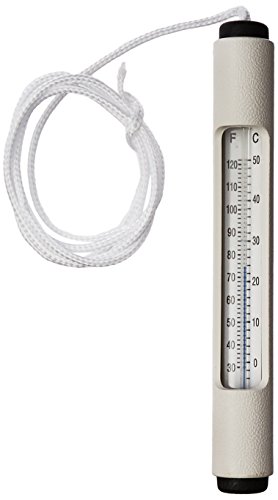
The Pentair R141036 is the simplest tethered option here, a tube thermometer in a protective ABS case that hangs from a 3-foot cord into the water. It reads in both Fahrenheit and Celsius, and the tube design places the sensing column below the surface rather than floating on top, which gives a steadier reading than a surface float in a small pond. The cord makes retrieval easy by hand, and the ABS case guards the tube against bumps from fish and nets. It is a plain, durable tool for owners who want one reliable number without electronics.
Specs
- Model: R141036, model 127
- Type: Tube thermometer with ABS case
- Cord: 3 feet
- Scale: Fahrenheit and Celsius
- Case: ABS
- Temperature range: not stated
- Power: None required
Best for: Small preformed ponds and stock tanks where a tethered tube can be dipped and retrieved by hand.
Watch out for: The published temperature range is not stated on the listing, so confirm the scale covers the coldest water expected before relying on it through winter.
Which One Fits Your Situation
A Small Goldfish Pond Checked Every Day
The Laguna floating thermometer fits here, because a daily walk to the edge is already part of the routine and the large dial with its feeding zone indicator answers the only question that matters most days. The Aquascape submersible unit is the backup for cold snaps, since its wider range keeps reporting when the Laguna stops at 30 degrees. Keep both tethered at opposite ends of the pond.
A Deep Koi Pond Where Winter Survival Matters
The Aquascape 74000 is the core pick, because it reads at the depth where koi rest through winter and its range reaches 20 degrees below zero. Add the INKBIRD IBS-P01R so the number can be checked from indoors each morning without disturbing the fish, and use its wide range to catch sudden drops. The combination covers both depth and convenience.
A Pond Far From the House
The Ambient Weather WS-50-F007PF fits this situation, since its console sits indoors and its wireless link is rated for 300 feet in open line of sight. The console history shows whether the water is trending down over several cold nights, which a single spot reading cannot. Place the console where it is seen every morning, and confirm the link holds through trees and walls.
A First Pond on a Tight Budget
The Laguna floating thermometer and the Pentair tube thermometer are the budget pairing, because neither needs batteries, apps or a receiver, and both read in Fahrenheit and Celsius. The Laguna floats where it can be seen at a glance, while the Pentair hangs from its cord for a steadier reading below the surface. Together they cost little and cover the whole keeping season.
Common Mistakes
- Reading the surface on a sunny afternoon and treating it as the temperature the fish experience at depth.
- Buying a thermometer whose scale stops at 30 or 32 degrees, then having no reading during the coldest nights.
- Letting a floating thermometer drift into the skimmer or waterfall instead of anchoring it with its tether.
- Placing a wireless receiver behind thick walls or dense foliage and trusting a range figure measured in open air.
- Assuming a pool thermometer and a pond thermometer are interchangeable without checking whether the listing covers pond use and depth reading.
Frequently Asked Questions
What temperature should pond water be before I stop feeding koi?
Most keepers stop feeding once the water holds near 50 degrees Fahrenheit, because digestion slows sharply in cold water and uneaten food fouls the pond. A thermometer that reads accurately through autumn shows when that threshold is crossed, rather than relying on the calendar. Check the reading at depth in the morning, since surface water warms and cools faster than the layer the fish occupy.
Can I use a pool thermometer in a fish pond?
A pool thermometer can work in a pond only when its listing covers pond use and its reading depth suits the fish. Many pool floats measure the top few inches, which misleads feeding and winter decisions in a deeper pond. A submersible pond thermometer or a tethered tube reads where the fish live, so confirm the intended use and the measurement depth before substituting one for the other.
How deep should a pond thermometer sit?
The sensor should sit where the fish spend most of their time, usually below the surface layer and above the bottom sludge. In a deep koi pond that is often a foot or more down, where the temperature stays stable through hot afternoons and cold nights. A floating dial reads the surface by design, so use a submersible or tethered model when the deep reading guides decisions.
Do wireless pond thermometers work through winter?
Wireless models keep working through winter as long as the sensor stays within range of the receiver and its batteries hold up in the cold. Cold shortens battery life, so fresh batteries before the first freeze are worth the effort. The sensor range also matters: a unit that stops at 32 degrees cannot report the coldest nights, so a wider-range sensor is the safer winter choice.
More from Amazon
Programs that pair well with the guide above. Offers and eligibility are set by Amazon and may change.
Collect the home and kitchen items you want in one registry that guests can shop from.
Create a wedding registrySet up recurring deliveries of everyday items on eligible products. Terms and savings are set by Amazon.
Explore Subscribe & SaveFree shipping on eligible items, Prime Video and more. Eligible new members can start with a free trial.
Start a Prime free trialAudiobooks and podcasts to listen to on the go. Eligible new members can start with a free trial.
Try Audible freeAs an Amazon Associate we earn from qualifying purchases.


Write Your Review
No reviews yet. Be the first to share your experience!