
Our Short List of 3

- Best for: A homeowner who wants instant rain and freeze shutoff with no wire run.
- Quick Response shutoff when rain begins
- Freeze shutoff at 37 degrees Fahrenheit
- Wireless design with built-in battery
- Wireless range up to 800 feet line of sight
- Best for: A yard where both the rain amount and the freeze point need adjusting.
- Rainfall settings adjustable from 1/8 to 1/2 inch
- Freeze settings adjustable from 33 to 41 degrees Fahrenheit
- Icon-driven controller interface
- Wireless sensor with 1 controller interface and 1 sensor

- Best for: A wired install where the controller sits within 25 feet of open sky.
- Rainfall trigger adjustable from 1/8 to 3/4 inch
- Adjustable vent ring controls drying time
- Includes 25 feet of UV-resistant extension wire
- UV-resistant polymer body with aluminum latching bracket
All 5 Picks at a Glance
| Product | Specs | Action |
|---|---|---|
| Hunter Rain-Clik WRCLIK Wireless Rain/Freeze Sensor |
| Check price on Amazon |
| Rain Bird Wireless Rain and Freeze Sensor System |
| Check price on Amazon |
| Rain Bird CPRSDBEX Wired Rain Sensor |
| Check price on Amazon |
 Hunter Wired Mini-Clik Rain Sensor |
| Check price on Amazon |
 Orbit Wireless Rain and Freeze Sensor |
| Check price on Amazon |
Key takeaways
- Compare the best rain sensors for sprinklers, from wired dial models to wireless rain-and-freeze kits, and stop watering when the rain did the job.
A sprinkler controller on a fixed schedule waters whether it rained or not, and that habit shows up twice: in soggy turf and on the water bill. A rain sensor breaks the habit by watching the weather for you, opening the sensor circuit when rain falls and letting the schedule resume once the discs dry. The real decision is not whether to add one, but which kind fits the controller already on the wall — wired or wireless, rain-only or rain-and-freeze, and how much rainfall should trigger the pause.
This guide serves homeowners with an in-ground sprinkler system who want automatic rain shutoff without replacing the controller, renters and DIY installers adding a first sensor, and anyone in a freeze-prone climate who also needs cold-weather shutoff. The five sensors below were chosen from the names and specs on their Amazon pages, covering wired dial models, wireless kits with freeze sensing, and one compact wired option for tight mounting spots.
Quick Picks
As an Amazon Associate we earn from qualifying purchases.
| Product | Best for | Key spec from title |
|---|---|---|
| Hunter Rain-Clik WRCLIK | Wireless rain-and-freeze shutoff without trenching | Freeze shutoff |
| Rain Bird Wireless Rain and Freeze Sensor System | Adjustable rain and freeze thresholds | 1 controller interface and 1 sensor |
| Rain Bird CPRSDBEX | Dial-adjustable wired shutoff | Mounting bracket and wire |
| Hunter Wired Mini-Clik | Compact wired sensor for tight spots | Wired sensor |
| Orbit Wireless Rain and Freeze Sensor | Wireless placement on Orbit and major-brand controllers | Wireless rain-and-freeze sensing |
How to Choose
Wired or wireless
A wired sensor connects to the controller with a cable, so the run between the two decides whether the install is easy or miserable. Most wired models in this guide ship with 25 feet of wire, which suits a controller mounted on the garage wall with a gutter or fence post nearby. When the controller lives deep inside the house or the only open sky sits across the yard, a wireless sensor earns its keep: the transmitter goes where rain falls freely and the receiver wires into the controller indoors. Wireless models need a battery or solar charging, so weigh a wire run against a battery you must check once a season.
Rain-only or rain-and-freeze
A rain-only sensor pauses watering after a set amount of rainfall, and that covers most warm-climate yards where freezing never threatens the pipes. Add a freeze sensor when overnight lows regularly dip near freezing during the watering season, because a system that sprays at dawn can coat walks and drives in ice. Freeze models shut the system off below a stated temperature, and some let you choose that threshold while others fix it at one value. If your winters are mild, a rain-only model saves money and complexity; if frost is a regular visitor, the combined sensor is the safer buy.
Match the trigger to your climate
The rainfall threshold sets how much rain must fall before watering pauses, and the right value depends on how your soil holds water. Light, frequent showers in a humid climate call for a low threshold, so the system skips a cycle after even a modest soaking. In dry regions with sandy soil, a higher threshold keeps the system from skipping watering after a sprinkle that never reached the roots. Adjustable dial models let you change this with a twist, while fixed-threshold sensors lock you into the factory setting. Check whether the listing states an adjustable range before ordering.
Check the controller connection first
A rain sensor is only useful if the controller accepts one, so confirm the sensor input before spending anything. Most standard 24-volt controllers provide a sensor port, often labelled SEN, and the sensor wires across it or into the common wire. Some smart controllers exclude certain sensors by name, and a few battery-operated timers have no sensor input at all. Read the controller manual for the sensor terminal type, normally closed or normally open, and match it to the sensor listing. A five-minute check here prevents a return and a second trip to the hardware aisle.
The 5 Best Options
Hunter Rain-Clik WRCLIK Wireless Rain/Freeze Sensor
- Best for: A homeowner who wants instant rain and freeze shutoff with no wire run.
- Quick Response shutoff when rain begins
- Freeze shutoff at 37 degrees Fahrenheit
- Wireless design with built-in battery
- Wireless range up to 800 feet line of sight
A homeowner who wants instant rain and freeze shutoff with no wire run.
Confirm the controller has a sensor input, since compatibility is not universal.
The WRCLIK is the wireless pick for homeowners who want the fastest response to a storm without running cable through walls. Its Quick Response feature shuts irrigation off as soon as rain begins, rather than waiting for a set amount to collect, and a freeze sensor stops watering when temperatures fall to 37 degrees Fahrenheit. A built-in battery powers the transmitter, wall and gutter mounting options cover most houses, and the wireless link reaches up to 800 feet line of sight from sensor to receiver.
Rain Bird Wireless Rain and Freeze Sensor System
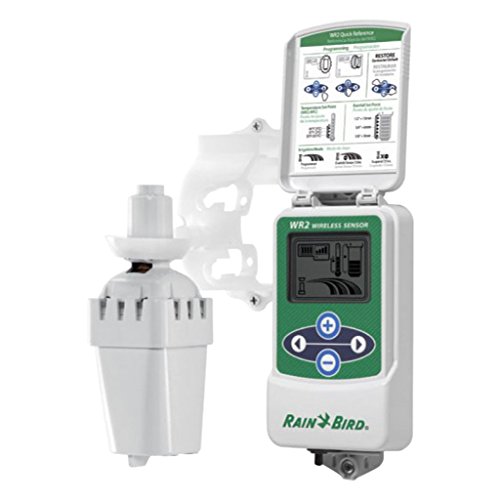
- Best for: A yard where both the rain amount and the freeze point need adjusting.
- Rainfall settings adjustable from 1/8 to 1/2 inch
- Freeze settings adjustable from 33 to 41 degrees Fahrenheit
- Icon-driven controller interface
- Wireless sensor with 1 controller interface and 1 sensor
A yard where both the rain amount and the freeze point need adjusting.
It does not work with Rain Bird ESP-SMT or ESP-SMTe smart controllers.
This Rain Bird system suits buyers who want to tune both triggers instead of accepting fixed values. Rainfall shutoff adjusts from one-eighth to one-half inch and the freeze threshold adjusts from 33 to 41 degrees Fahrenheit, so the sensor can match a dry climate or a frost-prone one. An icon-driven controller interface handles programming, and the wireless sensor talks to it without a cable run. The stated fit covers Rain Bird and compatible 24-volt controllers, with one named exception to check before buying.
Rain Bird CPRSDBEX Wired Rain Sensor
- Best for: A wired install where the controller sits within 25 feet of open sky.
- Rainfall trigger adjustable from 1/8 to 3/4 inch
- Adjustable vent ring controls drying time
- Includes 25 feet of UV-resistant extension wire
- UV-resistant polymer body with aluminum latching bracket
A wired install where the controller sits within 25 feet of open sky.
Routing the wire takes planning when the controller is far from the mounting spot.
The CPRSDBEX is the straightforward wired choice for a controller with a nearby mounting spot. A twist dial sets the rainfall trigger from one-eighth to three-quarters of an inch, and an adjustable vent ring controls how quickly the sensor dries and lets watering resume. The kit includes a mounting bracket and 25 feet of UV-resistant extension wire, and the UV-resistant polymer body with an aluminum latching bracket is built for exposed mounting on a fence, wall, or gutter.
Hunter Wired Mini-Clik Rain Sensor
- Best for: Replacing an old wired sensor on a system that already has a cable run.
- Rainfall trigger adjustable from 1/8 to 3/4 inch
- Includes 25 feet of sheathed two-conductor wire
- Debris tolerant for reliable operation
- Compatible with all Hunter controllers and most other brands
Replacing an old wired sensor on a system that already has a cable run.
It senses rain only, so freeze protection needs a separate solution.
The Mini-Clik is the compact wired option for tight mounting spots and simple systems. It halts scheduled irrigation once a preset amount of rain has fallen, then lets the controller resume normal watering after the storm passes and the discs dry. The sensor ships with 25 feet of sheathed two-conductor wire, tolerates debris in varied environments, and lists compatibility with all Hunter controllers and most other brands, which makes it a flexible replacement for an ageing sensor on an existing system.
Orbit Wireless Rain and Freeze Sensor
- Best for: A wireless install on an Orbit or Hydro-Rain controller at a modest cost.
- Wireless rain and freeze sensing
- Water-absorbing disks suspend watering when wet
- Built-in thermistor detects low temperatures
- Adjustable rain-delay threshold
A wireless install on an Orbit or Hydro-Rain controller at a modest cost.
Wireless placement needs a clear signal path back to the receiver module.
The Orbit wireless sensor fits buyers who want wireless placement on a budget, especially on Orbit or Hydro-Rain controllers. Water-absorbing disks expand when wet and prompt the controller to suspend watering, while a built-in thermistor adds low-temperature shutoff without a second device. An adjustable rain-delay threshold lets you set how much rainfall triggers the pause, and the wireless link removes the wire run between the controller and the mounting spot entirely.
Which One Fits Your Situation
You have a basic controller and a short wire run
Pick the Rain Bird CPRSDBEX or the Hunter Wired Mini-Clik. Both ship with 25 feet of wire, adjust from one-eighth to three-quarters of an inch, and wire straight into a standard sensor port. The CPRSDBEX adds a vent ring for drying control, while the Mini-Clik is the smaller of the two when the mounting spot is cramped.
Your controller sits far from open sky
Go wireless with the Hunter Rain-Clik WRCLIK or the Rain Bird wireless system. The sensor mounts where rain falls freely while the receiver stays with the controller, and neither asks you to fish cable through finished walls. The Hunter reacts fastest to the first drops, while the Rain Bird lets you set both thresholds.
Freezes arrive before the watering season ends
Choose a rain-and-freeze model: the Hunter Rain-Clik WRCLIK, the Rain Bird wireless system, or the Orbit wireless sensor. Each stops watering in cold weather as well as in rain, which keeps walks and drives free of ice from a dawn cycle. The Rain Bird is the pick when you want to choose the exact freeze temperature.
You want the simplest possible install
Take the Hunter Wired Mini-Clik if a wire already runs to the old sensor, since it swaps into the same terminals with no new cable to route. If no wire exists, the Orbit wireless sensor is the least involved wireless option, with a sensor and module that pair without trenching or drilling through walls.
Common Mistakes
- Mounting the sensor under an eave or tree where rain never reaches it, so it never trips.
- Skipping the controller manual and buying a sensor the controller cannot accept.
- Setting the rainfall threshold too low, so a light drizzle cancels watering the lawn still needs.
- Running the wire through a sprinkler spray zone, which keeps the discs wet and the system paused.
- Forgetting the sensor after install, letting discs clog with debris until it stops responding.
Frequently Asked Questions
Does a rain sensor replace a smart controller?
No, a sensor only pauses scheduled watering when rain falls or temperatures drop, while a smart controller also adjusts run times from forecasts and seasonal changes. A sensor is the cheaper add-on for a controller that already works, and it suits owners who do not need app control or weather-based scheduling.
How much rain should trigger the shutoff?
It depends on soil and climate, but a common starting point is one-quarter inch for average lawns. Sandy soil in a dry climate may need a higher setting so a sprinkle does not cancel a needed cycle, while heavy soil in a wet climate may need a lower one. Adjustable dial models let you fine-tune this after a few storms.
Will a rain sensor work with any controller?
Most standard 24-volt controllers accept a sensor, but compatibility is not universal. Check the controller manual for a sensor input and whether it needs a normally closed or normally open connection. A few smart controllers exclude specific sensors, and battery timers often have no sensor input at all.
How often does a rain sensor need attention?
Check it once a season by pressing the test spindle or wetting the discs and confirming the system pauses. Clean debris from the discs and vents, check that the mounting still faces open sky, and replace the battery on wireless models when the indicator says so. A neglected sensor can stick wet or dry and stop helping.
More from Amazon
Programs that pair well with the guide above. Offers and eligibility are set by Amazon and may change.
Collect the home and kitchen items you want in one registry that guests can shop from.
Create a wedding registrySet up recurring deliveries of everyday items on eligible products. Terms and savings are set by Amazon.
Explore Subscribe & SaveFree shipping on eligible items, Prime Video and more. Eligible new members can start with a free trial.
Start a Prime free trialAudiobooks and podcasts to listen to on the go. Eligible new members can start with a free trial.
Try Audible freeAs an Amazon Associate we earn from qualifying purchases.




Write Your Review
No reviews yet. Be the first to share your experience!