

Key takeaways
- Best all-around choice: a 30-gallon programmable tripod feeder. It is large enough for regular feeding without the weight and cost of a 55-gallon system.
- Best for a tight budget: a basic 6- or 12-gallon hanging feeder with a sealed timer housing. It reduces the upfront cost, but plan on more frequent servicing.
- Best for infrequent visits: a 55-gallon hopper with a wide lid, internal feed-control mechanism, and sturdy legs. Select a model that can be safely filled from ground level or with a stable ladder.
- Best for quiet operation: a gravity feeder. It avoids the motor noise that can accompany timed broadcast models, although it does not provide precise feeding windows.
- Best for broad distribution: an automatic broadcast feeder with an adjustable spinner plate and a claimed range of at least 30 feet. A larger pattern can reduce concentrated wear on one feeding spot.
- Best for remote placement: a solar-assisted unit, provided the panel receives several hours of unobstructed sun and the battery compartment remains protected from moisture.
Best Game Feeders for Reliable Wildlife Feeding
The best game feeder for most properties is a 30-gallon, battery-powered automatic spin feeder with a programmable timer, galvanized or powder-coated metal legs, a rain shield, and a broadcast range of roughly 20 to 40 feet.
That configuration offers a useful balance of capacity, predictable feeding, weather resistance, and manageable setup. Choose a smaller 6- to 12-gallon feeder for occasional use or limited space, a 55-gallon hopper for long intervals between refills, and a gravity feeder when quiet operation and low power consumption matter more than wide feed distribution.
Our top picks

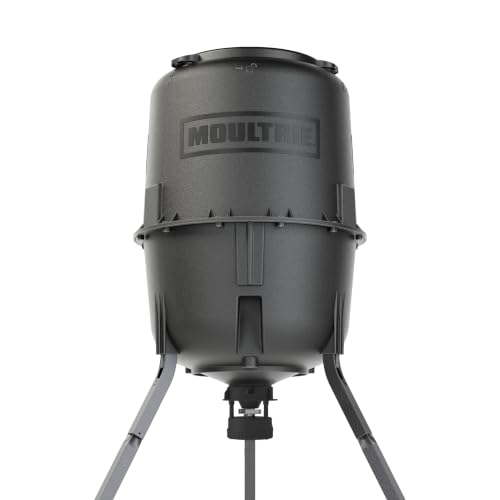


As an Amazon Associate we earn from qualifying purchases at no extra cost to you. Ratings are shown as listed on Amazon.
Quick comparison: which feeder fits your property?
| Feeder type | Typical capacity | Broadcast range | Power and runtime | Best for | Main drawback |
|---|---|---|---|---|---|
| Compact hanging spin feeder | 6–12 gallons | 15–25 feet | 6V or 12V battery; about 2–6 months | Small plots, feeders mounted from trees or posts | Frequent refills and lower weather protection |
| 30-gallon tripod spin feeder | 200–250 pounds of corn, depending on feed density | 20–40 feet | 6V or 12V battery; about 4–9 months | Most mixed-use properties | Requires leveling and secure leg placement |
| 55-gallon hopper feeder | 400–500 pounds | 20–40 feet, or gravity access below the hopper | 12V battery; commonly 4–12 months | Infrequent visits and larger wildlife areas | Heavy, harder to assemble, and more expensive |
| Gravity feeder | 50–300 pounds | Usually none; feed falls beside the unit | No timer; no motor battery required | Quiet feeding and simple maintenance | Less control over feeding times and greater clogging risk |
| Solar-assisted automatic feeder | 30–55 gallons | 20–40 feet | Rechargeable battery with solar panel | Remote locations with strong sunlight | Higher initial cost and panel-placement concerns |
Capacity figures vary with corn, pellets, protein feed, and other materials. A gallon is a volume measurement, so the same hopper can hold different weights depending on the feed.
Best choices by situation
- Best all-around choice: a 30-gallon programmable tripod feeder. It is large enough for regular feeding without the weight and cost of a 55-gallon system.
- Best for a tight budget: a basic 6- or 12-gallon hanging feeder with a sealed timer housing. It reduces the upfront cost, but plan on more frequent servicing.
- Best for infrequent visits: a 55-gallon hopper with a wide lid, internal feed-control mechanism, and sturdy legs. Select a model that can be safely filled from ground level or with a stable ladder.
- Best for quiet operation: a gravity feeder. It avoids the motor noise that can accompany timed broadcast models, although it does not provide precise feeding windows.
- Best for broad distribution: an automatic broadcast feeder with an adjustable spinner plate and a claimed range of at least 30 feet. A larger pattern can reduce concentrated wear on one feeding spot.
- Best for remote placement: a solar-assisted unit, provided the panel receives several hours of unobstructed sun and the battery compartment remains protected from moisture.
How the important features compare
Hopper capacity
Capacity determines service frequency, not simply how much feed you can buy. To estimate runtime, divide the hopper’s usable feed weight by the daily dispensing amount.
For example, assume a 30-gallon feeder holds approximately 225 pounds of corn and dispenses 4 pounds per day. The theoretical runtime is 225 ÷ 4 = 56 days. In practice, allow less because of spillage, wind, residual feed below the outlet, animals disturbing the unit, and moisture. A realistic planning figure might be 45 to 50 days.
Do not fill a large hopper merely because it can hold more. If feed will sit through repeated rain and humidity, a smaller refill interval may preserve quality and reduce caking.
Feed timers
Look for at least two programmable feeding events per day, adjustable run times, and a test or “spin” button. A timer with a digital display is easier to verify than one that relies only on small switches. Run-time adjustment matters because a motor operating for 4 seconds can dispense substantially less than one operating for 12 seconds.
Protect the timer from condensation. A gasketed control box, raised battery compartment, and cable grommets are more valuable than extra programming modes. Keep a written record of the chosen schedule so a battery change does not force you to reconstruct the settings.
Broadcast range and feed control
Manufacturers commonly advertise a maximum spread of about 20 to 40 feet. Actual distance depends on feed size, spinner speed, mounting height, wind, and whether the spinner is partially blocked by a skirt or protective cage.
An adjustable spinner plate or deflector is useful when the feeding area is close to a fence, patio, trail, or neighboring property. A wide pattern is not always better: spreading feed too far can make cleanup more difficult and may place feed where you do not want animals congregating.
Power options
Six-volt systems are common on compact feeders, while 12-volt batteries are better suited to larger motors, longer schedules, or solar charging. Battery life can range from roughly two months to nearly a year, but cold temperatures, weak batteries, frequent feeding cycles, and a jammed spinner all reduce runtime.
For a feeder visited monthly, use a fresh sealed lead-acid battery or a compatible rechargeable setup and inspect the terminals for corrosion. Solar panels help maintain charge; they do not compensate for a badly positioned panel, a failing battery, or a motor that is drawing excessive current.
Weather protection
The lid should overlap the hopper opening and shed water away from the feed outlet. A steep or domed lid is preferable to a flat lid that collects leaves and standing water. Look for galvanized steel, powder-coated steel, UV-resistant plastic, or a combination of these materials.
The most vulnerable parts are usually the timer seal, battery terminals, spinner motor, feed gate, and lid fasteners. A rain shield above the spinner helps, but it cannot prevent moisture from entering through a poorly seated lid. Avoid placing the feeder directly beneath a roof drip line or dense branches that funnel water.
Animal access and protection
Wildlife must be able to reach the feed without tipping the unit or damaging the hopper. Tripod legs should have broad feet or attachment points for ground stakes. A locking lid discourages some unwanted access, while a cage can protect the spinner and motor from larger animals.
Gravity feeders need special attention to the feed ports. Ports that are too large can allow excessive flow and waste; ports that are too small can clog when feed absorbs humidity. For broadcast feeders, the motor housing should be shielded from direct contact with animals without restricting the spinner.
Setup requirements that affect reliability
- Choose level, well-drained ground. A leaning hopper can shift feed toward one side, alter the broadcast pattern, and place extra stress on the legs.
- Measure the feeding zone. Keep the broadcast pattern away from roads, walkways, water edges, structures, and property boundaries where appropriate.
- Assemble the frame before filling it. A full hopper can weigh several hundred pounds and is unsafe to reposition manually.
- Anchor the legs. Use ground stakes, augers, or suitable fasteners when the manufacturer provides attachment points. Wind and animal contact can overturn an otherwise stable feeder.
- Install the battery with terminals protected. Apply terminal protectant if compatible with the battery, route cables away from sharp edges, and keep connectors above the lowest point where water can collect.
- Run a short test cycle. Confirm that the spinner turns freely, feed exits evenly, and the timer starts at the intended time before adding a full load.
- Record the settings and fill date. This makes it easier to identify a blocked outlet, abnormal feed consumption, or a failing battery.
Ownership realities: what wears out first
The motor and spinner are common failure points because dust, fine feed, insects, and moisture collect around moving parts. Timer batteries or digital timer modules can also fail before the hopper itself. Inspect the spinner plate for bending, the feed gate for swelling or corrosion, and the lid seal for cracks.
Empty and clean the hopper when changing feed types. Remove clumps rather than adding fresh feed on top of them. A dry brush or low-moisture cleaning method is usually safer for electronics than spraying the entire assembly. Let all parts dry completely before refilling.
Common mistakes include overfilling with damp feed, placing the solar panel in shade, mounting the unit on an unstable slope, setting too many long feed cycles, and ignoring local wildlife-feeding regulations. Rules can vary by state, county, municipality, season, and species. Check current local requirements before installing a feeder, particularly where wildlife congregation, disease management, hunting, or nuisance-animal restrictions apply.
Bottom line
For dependable general use, choose a 30-gallon automatic tripod feeder with a sealed programmable timer, adjustable broadcast control, a rain-shedding lid, and secure battery access. Move up to a 55-gallon hopper when refill frequency is the main problem, down to a compact hanging model when space and budget are limited, or to a gravity feeder when silence and simplicity outweigh timed distribution. The right capacity, stable installation, and regular inspection matter more to long-term reliability than adding extra timer modes or an unnecessarily large broadcast pattern.



Write Your Review
No reviews yet. Be the first to share your experience!