

Key takeaways
- Best for high-heat grilling: Philips Smoke-less Indoor Grill HD6371/94, with infrared heating and a cooking temperature around 446°F.
- Best for a family and all-in-one cooking: Ninja Foodi Smart XL Grill, which combines grilling with air frying, roasting, baking, and dehydrating.
- Best compact option: A small 1,000-to-1,200-watt electric grill with a 70-to-100-square-inch plate and removable drip tray.
- Best for easy cleanup: A clamshell grill with removable dishwasher-safe plates, especially if you cook burgers, sandwiches, and boneless chicken more often than steaks.
- Best lower-cost choice: A basic lidded indoor searing grill with an adjustable thermostat, removable nonstick plate, and separate grease tray.
The best indoor smokeless grill for most kitchens is a model with a removable plate, a dedicated grease tray, a lid or splatter shield, and a cooking surface of at least 100 square inches; the right choice then depends on whether you prioritize compact storage, high-heat searing, family-size capacity, or the simplest cleanup.
Our top picks

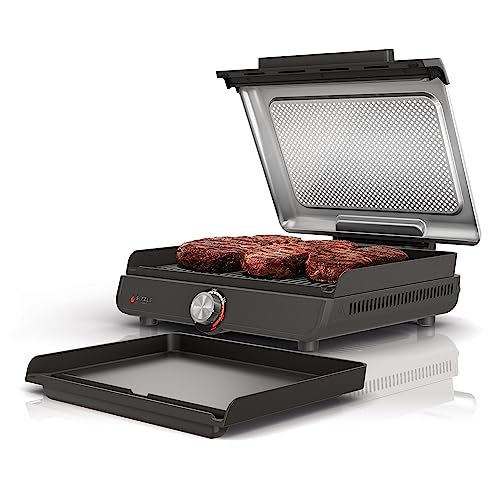


As an Amazon Associate we earn from qualifying purchases at no extra cost to you. Ratings are shown as listed on Amazon.
Best indoor smokeless grills by situation
- Best for high-heat grilling: Philips Smoke-less Indoor Grill HD6371/94, with infrared heating and a cooking temperature around 446°F.
- Best for a family and all-in-one cooking: Ninja Foodi Smart XL Grill, which combines grilling with air frying, roasting, baking, and dehydrating.
- Best compact option: A small 1,000-to-1,200-watt electric grill with a 70-to-100-square-inch plate and removable drip tray.
- Best for easy cleanup: A clamshell grill with removable dishwasher-safe plates, especially if you cook burgers, sandwiches, and boneless chicken more often than steaks.
- Best lower-cost choice: A basic lidded indoor searing grill with an adjustable thermostat, removable nonstick plate, and separate grease tray.
“Smokeless” does not mean completely smoke-free. These grills reduce smoke by controlling the temperature, directing fat away from the heating element, using water in a drip tray, or shielding the cooking surface. Fatty meats, excess marinade, and overheated residue can still create smoke, so normal kitchen ventilation remains important.
Head-to-head comparison
| Model or type | Cooking surface | Temperature | Smoke-reduction approach | Grease handling | Approximate footprint | Typical market range |
|---|---|---|---|---|---|---|
| Philips Smoke-less Indoor Grill HD6371/94 | About 167 sq in | Up to about 446°F | Infrared heating and separated drip area | Removable drip tray | About 18.5 × 11.3 in | $180–$300 |
| Ninja Foodi Smart XL Grill | About 108 sq in grill grate | Up to 500°F | Covered heating system, splatter shield, controlled airflow | Grease tray and removable shield | About 15.7 × 16.5 in | $250–$350 |
| Basic lidded indoor searing grill | About 90–120 sq in | Usually 400–450°F | Lid, drip tray, and fat separation | Removable tray; sometimes water-assisted | About 17 × 12 in | $60–$140 |
| Clamshell contact grill | About 70–100 sq in | Usually 350–450°F | Top plate reduces exposed grease and splatter | Sloped plates or narrow drip channel | About 13 × 12 in | $50–$180 |
Dimensions and usable cooking areas vary by configuration, so treat the figures as practical comparisons rather than interchangeable manufacturer specifications. The important difference is physical: the Philips gives you a broad, open grilling area, while a Ninja Foodi Smart XL occupies more counter depth because it also contains an enclosed convection chamber.
What separates a good smokeless grill from a disappointing one?
Cooking-surface size
Cooking area determines both serving size and how well food browns. A surface near 70 square inches is adequate for two burgers or two chicken breasts. Around 100 to 120 square inches is more comfortable for three or four portions. A surface above 150 square inches is useful for family meals, but it also takes longer to preheat and requires more storage space.
Do not fill every inch of the grate. Crowding traps steam and lowers the surface temperature. As a rough sizing calculation, four 4-inch burgers need approximately 50 square inches of geometric space, but allowing a 1-inch gap around each patty raises the practical requirement to roughly 80 square inches. That is why a nominally “four-serving” grill can feel cramped in daily use.
Smoke-reduction system
Look for a design that keeps dripping fat away from the heating element. A drip tray placed directly beneath the grate is more useful than a vague “smokeless” label. Infrared systems can brown efficiently, while lidded grills contain splatter and reduce the amount of grease reaching the air. Water-assisted trays can limit burning residue, but they require filling before cooking and careful emptying afterward.
Open grills give the most grill-like access and are easier to use for vegetables and skewers. Enclosed grills generally produce less splatter and can cook faster, but their smaller internal clearance may limit thick steaks, bone-in chicken, or large vegetables.
Temperature range and control
For burgers, sausages, vegetables, and chicken, a range of approximately 350°F to 425°F is usually sufficient. Steak searing benefits from a maximum near 450°F or higher. A digital temperature setting is convenient, but it does not guarantee that the grate itself reaches the displayed temperature. A heavy plate or grate tends to recover heat better after cold food is added than a very thin plate.
Adjustable heat also matters for cleanup. Lower heat helps finish thick food without scorching the exterior, while a short high-heat preheat improves browning. Avoid running an empty nonstick surface at its maximum setting for extended periods.
Grease collection
A useful grease system has a clear path from the cooking surface to a removable tray. Check whether the tray can hold a full meal’s worth of fat without overflowing and whether it can be removed while hot without touching the grate. Narrow channels are harder to clean than a broad, open tray.
For fatty burgers or bacon, line the surrounding work area with a washable mat or parchment placed outside the appliance—not on the heating surface. Never block vents or put loose paper near exposed heating elements.
Countertop footprint and ventilation
Measure more than the appliance’s listed width. Leave several inches around ventilation openings, and check the lid’s upward clearance beneath cabinets. A compact contact grill may fit a small kitchen better than a wide open grill, while a multi-function XL grill can consume much of a standard counter even when its cooking surface is not exceptionally large.
Use the range hood or a nearby exhaust fan whenever cooking fatty food. A window can help, but it is not a substitute for keeping the appliance away from curtains, cabinets, and other heat-sensitive surfaces.
Cleanup and ownership realities
The cooking plate, drip tray, splatter shield, and grease channels are the parts most likely to determine whether you keep using the grill. Nonstick coatings eventually wear, especially when exposed to metal utensils, abrasive pads, cooking spray buildup, or repeated overheating. Silicone or wooden tools extend plate life.
Clean while residue is still warm, but unplug the grill first and do not pour cold water onto a hot plate. Remove loose grease with paper towels, then wash removable parts according to the manual. A dishwasher-safe label does not mean unlimited dishwasher durability; repeated harsh cycles can dull coatings and degrade plastic components.
For a basic grill, a typical cleanup routine takes about five minutes: remove the food, unplug the unit, empty the tray, wipe the plate, and wash the tray once it is cool. For a multi-function grill with a mesh splatter shield and several accessories, expect closer to 10 or 15 minutes. That difference matters if you grill several times a week.
Decision matrix
| Your priority | Choose this design | Why | Trade-off |
|---|---|---|---|
| Small counter and occasional use | Compact clamshell grill | Fast setup, small storage footprint, contained splatter | Less room for vegetables and thick food |
| Steak and steak-like searing | Open infrared or high-temperature grill | Broad surface and stronger browning potential | More exposed grease and ventilation demand |
| Family dinners several times a week | XL grill with at least 100 sq in of usable grate | More food per batch and better temperature recovery | Larger footprint and more parts to wash |
| Beginner who wants simple controls | Dial-controlled lidded grill | Few settings and straightforward operation | Less precise than digital temperature control |
| Lowest ownership hassle | Removable dishwasher-safe plate and tray | Less scrubbing and easier grease disposal | Replacement plates may be expensive or unavailable |
How to use an indoor smokeless grill with less smoke
- Position it first. Set the grill on a stable, heat-resistant surface with clear space around its vents.
- Prepare the grease system. Insert the tray correctly and add the recommended amount of water if the manual specifies water-assisted smoke reduction.
- Preheat with the lid open or closed as directed. Preheating improves browning and reduces the time food spends releasing moisture.
- Dry the food. Pat meat and vegetables dry, and use only a thin coating of oil. Wet marinades drip, splatter, and can burn.
- Leave space between pieces. Crowding lowers the cooking temperature and increases steaming.
- Empty the tray after cooking. Do not store grease in the appliance, where it can harden around channels and create odor during the next use.
Bottom line
Choose the Philips Smoke-less Indoor Grill when a broad cooking surface and focused grilling performance matter most. Choose the Ninja Foodi Smart XL Grill when you want grilling plus enclosed-air cooking and can accept a larger countertop footprint. For occasional burgers, sandwiches, and chicken, a simpler lidded grill is usually the better value. Whichever model you buy, prioritize removable parts, a real grease path, usable temperature control, and dimensions that fit both your counter and your storage space.


Write Your Review
No reviews yet. Be the first to share your experience!