

Key takeaways
- Corded electric: A 10- to 12-amp motor supplies steady output for sidewalks and driveways. It is a strong choice for smaller yards, but the cord can snag on shrubs and must be kept behind the cutting path.
- Battery electric: A 4.0Ah battery often provides approximately 30 to 60 minutes of intermittent edging, depending on grass density, blade depth, and voltage platform. A second battery matters more than a slightly larger blade when the property has many borders.
- Gas: Gas machines remain useful for long borders and thick, damp growth. They are heavier and require fuel, oil where applicable, seasonal storage, and carburetor or starting-system maintenance.
- Attachment systems: An attachment is practical for occasional work, but shaft balance and powerhead compatibility affect accuracy. A dedicated wheeled edger usually tracks more predictably.
The best lawn edgers are the ones that match your border material, cutting frequency, and tolerance for cord, fuel, or battery charging: choose a wheeled electric edger for the straightest repeatable lines, a cordless model for occasional maintenance and mobility, and a gas edger for large properties with long, neglected borders.
Our top picks
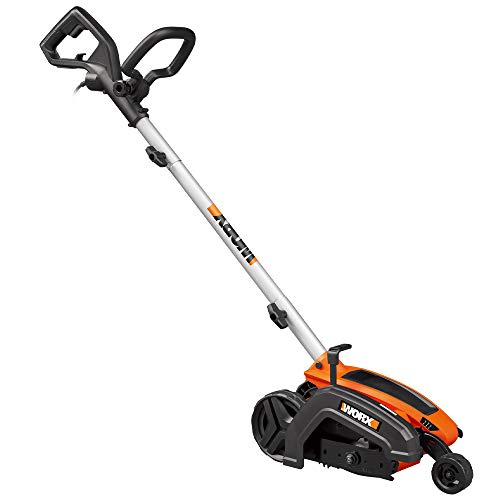


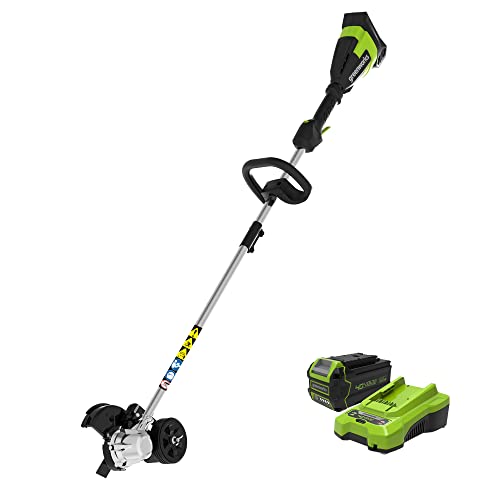
As an Amazon Associate we earn from qualifying purchases at no extra cost to you. Ratings are shown as listed on Amazon.
Quick picks by lawn situation
| Situation | Best choice | Why it fits | Typical market range |
|---|---|---|---|
| Small lawn with nearby outlet | 12-amp corded wheeled edger | Consistent power, no battery limit, usually the lowest running cost | $90–$180 |
| Several beds, paths, and obstacles | 18V or 20V cordless edger | Easy maneuvering without managing an extension cord | $120–$280 with battery and charger |
| Long driveway or many sidewalk sections | 40V–56V cordless wheeled edger | More torque and runtime for repeated, deeper cuts | $220–$450 with battery and charger |
| Large property or overgrown edges | Gas wheeled edger | Long runtime and strong recovery in thick grass | $250–$550 |
| Already own a compatible powerhead | Edger attachment | Lower cost and convenient storage, provided the powerhead has adequate torque | $70–$180 |
What separates the best lawn edgers
Blade diameter and cutting depth
Most residential edgers use a metal blade approximately 7.5 to 9 inches in diameter. A larger blade does not automatically cut better, but it generally maintains useful cutting depth as the blade wears. For routine lawn maintenance, an adjustable depth of roughly 1 to 2 inches is sufficient. If grass has grown over a sidewalk or the edge has not been renewed for months, a model capable of about 2.5 to 3.5 inches gives you more recovery room.
Use shallow settings near irrigation lines, landscape lighting, and shallow-rooted ornamental plants. Deep edging can sever roots or expose cables. Blade guards and a visible depth lever are more useful than an impressive maximum-depth number that is difficult to control.
Power source
- Corded electric: A 10- to 12-amp motor supplies steady output for sidewalks and driveways. It is a strong choice for smaller yards, but the cord can snag on shrubs and must be kept behind the cutting path.
- Battery electric: A 4.0Ah battery often provides approximately 30 to 60 minutes of intermittent edging, depending on grass density, blade depth, and voltage platform. A second battery matters more than a slightly larger blade when the property has many borders.
- Gas: Gas machines remain useful for long borders and thick, damp growth. They are heavier and require fuel, oil where applicable, seasonal storage, and carburetor or starting-system maintenance.
- Attachment systems: An attachment is practical for occasional work, but shaft balance and powerhead compatibility affect accuracy. A dedicated wheeled edger usually tracks more predictably.
Accuracy on sidewalks, beds, and driveways
For a sidewalk, look for a guide wheel, curb-following wheel, or sturdy blade guard that keeps the blade at a repeatable distance from concrete. A narrow front wheel can follow curves but may wander on uneven ground. Wider wheels provide better tracking on long, straight driveway edges.
For flower beds, a depth lever with several positive stops is preferable to a friction-only adjustment. The operator should be able to make a shallow pass without the blade gradually sinking. A trenching-style edger can create a crisp soil boundary, but it is less forgiving around exposed roots and decorative edging.
For driveways, prioritize torque, wheel stability, and a blade that can be replaced easily. Concrete and asphalt do not normally touch the blade when the tool is set correctly, but occasional contact can quickly dull or damage it. Do not use an edger to grind against hard paving.
Notable models and the jobs they suit
Best corded option: Greenworks 12 Amp 27032
The Greenworks 12 Amp 27032 is a sensible choice for a small or medium lawn with an accessible outdoor outlet. Its corded motor avoids battery-runtime concerns, and the wheeled design is better suited to maintaining straight sidewalk and driveway lines than a handheld string trimmer used on its side. It is most attractive to homeowners who edge several times during the growing season and do not want fuel or battery-platform costs.
Best simple corded alternative: BLACK+DECKER LE750
The BLACK+DECKER LE750 is another established corded wheeled design for routine residential borders. Its appeal is simplicity: plug it in, set the depth, and follow the pavement edge. It is better suited to regular grass control than cutting through a heavily overgrown bank. As with any corded edger, use a properly rated outdoor extension cord and keep it visible behind you.
Best battery-platform choice: EGO Power+ EA0800
The EGO Power+ EA0800 is a cordless edger attachment for the EGO Power+ system rather than a complete standalone wheeled edger. It makes sense for owners who already have a compatible EGO powerhead and battery. Its value depends on that existing equipment: buying the attachment alone can be economical, while purchasing an entire platform for occasional edging is harder to justify.
Best for occasional light work: an 18V or 20V cordless wheeled edger
Compact battery edgers are convenient around patios, narrow side paths, and small planting beds. Their lower weight helps when frequently repositioning the tool, but they can slow in thick turf or when set deeply. Select a model with a metal blade, a replaceable blade specification, and a battery of at least 2.0Ah; 4.0Ah is a more useful target for a property with multiple borders.
Decision matrix: match the edger to your routine
| Your priority | Recommended specification | What to avoid |
|---|---|---|
| Lowest purchase and operating cost | 10–12 amp corded model, 7.5–9 inch blade | Buying into a high-voltage battery system for two short edging sessions |
| New to edging | Wheeled design, guide wheel, adjustable depth, visible blade guard | Unwheeled attachment with a narrow sightline |
| Small yard with many curves | Light cordless model with a narrow front wheel | Heavy gas machine that is difficult to turn |
| Weekly maintenance | Shallow depth adjustment and readily available replacement blades | Very deep fixed setting that removes too much soil each time |
| Rare, overgrown maintenance | Higher-torque 40V–56V cordless or gas model | Small low-voltage motor expected to cut several inches in one pass |
Runtime and cost calculation
Suppose your borders total 600 linear feet and your cordless edger advances at an average working speed of 1.5 feet per second. The cutting time is approximately 600 ÷ 1.5 = 400 seconds, or about 6.7 minutes. Allowing for turns, repositioning, and a second pass, plan on 15 to 20 minutes of real use. A battery that delivers 30 minutes under comparable conditions should handle that job, but a heavily overgrown edge may reduce runtime substantially. This is why battery capacity, not only voltage, matters.
For a homeowner who edges 12 times per year, a $160 corded tool costs about $13.33 per annual use in the first year, before any extension cord or replacement blade. A $300 cordless kit costs $25 per use in the first year. The cordless option becomes more compelling when it is also used for other compatible tools or when avoiding cord management saves enough time to matter.
How to produce a cleaner edge
- Mow first. The shorter grass makes the pavement or bed boundary visible and reduces the chance of cutting too deeply.
- Inspect the route. Mark sprinkler heads, lighting wires, shallow roots, and loose stones. Never assume a buried service is deep enough to ignore.
- Set the blade shallow. Start around 1 inch for a maintained border. Increase depth only when the edge needs rebuilding.
- Keep the guide wheel against the hard boundary. Move at a steady walking pace rather than forcing the blade through dense sections.
- Make a second pass when necessary. Two controlled passes are safer and cleaner than forcing a deep cut in one pass.
- Clear debris and inspect the blade. Disconnect the cord or remove the battery before touching the blade area.
Ownership details that affect value
The blade usually wears before the motor. Abrasive soil, gravel, and accidental pavement contact can blunt its edge or reduce its diameter. Check whether replacement blades are sold separately and whether changing one requires ordinary hand tools. A bent blade, excessive vibration, or a machine that pulls sideways is a reason to stop and inspect it.
After each use, brush soil and grass from the guard and wheels. Do not hose an electric motor, battery compartment, or switch assembly. Store batteries indoors in a dry place, and avoid leaving them fully depleted for long periods. Gas models need fresh fuel practices and end-of-season preparation; stale fuel is a common cause of difficult starting.
Finally, do not substitute a string trimmer for precise edging unless the border is informal. A trimmer can work for soft bed lines, but a wheeled edger provides better depth control and a more repeatable distance from concrete. For most patios and residential gardens, the best lawn edgers are not the most powerful models—they are the ones whose wheels, depth adjustment, and blade availability make clean maintenance easy to repeat.



Write Your Review
No reviews yet. Be the first to share your experience!