

Key takeaways
- Round ring burners: Produce a traditional campfire appearance and suit circular tables.
- Linear burners: Fit rectangular fire tables and spread warmth along the length of the seating area.
- H-shaped or multi-ring burners: Cover more surface area and are useful on wide tables, though they often use more propane.
- Porous lava rock: Affordable, lightweight, and good at hiding burner hardware.
- Fire glass: Reflects light and gives a cleaner modern appearance, but it costs more and shows soot more readily.
Best Propane Fire Pits for Warm Patio Evenings
The best propane fire pits for most patios are 28- to 32-inch square or round models producing about 40,000 to 50,000 BTU, with a stainless-steel burner, electronic ignition, a concealed 20-pound tank, and a weather-resistant aluminum or steel cabinet.
That specification balances useful warmth, manageable size, straightforward operation, and reasonable fuel consumption. Smaller tabletop units make sense for balconies and occasional use, while larger 50,000- to 60,000-BTU fire pits are better for entertaining groups—but they need more clearance and usually consume propane faster.
Our top picks


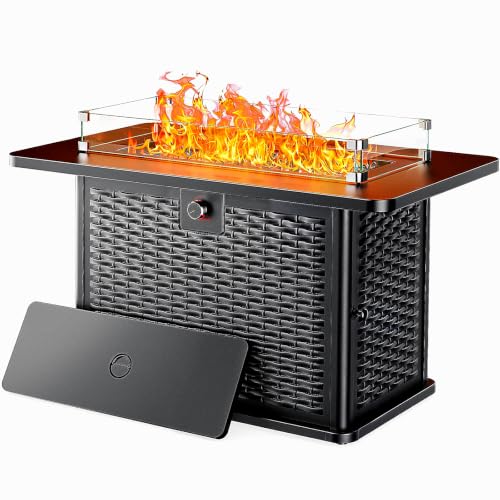
As an Amazon Associate we earn from qualifying purchases at no extra cost to you. Ratings are shown as listed on Amazon.
Best propane fire pits by patio situation
| Patio situation | Recommended format | Useful specifications | Typical price range | Main compromise |
|---|---|---|---|---|
| Small balcony or compact deck | Tabletop fire pit | 15–20 inches wide, 10,000–30,000 BTU, 1 lb or 20 lb propane | $100–$250 | Less heat and limited table space |
| Couple or small family | 28-inch square or round pit | 40,000–50,000 BTU, 20 lb tank, 15–25 lb media capacity | $250–$600 | Usually requires a cover and sheltered storage |
| Frequent entertaining | 32–42-inch fire table | 50,000–60,000 BTU, 20 lb or 30 lb tank, 25–45 lb media capacity | $500–$1,200 | Heavier, larger footprint, higher fuel use |
| Minimal maintenance | Aluminum cabinet with stainless burner | Powder-coated aluminum, 304 stainless steel, fitted cover | $450–$1,200 | Costs more initially |
Heat output: more BTUs are not automatically better
Propane fire pit heat output is measured in BTUs per hour. A 30,000-BTU burner can make a small seating area comfortable, while 40,000 to 50,000 BTUs is a more versatile range for a normal patio. Larger outputs help compensate for wind and distance, but the warmth is still concentrated near the flame. A fire pit is not an efficient substitute for a directional patio heater.
Look for a burner that distributes flame across most of the tabletop rather than concentrating it in a narrow center ring. A broad flame pattern gives more even radiant heat and makes the fire look proportionate to the table. If a model lists a high BTU number but has a small burner opening, expect a taller, hotter-looking flame in the center and less useful warmth around the edges.
A practical propane-runtime calculation
A standard 20-pound propane cylinder contains roughly 430,000 BTUs of usable energy when full. At a continuous 40,000-BTU setting, the theoretical runtime is:
430,000 ÷ 40,000 = about 10.75 hours.
In real use, runtime varies with fill level, regulator performance, temperature, and how often you adjust the flame. A reasonable planning figure is about 8 to 10 hours at a high setting for a 40,000-BTU pit. At 50,000 BTUs, expect approximately 7 to 9 hours. Using a medium flame can extend the cylinder over several evenings.
Burner design and fire media
Stainless-steel burners generally provide the best long-term resistance to heat, condensation, and corrosion. Choose 304 stainless steel when available, particularly if the patio is near saltwater. Basic painted steel burners can perform well but may eventually develop rust around burner ports and welds.
- Round ring burners: Produce a traditional campfire appearance and suit circular tables.
- Linear burners: Fit rectangular fire tables and spread warmth along the length of the seating area.
- H-shaped or multi-ring burners: Cover more surface area and are useful on wide tables, though they often use more propane.
- Porous lava rock: Affordable, lightweight, and good at hiding burner hardware.
- Fire glass: Reflects light and gives a cleaner modern appearance, but it costs more and shows soot more readily.
Use only media specified for propane fire pits. Do not cover burner ports with excessive rock or glass. A deep layer can restrict airflow, cause uneven ignition, or trap moisture against the burner.
Propane storage: hidden tank or external cylinder?
A concealed 20-pound cylinder makes a fire table look tidier and avoids a hose crossing the patio. The cabinet must still have adequate ventilation, because propane is heavier than air and can collect in a low, enclosed space. Never modify the cabinet to make a tight tank fit, and never store spare cylinders inside the fire-pit enclosure.
External-tank models are less attractive but can be easier to inspect, refill, and replace. They may also run longer when connected to a larger cylinder approved for the appliance. Check the hose length and regulator connection before buying; some tables leave very little room for the tank valve and hose bend.
Measure the tank compartment, not just the advertised table width. A standard 20-pound cylinder is approximately 12 inches in diameter and 18 inches tall, although dimensions vary by manufacturer. Allow room to turn the valve and remove the cylinder without lifting the entire fire pit.
Tabletop dimensions and seating clearance
A 28-inch fire pit is usually sufficient for two to four people. A 32-inch model offers a more useful balance of flame area and space for drinks. Rectangular tables around 42 inches long can serve six people, but they need a larger patio and more generous clearances.
For sizing, leave at least 24 inches of usable space between the flame area and the front edge of the table. This keeps glasses and food away from the hottest zone. Also maintain the clearance specified in the manual from walls, railings, umbrellas, awnings, and overhead branches. Portable propane fire pits should not be used in enclosed porches, garages, tents, or beneath low combustible ceilings.
Ignition systems and controls
Push-button electronic ignition
This is the most convenient arrangement: turn on the propane, press the ignition button, and adjust the flame with a control knob. Battery-powered igniters are simple to replace, but keep a spare battery in your outdoor storage. If the burner does not light promptly, turn the control off, wait several minutes for gas to disperse, and follow the manual rather than repeatedly clicking the igniter.
Match or manual ignition
Manual systems are mechanically simple and can remain usable when a battery fails. They are less convenient in wind and require a long lighter or fireplace match. A removable access panel is important because it lets you light the burner without reaching over the media.
The most useful safety controls are an excess-flow valve, a flame-failure shutoff, a properly rated regulator, and clearly marked controls. An automatic flame-failure device stops gas if the flame goes out, reducing the chance of unburned propane accumulating.
Weather-resistant finishes and ownership realities
Powder-coated aluminum cabinets resist rust and are easier to move than steel. Powder-coated steel is often more affordable and heavier, but scratches can expose metal to corrosion. Stainless-steel tops and burners resist weather well, though stainless can discolor from heat and develop surface staining without cleaning.
The parts most likely to need attention are burner ports, ignition electrodes, control knobs, hose connections, and the protective finish around the base. Keep the unit covered only after it has cooled completely and dried. A waterproof cover protects against rain, but trapped moisture can accelerate corrosion if the pit is covered while damp.
- Remove leaves and debris before every use.
- Inspect the hose and regulator for cracking, abrasion, or insect nests at the start of the season.
- Clean soot from fire glass with a soft cloth and a cleaner approved for the finish.
- Do not pour water onto hot glass, lava rock, or the burner.
- Store the propane cylinder upright and outdoors in accordance with local rules.
- Replace damaged burner parts rather than drilling or enlarging burner ports.
What to buy for the best overall balance
For most homeowners, choose a 28- to 32-inch fire table rated at 40,000 to 50,000 BTUs. Prioritize a 304 stainless-steel burner, an electronic ignition with flame-failure protection, a ventilated cabinet sized for a standard 20-pound cylinder, and a fitted weather cover. Aluminum construction is worth considering if you frequently move the pit or live in a wet or coastal climate.
Choose a tabletop model when space and portability matter more than heat. Choose a larger rectangular fire table when the goal is to warm several seated guests and provide a usable surface around the flame. Whichever format you select, correct clearance, careful propane storage, and regular burner inspection matter more to safe ownership than an extra 10,000 BTUs.
Frequently asked questions
How much patio area can a propane fire pit warm?
Most residential models provide noticeable warmth within roughly 3 to 6 feet, depending on wind, flame height, seating position, and the surrounding walls. They do not heat an entire open yard evenly.
Is fire glass better than lava rock?
Fire glass is cleaner-looking and reflects more light, while lava rock is less expensive and hides burner components effectively. Fire glass also requires more careful cleaning and should be the size and type specified by the manufacturer.
Can a propane fire pit stay outside year-round?
Many can remain outdoors with a properly fitted cover, but exposure shortens the life of finishes, igniters, hoses, and burners. Keep the unit dry, remove standing water, and store detachable components indoors when severe weather or freezing conditions are expected.


Write Your Review
No reviews yet. Be the first to share your experience!