

Key takeaways
- The foam usually compresses first. Look for permanent dents, cracking, or a pad that no longer returns to its original thickness. Replace an insert when your knees can feel the frame or ground beneath it.
- Hinges and rivets need inspection. Open and close a folding model several times before each season. Stop using it if the hinge develops side-to-side movement or fails to lock securely.
- Feet can sink into soft soil. Broad rubber or plastic feet spread the load better than narrow metal ends. On very soft ground, place the kneeler on a firm board rather than forcing it into the soil.
- Fabric covers are not automatically waterproof. A removable cover is convenient only if it can be washed and dried fully. Never put away a damp cover inside a closed shed.
- Do not use a kneeler as a step. Frames designed for sitting or kneeling are not ladders. Standing on the seat or handles can shift the centre of gravity and damage the hinge.
- Check capacity in both configurations. The rated load may differ between kneeling and sitting modes. Include clothing, tools, and any pressure from leaning when choosing a margin.
The best garden kneelers for most people are reversible kneeler-to-seat designs with at least 2.5 cm of closed-cell foam, a water-resistant cover, sturdy side rails, and a seat height of roughly 45–50 cm; choose a lightweight foam pad instead if you only need occasional protection on dry ground.
Our top picks
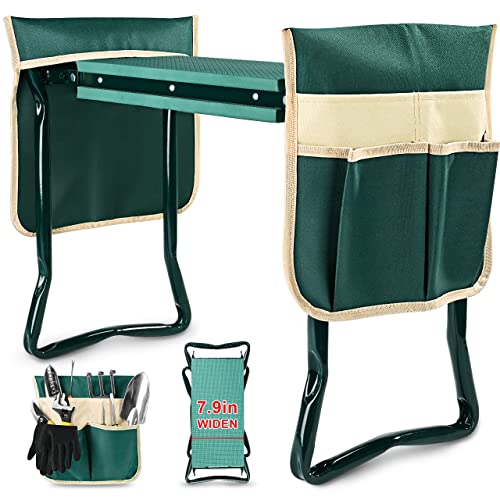
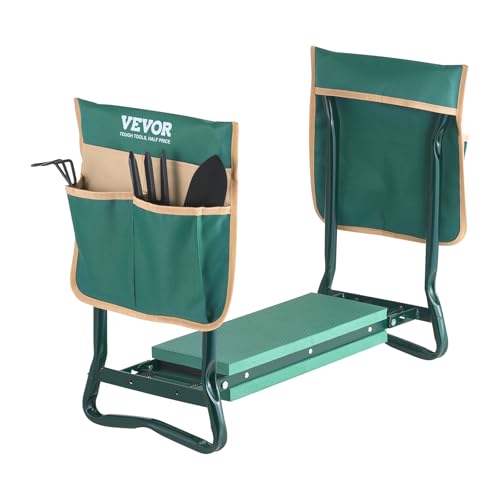
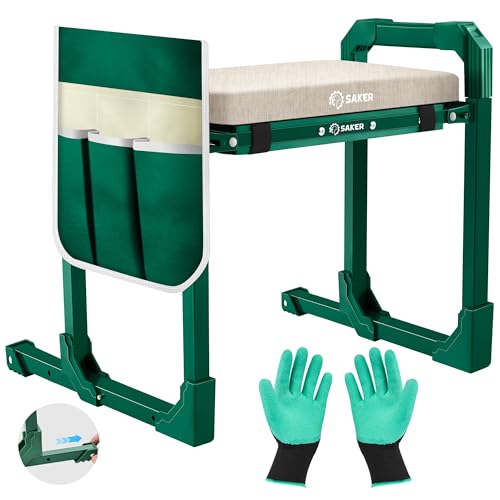

As an Amazon Associate we earn from qualifying purchases at no extra cost to you. Ratings are shown as listed on Amazon.
Best garden kneelers by gardening situation
| Gardening situation | Best type | Useful specifications | Why it suits the task |
|---|---|---|---|
| Short weeding sessions and planting annuals | Foam kneeling pad | 40–48 cm long, 20–30 mm thick, under 300 g | Fast to carry, store, and rinse; no frame to obstruct movement |
| Frequent bed maintenance | Foldable kneeler with handles | 25–40 mm closed-cell foam, steel or aluminium frame, 1.5–3 kg | Combines knee cushioning with support when standing |
| Potting, deadheading, and low containers | Reversible kneeler-to-seat | Seat height 45–50 cm, seat width 38–45 cm, load rating around 100–125 kg | Lets you change position without moving to a separate chair |
| Wet soil, damp lawns, or muddy allotments | Waterproof closed-cell pad or coated-frame model | Non-absorbent foam, sealed seams, powder-coated metal | Does not retain water or become heavy after use |
| Small shed, balcony, or shared storage | Thin folding pad or compact folding frame | Folded thickness under 8 cm; folded length under 55 cm | Fits behind a door or beside a tool box |
What makes a garden kneeler comfortable?
Cushioning: thickness matters, but density matters more
Look for closed-cell EVA or similar dense foam rather than soft open-cell sponge. Closed-cell foam does not soak up water and usually springs back after repeated use. A pad around 20 mm thick is adequate for brief work on reasonably soft soil. For gravel, compacted beds, or longer sessions, 25–40 mm provides a more forgiving surface.
Very thick foam is not automatically better. A cushion that compresses heavily can allow knees to reach the hard ground beneath it, while an overly soft surface can feel unstable when you shift position. A firm, slightly textured pad is usually a better compromise than a plush cushion. Grooves or raised patterns can help shed water, but deep channels may collect soil and plant debris.
Waterproof materials and cleanability
The most practical construction is a closed-cell foam pad, or a removable foam insert inside a vinyl, polyurethane-coated, or similarly water-resistant cover. Check the seams and stitching: a water-resistant fabric is less useful if the cover has exposed absorbent edges.
After muddy work, brush off dry soil first, then wipe the surface with mild soapy water. Avoid storing a folded kneeler while it is wet, because trapped moisture can encourage mildew on fabric covers and corrosion around frame joints. Do not use harsh solvents or abrasive scouring pads, which can damage coatings and make the foam brittle over time.
Head-to-head: pad, folding kneeler, or kneeler-to-seat?
Foam kneeling pad
A pad is the simplest and often the best-value choice. It is light, silent, and easy to position between plants. Its limitations are equally clear: it offers no help when standing, no back support, and little protection if you kneel on uneven stones outside the pad’s footprint. A 40–48 cm pad is large enough for one kneeling position without becoming awkward to carry.
Folding garden kneeler with handles
This design adds a metal frame and side rails. Used one way, the padded surface supports your knees; turned over, it becomes a raised support for standing up. Handles are valuable when you are moving repeatedly between kneeling and standing, but they must be positioned high enough to grip without twisting your wrists.
Steel frames are generally less expensive and can feel rigid, while aluminium frames reduce weight and resist rust when their finish remains intact. Inspect the hinge, rivets, and feet rather than focusing only on the cushion. Those parts receive the most repeated loading.
Reversible kneeler-to-seat
A seat version is useful for potting benches, container gardens, pruning low shrubs, and sorting seedlings. Seat height is the key measurement. Around 45 cm suits many adults for short tasks, while a lower seat can make standing harder and a taller one may feel unstable on uneven ground.
Check both the seat width and the usable kneeling area. A seat measuring 38–45 cm wide is practical for most gardening tasks, but the exact load rating matters more than width. Never assume that a frame designed for kneeling has the same safe capacity when used as a seat; follow the manufacturer’s stated rating for both orientations.
Decision matrix: which garden kneeler should you buy?
| Your priority | Recommended choice | Target specification | Acceptable compromise |
|---|---|---|---|
| Lowest budget | Single foam pad | 20–30 mm closed-cell foam; under 300 g | No standing support |
| Beginner with occasional use | Simple folding kneeler | Under 2.5 kg; padded handles; locking hinge | Smaller seat area |
| Experienced gardener working weekly | Reversible kneeler-to-seat | 25–40 mm padding; 45–50 cm seat height; 100 kg or higher rating | More storage space and weight |
| Very limited storage | Foldable pad or slim frame | Under 8 cm thick when folded | Less cushioning or no seat |
| Wet climate or muddy allotment | Closed-cell pad or coated-frame model | Non-absorbent foam; corrosion-resistant finish | Less soft fabric comfort |
| Frequent standing and kneeling | Handle-equipped frame | Wide feet, stable hinge, padded hand grips | Heavier than a pad |
How to choose the right dimensions
Measure the space where you usually work, not just your available storage. In a dense border, a long framed kneeler can catch stems and crush nearby plants. A pad roughly 45 cm long is easier to place between rows. For a vegetable bed, compare the kneeler’s width with the gap between plants; leave enough room to reposition without kneeling on the crop or stretching excessively.
For a seat, measure from the ground to the back of your knee while wearing gardening shoes. A seat approximately 3–8 cm below that measurement often feels easier to use for short jobs, but ground slope changes the effective height. On uneven soil, wide feet are more important than an extra few centimetres of padding.
As a simple storage check, multiply the folded width by folded depth and height. For example, a kneeler folded to 50 cm by 35 cm by 8 cm occupies about 14,000 cubic centimetres, or 14 litres of rectangular storage volume. A 45 cm by 25 cm foam pad occupies only about 1–2 litres depending on its thickness, so the convenience difference is substantial in a small shed.
Durability and ownership realities
- The foam usually compresses first. Look for permanent dents, cracking, or a pad that no longer returns to its original thickness. Replace an insert when your knees can feel the frame or ground beneath it.
- Hinges and rivets need inspection. Open and close a folding model several times before each season. Stop using it if the hinge develops side-to-side movement or fails to lock securely.
- Feet can sink into soft soil. Broad rubber or plastic feet spread the load better than narrow metal ends. On very soft ground, place the kneeler on a firm board rather than forcing it into the soil.
- Fabric covers are not automatically waterproof. A removable cover is convenient only if it can be washed and dried fully. Never put away a damp cover inside a closed shed.
- Do not use a kneeler as a step. Frames designed for sitting or kneeling are not ladders. Standing on the seat or handles can shift the centre of gravity and damage the hinge.
- Check capacity in both configurations. The rated load may differ between kneeling and sitting modes. Include clothing, tools, and any pressure from leaning when choosing a margin.
Bottom line
Choose a 25–40 mm closed-cell foam pad for occasional planting and the smallest possible storage footprint. For regular bed maintenance, a folding kneeler with wide feet, a secure hinge, and padded handles is the better all-rounder. If you spend long periods potting or pruning low plants, select a reversible kneeler-to-seat and compare its seat height, usable width, folded dimensions, and dual-position load rating rather than judging the cushion alone.

Write Your Review
No reviews yet. Be the first to share your experience!