

Key takeaways
- Yard under 1,500 square feet, flat, with an outdoor outlet: Choose a 14-inch corded mower. It is light, inexpensive to store, and will not run out of power.
- Yard under 3,000 square feet with no convenient outlet: Choose a 16–17-inch cordless mower with a 4.0Ah battery.
- Yard up to about 5,000 square feet: Choose a 19–21-inch cordless mower with a 5.0Ah battery or larger, preferably with a second battery if the grass is thick.
- Narrow gates, small sheds, or limited closet space: Favor a 14–16-inch deck and a mower with vertical or compact folding storage.
- Slopes or uneven ground: Select a self-propelled cordless mower only when the slope justifies its extra weight and energy use. For a small, manageable lawn, a lighter push mower is often easier to control.
The best electric lawn mowers for small yards are usually a 14–16-inch corded mower for the lowest cost and simplest maintenance, or a 16–21-inch cordless mower when you need freedom from an outlet, easier storage, or occasional work on a slope.
Our top picks
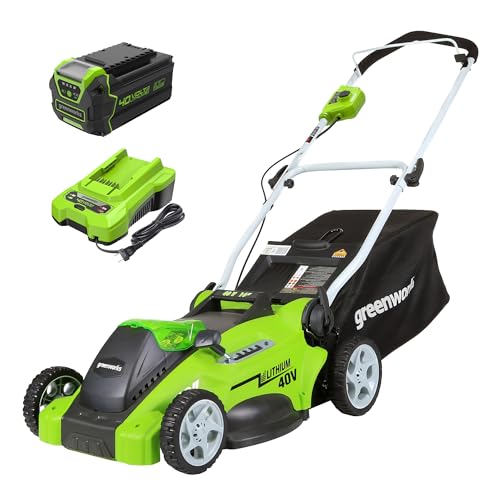

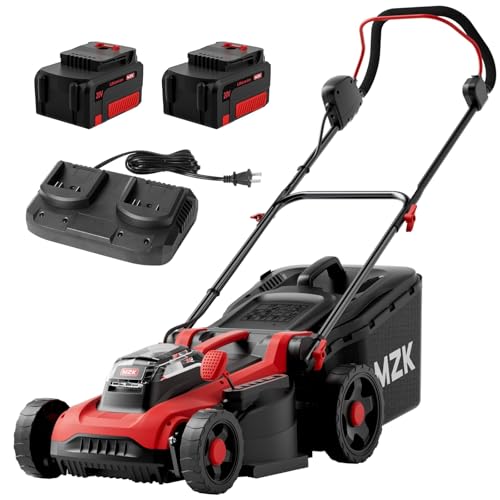

As an Amazon Associate we earn from qualifying purchases at no extra cost to you. Ratings are shown as listed on Amazon.
Quick picks by small-yard situation
- Yard under 1,500 square feet, flat, with an outdoor outlet: Choose a 14-inch corded mower. It is light, inexpensive to store, and will not run out of power.
- Yard under 3,000 square feet with no convenient outlet: Choose a 16–17-inch cordless mower with a 4.0Ah battery.
- Yard up to about 5,000 square feet: Choose a 19–21-inch cordless mower with a 5.0Ah battery or larger, preferably with a second battery if the grass is thick.
- Narrow gates, small sheds, or limited closet space: Favor a 14–16-inch deck and a mower with vertical or compact folding storage.
- Slopes or uneven ground: Select a self-propelled cordless mower only when the slope justifies its extra weight and energy use. For a small, manageable lawn, a lighter push mower is often easier to control.
Corded versus cordless: which is better for a small lawn?
A corded electric mower supplies continuous power, so its practical runtime is unlimited. That makes it particularly suitable for a small rectangular lawn close to a weather-protected outlet. The trade-off is managing an extension cord without cutting across it or allowing it to catch on shrubs, trees, and edging.
A cordless mower is more convenient around obstacles and does not require an extension cord. Battery capacity, grass height, moisture, slope, and mowing speed all affect coverage. Battery-powered models also need charging time and eventually a replacement battery, which can be one of the most expensive ownership parts.
For most small yards, deck width matters more than maximum motor power. A wider deck finishes sooner, but it is harder to maneuver through narrow gates and takes up more storage space. A 14-inch deck is nimble; a 16-inch deck is a useful compromise; a 20- or 21-inch deck reduces passes on open lawns but can feel bulky in tight spaces.
Comparison of suitable mower sizes
| Mower type | Typical deck | Typical weight | Typical usable coverage | Best fit |
|---|---|---|---|---|
| Compact corded | 14 inches | 25–35 lb | Unlimited while connected | Flat lawns under 1,500 sq. ft., narrow access |
| Mid-size corded | 14–16 inches | 30–45 lb | Unlimited while connected | Small lawns with nearby outlets |
| Compact cordless | 16–17 inches | 35–50 lb | About 2,000–4,000 sq. ft. per charge | Typical urban or townhouse yards |
| Full-size cordless push | 19–21 inches | 45–65 lb | About 3,000–7,000 sq. ft. per charge | Open lawns and fewer storage constraints |
| Self-propelled cordless | 20–21 inches | 55–75 lb | About 2,000–5,000 sq. ft. per charge | Slopes or users who need powered forward movement |
These coverage figures are planning ranges, not guarantees. Tall, wet, dense, or overgrown grass can reduce coverage substantially. A mower used every five to seven days will usually travel farther on one charge than the same mower used on a lawn that has grown for two weeks.
Product types and established examples
Best low-cost choice: a 14-inch corded mower
Compact corded models such as the Sun Joe MJ401E and American Lawn Mower Company 50514 represent this category. Models in this class commonly use a 12-amp motor, a 14-inch cutting deck, a small collection bag, and several manual height settings. General market pricing is often about $120–$220, depending on included features and seasonal promotions.
They are a good match for a flat front lawn, courtyard, or small backyard where an outlet is within practical cable distance. Their narrow decks make turning easy and reduce the amount of grass left around beds and fences. They are less suitable for disconnected lots, lawns with many obstacles, or areas where a cord would cross a walkway.
Best all-around cordless size: a 16- or 17-inch push mower
A 16- or 17-inch cordless mower balances maneuverability and coverage. Greenworks 40V push mowers are common examples of this format, with configurations that vary by deck size, battery capacity, and whether a charger is included. Expect roughly $250–$500 for a kit in the broad market, with higher prices for larger batteries or bundled tools.
For a lawn around 2,500 square feet, a 4.0Ah battery is a sensible starting point if the grass is maintained regularly. Look for a removable battery, a battery gauge visible from the handle, a rigid or reinforced deck, and a handle that folds without requiring a complicated disassembly process.
Best for an open lawn: a 20- or 21-inch cordless mower
The EGO Power+ LM2114 is an example of a full-size cordless push mower category. Comparable 21-inch models generally offer a broad height range, a larger grass bag, and enough battery capacity for several thousand square feet under normal conditions. Kit prices commonly fall around $450–$800, depending on battery size and whether the mower is self-propelled.
A 21-inch mower can reduce mowing time, but measure your gate first. The advertised deck width may not equal the widest point around the wheels, handle, or side discharge cover. These machines also occupy more floor area even when folded.
How to calculate the battery size you need
Start with lawn area, then allow for real-world losses. For example, suppose a lawn measures 50 by 40 feet:
- 50 × 40 = 2,000 square feet.
- Add about 25% for turns, overlap, and less efficient cutting in thick grass: 2,000 × 1.25 = 2,500 square feet of planning coverage.
- If the mower’s stated coverage is 3,000 square feet with its included battery, it should provide a reasonable margin for normal weekly mowing.
Do not compare amp-hours across different voltage platforms as if they were identical. A rough energy estimate is volts multiplied by amp-hours: a 40V, 4.0Ah battery stores about 160 watt-hours, while a 56V, 5.0Ah battery stores about 280 watt-hours. Motor efficiency and cutting conditions still matter, but this calculation helps explain why a larger battery usually covers more area.
Features that matter more than marketing claims
- Cut-height range: Look for roughly 1–4 inches, with a single-lever adjustment if possible. Keep cool-season grass higher during hot or dry periods rather than removing too much leaf in one pass.
- Charging time: Compact batteries may take about 60–120 minutes to charge; larger packs can take two to four hours with standard chargers. A rapid charger costs more but matters if you need to mow on a schedule.
- Storage: Check folded dimensions, handle-lock design, and whether the mower can stand vertically. Remove the battery before storing and keep it in a dry, moderate-temperature location.
- Deck material: Polymer decks resist rust and reduce weight. Steel decks can feel robust but add weight and require prompt removal of wet clippings to limit corrosion.
- Bagging and mulching: A small bag fills quickly in spring growth. A mulch plug is convenient for routine mowing, while side discharge is useful when grass is unusually tall.
- Slope performance: Self-propulsion helps with sustained inclines but reduces battery runtime and adds weight. On a modest slope, large rear wheels and a comfortable handle may be more valuable than drive assistance.
Ownership realities: what wears first
The blade is the first routine consumable. A dull blade makes the mower work harder, leaves ragged tips, and reduces battery coverage. Inspect it several times each season and sharpen or replace it when the edge is damaged or visibly rounded. Always remove the battery or unplug the mower before working underneath it.
Grass buildup underneath the deck is another common problem. After mowing, disconnect power, tip the mower according to the manual, and brush away clippings once the deck is dry. Avoid directing a hose at the motor, battery compartment, controls, or electrical connectors.
Wheels, handle fasteners, hinges, and the collection bag can also wear before the motor does. Avoid mowing stones, branches, and hidden edging. Do not use a corded mower with an undersized or damaged extension cord, and do not leave a lithium-ion battery on a hot porch or in a freezing shed.
Bottom line
Choose a 14-inch corded mower when price, light weight, and unlimited runtime matter most. Choose a 16- or 17-inch cordless mower for the best balance in a typical small yard. Move to a 20- or 21-inch cordless model when the lawn is open and you value fewer passes; choose self-propulsion only when slopes or mobility make pushing difficult. The right mower is the one whose deck fits your gates and storage, whose battery covers your calculated area with a margin, and whose cut-height controls suit how often you mow.



Write Your Review
No reviews yet. Be the first to share your experience!